Tonyr1084

Joined Sep 24, 2015
9,744
this is why discussions of systems exceeding 100% efficiency are seldom allowed on this forum. I think that they should indeed have a separate space for themselves, along with a size limit. Some concepts are so lame as to be funny.
Folks could be educated about the laws of physics and thermodynamics there.
I was somewhere around the age of 7 years old. My father always spoke of electricity in the home as "Current". So as a child I envisioned a river of electrons flowing through the wires (probably rightfully so but somewhat mis-conceived). If I could possibly be fast enough I could maintain that flow and the light should logically stay on. Of course that was the thinking of a very young boy and the product of a misnomer.

I bought a meter for a neighbor/friend because he was always asking me to come over and read the voltage of his car battery. It was becoming a nuisance, so I bought him his own meter. A cheap RS meter with dArsenval movement. He must have heard his own father refer to electricity as "current". So when he wanted to test his battery he set the meter to "Current" and then touched the leads to the positive and negative terminals of his battery. Instantly the fuse blew. He called and said his meter didn't work. Yes, indeed it didn't work. He mistook "Current" for "Voltage", which, as we all know, are two different things. But as a young boy this was what I conceived current to be.
Yes, because electricity travels near the speed of light and you couldn't possibly do it fast enough! Duh.
Made me laugh. Loved the "Duh". But what did a 7 year old know about the speed of light? I had a flashlight. One evening I pointed it at the fence and switched it on. Shortly after switching it on I could see the light reach the fence; a distance of "Probably" 30 feet. I was convinced I could see the speed of light. Remember, this is the mind of a (probably) 10 year old. In school we were studying evolution. At the same time I was cutting shoots of rubber tree clippings into buckets of water. One morning I went out to look at the progress and saw things swimming around in the water. At that moment I was convinced I discovered proof of evolution. It was actually mosquito larvae. Again, children and their world of discovery.
 

Thread Starter

pirlem

Joined Feb 7, 2022
25
Hello again dear forum,
(How nice to read all your electronic anecdotes, I also have a couple of similar ones from some experiments I did in the past, maybe I ll share some in the future)

An update on this project:
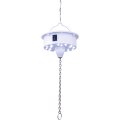
I have been looking for alternatives and I think I could reduce the size of the needed disco ball, and use one that has a diameter of 12 inches/30 cm (something like THIS ONE HERE) it weighs 2.5kg.
Then, use a battery-powered motor that can load up to 3kg (something like THIS ONE HERE). This motor uses 2x AA batteries, that is 3V. Now, in the case of purchasing these two products, I could modify the power supply and connect a solar panel to activate the motor, instead of using the batteries.
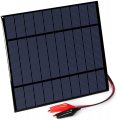
Here the question would be: what type of solar panel could I use for this? In my experience, I have a solar panel with the following specifications, and the truth is that for a small motor to work, there has to be a very strong sun and fall directly to the solar panel, if not, the motor does not move.

Specifications on the solar panel I already have:
Material: Polycrystalline silicon
Working voltage: 5 V.
Max. Power: 2.5 W.
Working current: 0 - 0.5 A.
Open-circuit voltage: 5.5 V.
Short circuit current: 0.55 A.
Product size: 130 x 150 mm / 5.12 x 5.9 inches.

What solar panel could I use, in your opinion, do you think that the one I have can work with? Do you have any other suggestions for a good quality solar panel that is not very expensive? The one I bought cost around $15

Thank you very much in advance once again for your kind advice!
j
 

Attachments

Ya’akov

Joined Jan 27, 2019
10,242
Yes, that is correct. The intention is that the mirrorball spins when there is sunlight.
Unfortunately, you will need quite a large panel to make it feasible for that motor to rotate the ball in average sunlight. Since you are not going to track the sun, you will have direct sunlight for some part of the day and indirect for the rest. You have to design for the valleys, not the peak, in this case.

One thing you could do to help determine the size you‘ll need is to use your current panel as a test instrument. Ideally, you would use a logging voltmeter of some kind but since you probably don’t have that, you can just take periodic measurements, say hourly, from the panel placed where you intend to use it.

The resulting data will give you an idea of the relative strength of the sun throughout the day. It would be best to do it on a few days with different cloud cover but any data will help.

Then, you will have to decide what the cutoff for rotation is. That is, you are unlikely to want to use a panel big enough to use dawn to dusk sunlight, so there will be some arbitrary level where it will just not work.

One other strategy is to arrange a battery in such a way that when the sun is more than string enough for the motor, the excess is stored in the battery to make up for when it is not strong enough. Of course, this is complicated to some extent but not terribly. I think it could be mostly done with various off-the-shelf modules.

In any case, there is a simple physical limit to the amount of power that a PV panel (solar cell array) can produce based on its surface area. There is a fixed amount of power delivered by the sunlight, and the output of the PV is quite a bit less than that power due to conversion inefficiencies.

There are two places you can optimize this system:

1. Power delivery, that is, the PV panel and the associated electronics, and possibly, storage.
2. The motor, which includes the motor itself, and friction reduction measures including bearings and mounting.

You can work on one or both. The more efficient each is, the less overall power will be needed.
 

MisterBill2

Joined Jan 23, 2018
27,584
Hello again dear forum,
(How nice to read all your electronic anecdotes, I also have a couple of similar ones from some experiments I did in the past, maybe I ll share some in the future)

An update on this project:
I have been looking for alternatives and I think I could reduce the size of the needed disco ball, and use one that has a diameter of 12 inches/30 cm (something like THIS ONE HERE) it weighs 2.5kg.
Then, use a battery-powered motor that can load up to 3kg (something like THIS ONE HERE). This motor uses 2x AA batteries, that is 3V. Now, in the case of purchasing these two products, I could modify the power supply and connect a solar panel to activate the motor, instead of using the batteries.
Here the question would be: what type of solar panel could I use for this? In my experience, I have a solar panel with the following specifications, and the truth is that for a small motor to work, there has to be a very strong sun and fall directly to the solar panel, if not, the motor does not move.

Specifications on the solar panel I already have:
Material: Polycrystalline silicon
Working voltage: 5 V.
Max. Power: 2.5 W.
Working current: 0 - 0.5 A.
Open-circuit voltage: 5.5 V.
Short circuit current: 0.55 A.
Product size: 130 x 150 mm / 5.12 x 5.9 inches.

What solar panel could I use, in your opinion, do you think that the one I have can work with? Do you have any other suggestions for a good quality solar panel that is not very expensive? The one I bought cost around $15

Thank you very much in advance once again for your kind advice!
j
OK, you have a specification for the solar panel: 5 volts nominal, 5.5 max, 0.5 amps working current. For the motorized ball the motor is rated to work with 3 volts from two AA cells in series. If there was given an average running time for use with those batteries, we could figure out the motor current.
BUT we do know that drawing half an amp from two AA cells they will not last very long at all.
Given that understanding it is very reasonable to think that the motor draws quite a bit less than a half an amp. So based on that, the solar cell will undoubtedly drive the motor fairly well in less than brilliant sunshine, since it only requires 3 volts.
Evaluating available information is a handy way to solve problems and answer questions, and usually better that making random assumptions.
Of course, I make no claims as to the truthfulness of the advertising of the products.
 

Thread Starter

pirlem

Joined Feb 7, 2022
25
So have you already purchased the motor and tried it with the panel?
I only have the 5V solar panel from an earlier project. The motor I used it with is a small dc motor I had also laying around, not the one I wrote about above: Battery Powered Mirror Ball Motor, this one I am thinking of ordering soon and try it with the solar panel I have or get a bigger one.

Similar or larger panel, also with a nominal 5V output, in parallel with the one you have.
that could work,, I ll try it soon
 

Thread Starter

pirlem

Joined Feb 7, 2022
25
Unfortunately, you will need quite a large panel to make it feasible for that motor to rotate the ball in average sunlight. Since you are not going to track the sun, you will have direct sunlight for some part of the day and indirect for the rest. You have to design for the valleys, not the peak, in this case.

One thing you could do to help determine the size you‘ll need is to use your current panel as a test instrument. Ideally, you would use a logging voltmeter of some kind but since you probably don’t have that, you can just take periodic measurements, say hourly, from the panel placed where you intend to use it.

The resulting data will give you an idea of the relative strength of the sun throughout the day. It would be best to do it on a few days with different cloud cover but any data will help.

Then, you will have to decide what the cutoff for rotation is. That is, you are unlikely to want to use a panel big enough to use dawn to dusk sunlight, so there will be some arbitrary level where it will just not work.

One other strategy is to arrange a battery in such a way that when the sun is more than string enough for the motor, the excess is stored in the battery to make up for when it is not strong enough. Of course, this is complicated to some extent but not terribly. I think it could be mostly done with various off-the-shelf modules.

In any case, there is a simple physical limit to the amount of power that a PV panel (solar cell array) can produce based on its surface area. There is a fixed amount of power delivered by the sunlight, and the output of the PV is quite a bit less than that power due to conversion inefficiencies.

There are two places you can optimize this system:

1. Power delivery, that is, the PV panel and the associated electronics, and possibly, storage.
2. The motor, which includes the motor itself, and friction reduction measures including bearings and mounting.

You can work on one or both. The more efficient each is, the less overall power will be needed.
All this is amazing, thank you very much for detailing everything so specifically.
I'll keep all this in mind in my next steps in the project, thanks again, I'll be posting updates soon.

thinking forward...I guess that since it is an artistic installation that speaks of the sun poetically, it could be a good point that the mirrorball only rotates for a short time per day (specifically only when the sun directly hits the panel). a bit like alerting the visitor to the importance of climate awareness and the pass of time...
 

Thread Starter

pirlem

Joined Feb 7, 2022
25
OK, you have a specification for the solar panel: 5 volts nominal, 5.5 max, 0.5 amps working current. For the motorized ball the motor is rated to work with 3 volts from two AA cells in series. If there was given an average running time for use with those batteries, we could figure out the motor current.
BUT we do know that drawing half an amp from two AA cells they will not last very long at all.
Given that understanding it is very reasonable to think that the motor draws quite a bit less than a half an amp. So based on that, the solar cell will undoubtedly drive the motor fairly well in less than brilliant sunshine, since it only requires 3 volts.
Evaluating available information is a handy way to solve problems and answer questions, and usually better that making random assumptions.
Of course, I make no claims as to the truthfulness of the advertising of the products.
Yes, thank you, it is true as you say, that the best thing to do is to measure the current required by the motor once I have it in hand, and not assume what the product advertisement on the internet indicates.
Anyway it's good and I'm glad to know your preliminary measurements, and that it could work eventually, given the case. At least I'm glad to know that maybe my initial idea wasn't so farfetched :) The only thing left to do is try it when I already have everything at hand
 

MisterBill2

Joined Jan 23, 2018
27,584
Certainly is the motor will run for an acceptable length of time powered only by two AA cels and 3 volts from them, it does not draw much current. Why that was noot obvious to everybody is a puzzle..
 

Thread Starter

pirlem

Joined Feb 7, 2022
25
Hello again,
An update on this project:

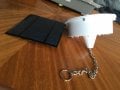
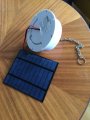
- The mirrorball motor I ordered works fine with the 5V solar panel. It came in by post today and I've already made the connections ok.
Although instead of 2x 1.5V batteries as it was written in the seller's specs, it actually requires 3 AA batteries, so it runs on 4.5V. But anyway, as I mentioned the system is working fine with the 5V solar panel. I don't have the 2.5kg disco ball yet. but I have tested with a hanging box that weighs the same, and the rotation when there is sunlight is constant.

(Attached photos of the solar panel / motor device)

Thanks again for your enormous help, this forum is definitely an important space for knowledge sharing. I sincerely appreciate it very much... will return more often.
 

Attachments

Ya’akov

Joined Jan 27, 2019
10,242
Hello again,
An update on this project:

- The mirrorball motor I ordered works fine with the 5V solar panel. It came in by post today and I've already made the connections ok.
Although instead of 2x 1.5V batteries as it was written in the seller's specs, it actually requires 3 AA batteries, so it runs on 4.5V. But anyway, as I mentioned the system is working fine with the 5V solar panel. I don't have the 2.5kg disco ball yet. but I have tested with a hanging box that weighs the same, and the rotation when there is sunlight is constant.

(Attached photos of the solar panel / motor device)

Thanks again for your enormous help, this forum is definitely an important space for knowledge sharing. I sincerely appreciate it very much... will return more often.
Good news, it really simplifies things. I hope it works enough of the time to do what you want.
 

MisterBill2

Joined Jan 23, 2018
27,584
Hello again,
An update on this project:

- The mirrorball motor I ordered works fine with the 5V solar panel. It came in by post today and I've already made the connections ok.
Although instead of 2x 1.5V batteries as it was written in the seller's specs, it actually requires 3 AA batteries, so it runs on 4.5V. But anyway, as I mentioned the system is working fine with the 5V solar panel. I don't have the 2.5kg disco ball yet. but I have tested with a hanging box that weighs the same, and the rotation when there is sunlight is constant.

(Attached photos of the solar panel / motor device)

Thanks again for your enormous help, this forum is definitely an important space for knowledge sharing. I sincerely appreciate it very much... will return more often.
Now a question: Is it working in sunlight or from artificial light inside? I think that I recall a comment that it was for outside use.
Are you able to measure the voltage as it is working? I am wondering about that, and what voltage the solar array delivers to a light load under whatever light you are using.
And, if there was any information that came with the mirror bal, did it say how long it shold run on the three AA cells?
 

Thread Starter

pirlem

Joined Feb 7, 2022
25
Now a question: Is it working in sunlight or from artificial light inside? I think that I recall a comment that it was for outside use.
Are you able to measure the voltage as it is working? I am wondering about that, and what voltage the solar array delivers to a light load under whatever light you are using.
And, if there was any information that came with the mirror bal, did it say how long it shold run on the three AA cells?
Thanks.

I tried it outdoors, with sunlight directly on the solar panel, if I move it a little out of direct sun the motor turns off. And when I have tried the solar panel indoors with the cell phone lamp, it does not work.

How can I measure the voltage of the solar panel and the motor while it works? With a multimeter at the power connection points? I have one of those... Surely what you're saying is to measure it at different points, outside and inside, right?


And finally, no, there is no information inside the packaging or in the instruction booklet on how long the motor batteries will last.
 

MisterBill2

Joined Jan 23, 2018
27,584
OK, and thanks for the response. While a cell phone light is sort of bright it really does not have much power.
The good news is that as the package is intended for outside use, it works as desired, at least it seems to. And if measuring with a multimeter is a big effort, then don't bother. That part was my curiosity, not mandatory for the project.
 

Thread Starter

pirlem

Joined Feb 7, 2022
25
OK, and thanks for the response. While a cell phone light is sort of bright it really does not have much power.
The good news is that as the package is intended for outside use, it works as desired, at least it seems to. And if measuring with a multimeter is a big effort, then don't bother. That part was my curiosity, not mandatory for the project.
It's not a big effort, not at all. Only that right now the day is cloudy here:)
my question was: where in the system are the measurements made with the multimeter?,
since I am not an expert and maybe you could guide me.

I will do this as soon as I can and the weather conditions allow it. Thanks for your interest!
 

MisterBill2

Joined Jan 23, 2018
27,584
The connection will be across the connections to the motor package, probably the battery connection terminals.
The connections could also, as an alternative, be across the solar cell terminals, if they are more easily accessible. Either is OK, they two are functionally equal.
Does the ball still rotate on a cloudy day? But probably a bit slower than with more sun.
 

Thread Starter

pirlem

Joined Feb 7, 2022
25
The connection will be across the connections to the motor package, probably the battery connection terminals.
The connections could also, as an alternative, be across the solar cell terminals, if they are more easily accessible. Either is OK, they two are functionally equal.
Does the ball still rotate on a cloudy day? But probably a bit slower than with more sun.
ok, got it, thanks, so i'll test with the multimeter as soon as i can. The motor doesn't move at all when it's cloudy, it seems that my solar panel only generates power when sunlight falls directly on it.
 

MisterBill2

Joined Jan 23, 2018
27,584
OK, and solar panels evidently come in a number of varieties. Some will produce reduced power while others stop. I suspect it is the difference between a single series string and multiple strings of cells in parallel.
 
Top