Facebook
 Google
 GitHub
 Linkedin
Hi, I need some help verifying my thinking on solar panel charging of a 3.7v lithium ion battery.
Long story short we are renovating our old village street light. This was originally an oil lamp and we are getting a replica made and as there is no power supply nearby are going to install a small solar charged bulb that lights at night.
I am trying to use off the shelf parts rather than build something from scratch so that parts are easily replaceable. To start I am using one of these solar bulbs as they look like a bulb and have a 3 watt led array.
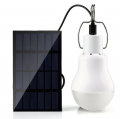
The internals of these are very basic with a circuit board housing 12 leds in parallel, a 4.7 or 5.6 ohm current limiting resistor, a diode to prevent discharge through the solar panel and a 3.7v li/ion mobile phone battery.
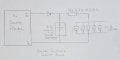
The circuit is something like this
My problem is that I want the lamp to come on at dusk and go off at dawn but these lamps only have a manual on off switch. I could use a photoresistor in a small circuit utilising a mosfet something like the below but this has a working voltage of 12v and I will only have the 3.7v of the Li-ion cell to work with. Presumably I can change the resistor values and possibly the MOSFET type for one with a lower gate voltage threshold and incorporate it into the existing circuit above??
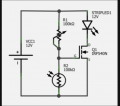
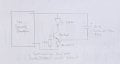
However I have since found the below circuit which I have copied from a video on Youtube (hopefully I have captured the connections correctly from the video). This circuit appears to turn on the led when there is no light on the solar panel(night time) and turn the LED off when the panel is producing a voltage (day time)
The lamps I am going to use above come as a pair with two solar panels so I was going to cannibalise the second bulb for the battery and parallel the two batteries in one bulb. Also I intended connecting the two solar panels in parallel so there is a better chance of the batteries being charged during daylight hours and then lasting at least 8 or so hours throughout the night.
to clarify a few requirements:-
1) This is purely aesthetic and not designed to provide a usable light
2) I want to keep the current drain of the circuit down to a minimum due to the low voltages in use
3) Ideally I would like all the components mounted inside the bulb (there is lots of room see youtube video of disassembly here)
4) The finished circuit needs to be reliable as possible within the realms of quality of the batteries and leds
5) Ideally I would like a hard switch between on and off which I think a mosfet achieves this but not sure how the BC 547 switches with the YouTube circuit as the light fades
There are also lots of pre-made MPPT modules available from online marketplaces which utilise TP4056 or CN3163 chips but not sure if they would provide better reliability than the basic component based circuits above
Please could you comment on the most reliable of the above circuits or suggest something else which either improves the above or achieves the same requirements.
Many thanks in advance
Long story short we are renovating our old village street light. This was originally an oil lamp and we are getting a replica made and as there is no power supply nearby are going to install a small solar charged bulb that lights at night.
I am trying to use off the shelf parts rather than build something from scratch so that parts are easily replaceable. To start I am using one of these solar bulbs as they look like a bulb and have a 3 watt led array.
The internals of these are very basic with a circuit board housing 12 leds in parallel, a 4.7 or 5.6 ohm current limiting resistor, a diode to prevent discharge through the solar panel and a 3.7v li/ion mobile phone battery.
The circuit is something like this
My problem is that I want the lamp to come on at dusk and go off at dawn but these lamps only have a manual on off switch. I could use a photoresistor in a small circuit utilising a mosfet something like the below but this has a working voltage of 12v and I will only have the 3.7v of the Li-ion cell to work with. Presumably I can change the resistor values and possibly the MOSFET type for one with a lower gate voltage threshold and incorporate it into the existing circuit above??
However I have since found the below circuit which I have copied from a video on Youtube (hopefully I have captured the connections correctly from the video). This circuit appears to turn on the led when there is no light on the solar panel(night time) and turn the LED off when the panel is producing a voltage (day time)
The lamps I am going to use above come as a pair with two solar panels so I was going to cannibalise the second bulb for the battery and parallel the two batteries in one bulb. Also I intended connecting the two solar panels in parallel so there is a better chance of the batteries being charged during daylight hours and then lasting at least 8 or so hours throughout the night.
to clarify a few requirements:-
1) This is purely aesthetic and not designed to provide a usable light
2) I want to keep the current drain of the circuit down to a minimum due to the low voltages in use
3) Ideally I would like all the components mounted inside the bulb (there is lots of room see youtube video of disassembly here)
4) The finished circuit needs to be reliable as possible within the realms of quality of the batteries and leds
5) Ideally I would like a hard switch between on and off which I think a mosfet achieves this but not sure how the BC 547 switches with the YouTube circuit as the light fades
There are also lots of pre-made MPPT modules available from online marketplaces which utilise TP4056 or CN3163 chips but not sure if they would provide better reliability than the basic component based circuits above
Please could you comment on the most reliable of the above circuits or suggest something else which either improves the above or achieves the same requirements.
Many thanks in advance