Severe ringing on PWM inputs in a SiC full‑bridge inverter

Thread Starter

BrokenPin

Joined Oct 1, 2023
44
Hello all,

I have a Bidirectional, Dual Active Bridge board that is based on the TIDA-010054 from Texas Instruments. However, whenever a DC bus is applied (even as low as 50 VDC), the 3.3 V PWM signals at the power board exhibit strong ringing/glitches correlated with the switching edges (PWMs running at 100KHz).
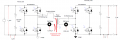
1758533248642.png
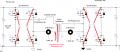
I am usign differential probe on power nodes (as shown in red in the above image); passive probe on logic lines. The scope and DC supply share the same AC outlet.

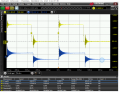
As shown below on the left, the PWM signal without putting my probe at the output. On the right, I am measuring the output of the inverter (in blue) using a differential probe (1:200).
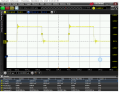
1758534010108.png 1758534023378.png


The frequency of the ringing on the digital PWM is ~90MHz and for the output, it is about 30MHz. I am running the board at 200VDC.

What is causing this ringing/noise on my PWM signal despite the board having isolated gate drivers?

This image below is when I touch one of the output connectors with the probe or anything !? The ringing amplitude gets bigger !?
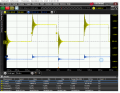
1758534102778.png

Thank you
 

MisterBill2

Joined Jan 23, 2018
27,315
IF the circuit is actually connected as the drawing in post #1 shows, the ringing is the response of the resonant circuit of the "planar transformer" winding and the associated "DC Blocking capacitor".
Even if the transformer is not connected exactly as shown, but connected correctly, the internal diodes in the associated FET devices can provide a path for resonant currents.
 

ronsimpson

Joined Oct 7, 2019
4,661
I would try placing ceramic or Polyethylene capacitors near the MOSFETS on both the input and output sides.
Choose caps with a resonant frequency that is up in the 30 to 100mhz range.
1759074080483.png
 

MisterBill2

Joined Jan 23, 2018
27,315
Does that direct connection between the source of Q5 and the drain of Q6 appear to be incorrect??
Is this an actual assembly?? or a simulation?? It may be that both sides of that planar transformer are tuned to resonate at the same frequency.
 

ronsimpson

Joined Oct 7, 2019
4,661

MisterBill2

Joined Jan 23, 2018
27,315
Is the circuit actually connected as in the circuit shown??? With the direct connection between Q5 and Q6?? It can not be working if that is the case.
 

MisterBill2

Joined Jan 23, 2018
27,315
The TS should be able to verify the circuit connections. THAT is why I am asking if it is really connected that way??
AND, I am also asking now: Does the circuit appear to actually be transferring power??? If it is not transferring power, then that is a far worse problem.
Of course, it had not occurred tome that the TS may not be able to see the assembled circuit.

I am also wondering why no others have noticed that obvious short circuit of the power input to the right side "H" bridge. Or does it simplynot bother them????
 

MisterBill2

Joined Jan 23, 2018
27,315
I have mentioned it a few times, and it has not been acknowledged by others, until this time. It is a quite obvious and very functionally important error. And extremely involved with the circuit ringing condition.
CERTAINLY it is a mistake, which is why I questioned several times if the circuit was actually connected as shown in the schematic diagram.
I was hoping it was a schematic mistake.
 

Thread Starter

BrokenPin

Joined Oct 1, 2023
44
IF the circuit is actually connected as the drawing in post #1 shows, the ringing is the response of the resonant circuit of the "planar transformer" winding and the associated "DC Blocking capacitor".
Even if the transformer is not connected exactly as shown, but connected correctly, the internal diodes in the associated FET devices can provide a path for resonant currents.
Sorry, I forgot to mention that I am not using any load, and I am measuring output straight out of the full bridge. There are no coupling inductors, DC blocking caps (I used 0 ohm res instead), and no load (I also did some tests with a resistive load, but the ringing got even worse)
 

Thread Starter

BrokenPin

Joined Oct 1, 2023
44
I would try placing ceramic or Polyethylene capacitors near the MOSFETS on both the input and output sides.
Choose caps with a resonant frequency that is up in the 30 to 100mhz range.
View attachment 356542
i used an RC snubber across each mosfet, calculated based on the ringing frequencies observed. I used a mlcc cap of 500pF and a res of 10ohm. The ringing amplitude on the 3.3V pwm signals got much better (it would get to -0.5V and 3.8-ish V) but the subber got too hot and caused 14W losses at fullbridge output with no load (at 200V).
 

Thread Starter

BrokenPin

Joined Oct 1, 2023
44
The TS should be able to verify the circuit connections. THAT is why I am asking if it is really connected that way??
AND, I am also asking now: Does the circuit appear to actually be transferring power??? If it is not transferring power, then that is a far worse problem.
Of course, it had not occurred tome that the TS may not be able to see the assembled circuit.

I am also wondering why no others have noticed that obvious short circuit of the power input to the right side "H" bridge. Or does it simplynot bother them????
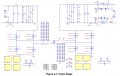
Thats a mistake on TI part, they last REVISED the Document on APRIL 2024 but they havent fixed it.
Here is the actual schematic below.
1759222171920.png
 

MisterBill2

Joined Jan 23, 2018
27,315
Oh Wow!!!! Fooled me completely, due to my poor mind-reading ability!! Sorry about that!! I had assumed that I was seeing the actual circuit. My error.
The good news is that there is a great deal of experience with bridge power circuits, the bad news is that I have not studied it very much. Quite often, any oscillation in a switching circuit is caused by inadequate gate charge removal, which allows the resulting higher impedance gate circuit to suffer positive feedback, leading to oscillation such as shown. a possible simple fix would be a gate to source pull-down resistor, while a more effective scheme would be having the gate driver circuit remove the charge more rapidly. Beyond those suggestions, gained from my very limited study, those who have studied more can provide better advice.
 

ronsimpson

Joined Oct 7, 2019
4,661
I forgot to mention
I am not using any load
no transformer
nor the resonant tank is assembled
RC snubber across each mosfet
There are no coupling inductors
and no load
DC blocking caps
So, the circuit is nothing like we thought.
-----------------------------------------------------------
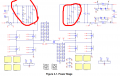
Do you have the input capacitors?
Do you have the output capacitors?
1759242746530.png
 

MisterBill2

Joined Jan 23, 2018
27,315
My advice about the gate drivers circuit is still valid!! AND since we have not seen the gate driver circuit it is not likely that there is much advice available from this sector, although probably a few are experts in that area. I am not experienced in gate drivers for this sort of application.
 
Top