Sequential LED Turn Signals

Thread Starter

B52_Chief

Joined Sep 2, 2025
20
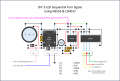
Hi All,

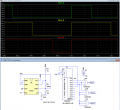
I've attached a PCB layout I'm working on (minus the board itself). I set it up a funtional(?) version on a solderless breadboard first, BUT it doesn't work. I've been studing 555/4017 diagrams till I'm crosseyed and I can't figure out why... :confused:

Thx, Joel

LED Chaser 555-4017.png
 

eetech00

Joined Jun 8, 2013
4,704
3-Tail light sequence is usually:
ON (inboard)->ON (middle)->ON (outboard)->ALL OFF

So, the circuit must light 3 LEDs at one time.
A 4017 will only light one LED at a time.
But a 40174 will work with output drive transistors..
 

Jerry-Hat-Trick

Joined Aug 31, 2022
804
3-Tail light sequence is usually:
ON (inboard)->ON (middle)->ON (outboard)->ALL OFF

So, the circuit must light 3 LEDs at one time.
A 4017 will only light one LED at a time.
But a 40174 will work with output drive transistors..
Or the 4017 with 6 diodes into the three transistors, although slightly untidy
 

sagor

Joined Mar 10, 2019
1,049
Check the R2/R3 and C2 values. According to datasheet, your values will produce a frequency over 1kHz. Even with a divide by 10 counter, you won't be able to see much flashing of LEDs flickering at 100Hz
 

panic mode

Joined Oct 10, 2011
4,936
you probably want R3 value of 47k, instead of 47 Ohm. that would get you 15Hz
and may as well be a typo... looks like "K" wandered up from R3 into C1 value
 

sghioto

Joined Dec 31, 2017
8,634
I've been studing 555/4017 diagrams till I'm crosseyed and I can't figure out why... :confused:
Try this modification below. The value of R3 will determine how fast the LEDs sequence.
What type of LED are you using for LEDs 1-3?
The 4017 outputs are only good for a few milliamps.
1756922444843.png

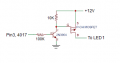
Additional driver circuit like below is required for high current LEDs
1756860361234.png
 
Last edited:

AnalogKid

Joined Aug 1, 2013
12,088
From another forum, the LEDs are automotive side marker lights, 12 V with internal current limiting. No known value of operating current.

ak
 

Thread Starter

B52_Chief

Joined Sep 2, 2025
20
Thanks All,

Just knowing I'm dealing with a "hi-current" application is a step further than I was...
Yes - I forgot to connect the coil on the relay.
Yes - R3 should have been 47K

I started out with one of these: LED Controler Module It was soon apparent it had to have a steady power source to operate properly. As the only turn signal I have access on my 14 Jeep Wrangler is pulsed, I did some research and came up with a "rectifier" circuit. That works great. The diagram I found shows a resitsor at the R1 locationand the extra diode (that jumps the coil). I'm not sure what they are for as I've used circiut with and without them.

I'm here because the Cheap aftermarket controler module failed. I'm hoping to build myself a better replacement.

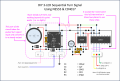
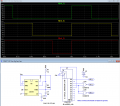
I have edited my diagram. The light sequence shown is based on the CD4017 outputs (I hate crossing lines on a diagram If I can help it). The leads would be connected to thr lamps in the correct order.

LED Chaser 555-4017 Pg2.png

A note on my drawings: I work in MS PowerPoint. The built it "connect-the-dots" feature is perfect for wire diagrams. When moving to PCB layouts I use scale representations on components on a scaled breadboard layout. This way I can ensure the whole thing fits together. I know there is software for this but thats a whole other learning curve. (I would be interested recomendation though)
 

sghioto

Joined Dec 31, 2017
8,634
I have edited my diagram.
The relay circuit is fine although there are circuits that can eliminate the relay.
Have you seen my circuit in post #8 ?
R3 needs to be 470K, at 47K the pulse rate is too fast.
R4 and C3 are required to insure the 4017 starts at LED1 when first powered ON.
D1 is needed to return the sequence back to LED1 on the fourth pulse from the 555.
 

crutschow

Joined Mar 14, 2008
38,415
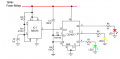
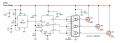
The top picture below is a modification to the CD4017 circuit using three CD4025 3-input NOR gates (one IC package), if you want the usual turn-signal sequence where subsequent LEDs stay lit, as noted in Post #4:

Note that the outputs are negative going (low is ON), to directly control high-side P-MOSFET LED drivers.
You can use CD4075 OR gates instead, if you want positive logic.

The bottom circuit is simpler for negative outputs, using just two CD4001 2-input NOR gates, since output O0 directly generates the desired signal for LED 1.

1756926558356.png
1756929006955.png
 
Last edited:

Thread Starter

B52_Chief

Joined Sep 2, 2025
20
This is progress (I think).

BTW - I only want one LED on at a time 1-2-3, 1-2-3, 1-2-3, repeat, etc. Here's a link to the lights: LED Markers

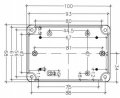
As I had this working before, everything is wired to a project box this size wich is already mounted (under the windshield cowl). Two 1.25" x 4.5" sloderable breadboards (one L one R) fit nicely
Picture1.jpg

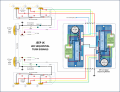
A pic of my original diagram:
Jeep Signal Phase 2.png

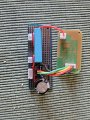
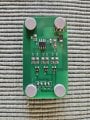
A shot of my PCB setup with the aftermarket PCB attached and a closeup of the 1" x 2.5" modules micro-components. I did not fully understand what I was looking at at the time. I definately see a resemblance to the diagrams now.
20250903_163457.jpg

20250903_163523.jpg

I'm concerned because it sounds like the number of additional components required for me to DIY the flasher module won't fit on the same board. At the end of the day, I don't want this feature bad enough to redo the wiring in the Jeep.

I'm trying to learn this stuff as I go. However... As this gets more complicated I'm starting to consider just replacing the failed aftermarket modules and hoping for the best.

I have a "12V" system. A pulsed 12V "signal" and two sets of 3 LED marker lamps designed for direct tie into a 12V system. I'm not at all stuck on my design. I'm just looking for a solution I can implement myself (In the space I have aloted).

Thx Joel
 
Last edited by a moderator:
Top