So much for a "morning" reply.
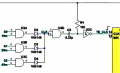
Built the circuit below. Upon power-up, Pin 3(4017) lights up. Pressing the PB turns Pin 2 high, and with an additional press Pin 4 goes high. As one LED turns on, the other two LED's are off. However, this is consistent only when I press deliberately. If I press lightly or quickly the LED sequencing order can fail.
Further observations:
While waiting for replies, I did some more reading. I noticed that the 1uF capacitor I was using was polarized. I think it was a Tantalum cap. I switched it out for a .33uF ceramic cap and I could not replicate the bouncing effects. But!... I also tried the switch with no cap in the circuit and also had no fails. Then I reinserted the polarized cap and could not reproduce the fails either! Perplexed. Not sure if my values for resistors & cap are in the right ballpark, so insight on this would be helpful. From readings, I learned that the diode in the debouncing circuit helps speed up the switching. Also, the inverter should be taking care or the RC ramping characteristics.
Q: Any advantage to debouncing from low side rather than high side? I can't see any, other than what may be simpler for the system/circuit.
I did a little debounce testing using switch circuit in the schematic I posted.
I used 0.47u and 100k resistor. I pressed the switch as fast as I could and I couldn't make it fail
For the circuit in post #39 you need larger values. R1 should be more like 18k and R4 should be about 82k.
There are different philosophies on this but I recommend about 50-100ms of debounce time to cover most decent switches.
If it bounces longer then that...its a crappy switch. And you really shouldn't leave the debounce circuits out, they are needed.
You should also use a Schmitt trigger for the inverter. The hysteresis it provides prevents oscillation due to the slow input rise time that is inherent with debounce circuits.
Also, use a 0.1uf cap across the power supply pin of each chip just to help stiffen the power supply.
eT
Update:
I also tried connecting the pushbutton circuit to the 4017 and pressed the button multiple times as fast as I could but couldn't make it fail. I used 0.47 and 100k for the 4017 POR. I should also mention that the first LED turns on at power up.
BTW....all tests were done with 6v supply. I'm using a CD40106B inverter.
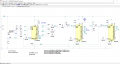
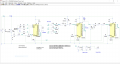
The 4060 is operational and within 2s of 10min...~6s of 40min. It's not critical that it be so precise, but who's complaining.
The output of PIN 1, Q12(divide by 4096) goes low for the first 5min before going high for 5min. I was expecting the opposite. Thought that the high from U5 4017 and the high from the 4060 into the AND gate would produce a high out, which would feed directly into U4 4017 needing a positive pulse to increment. But it is being inverted by U2C and producing a negative pulse.
The 4060 is operational and within 2s of 10min...~6s of 40min. It's not critical that it be so precise, but who's complaining.
The output of PIN 1, Q12(divide by 4096) goes low for the first 5min before going high for 5min. I was expecting the opposite. Thought that the high from U5 4017 and the high from the 4060 into the AND gate would produce a high out, which would feed directly into U4 4017 needing a positive pulse to increment. But it is being inverted by U2C and producing a negative pulse.
As crutschow has stated....the output is low for the first half cycle.
The 4017 is clocked by the trailing edge detector at the end of the first complete cycle.
I'll be breadboarding the CD4060 circuit this evening and will share the results.
On power up, the output of U2C is initially high because U3D is low and causes C5 to charge up, but POR causes U4 to ignore this. Once C5 is charged, U2C then goes low and the circuit is in its "ready" state.
When the first half timing cycle completes, U3A and U3D go high and C5 begins discharging. When the second half of the timing cycle completes, U3A and U3D go low and C5 begins to charge again and causes U2C to momentarily go high which clocks the 4017. The cycle then repeats.
I mentioned earlier I haven't tested this part of the circuit on a breadboard yet, but I just finished testing the 4060 timing and it works as intended with the values shown on the schematic I posted. The one thing you might want to add is an LED connected to Q4 of the 4060. The LED will flash continuously to let you know its working.
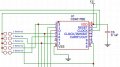
It will be important that I am able to select the # of batteries connected to the device(2 - 6) as in the schematic below. I believe I have a spare 6 position rotary switch for use as opposed to using jumper or dip switches. This should not hinder our tests without them. Just hoping to verify that I have wired it correctly. Diode is missing in my schematic from switch to reset of 4017.
The values I have for the 4060 timing are different(4.5uF/13.42k), the 4.5uF being a combination of three 1.5uF ceramic caps. Bottom line, your circuit, containing a variable resistor can dial in a multitude of times.
Q: Does powering up the 4017 Decade Counter place the outputs(in our case, S0, S1, & S2) in a particular state? I am using a jumper wire on the bread board to power the IC. This, of course, seems to emulate a push button action and S1 generally lights up as apposed to S0. Perhaps a power-on delay would work?
The values I have for the 4060 timing are different(4.5uF/13.42k), the 4.5uF being a combination of three 1.5uF ceramic caps. Bottom line, your circuit, containing a variable resistor can dial in a multitude of times.
Yes...its difficult to use fixed value components because of manufacturing variances.
The trimpot allows tuning.
Q: Does powering up the 4017 Decade Counter place the outputs(in our case, S0, S1, & S2) in a particular state? I am using a jumper wire on the bread board to power the IC. This, of course, seems to emulate a push button action and S1 generally lights up as apposed to S0. Perhaps a power-on delay would work?
It will be important that I am able to select the # of batteries connected to the device(2 - 6) as in the schematic below. I believe I have a spare 6 position rotary switch for use as opposed to using jumper or dip switches. This should not hinder our tests without them. Just hoping to verify that I have wired it correctly. Diode is missing in my schematic from switch to reset of 4017.
They will be hooked up 2,3,4,5 or 6 so that the sequence will cycle depending on how many batteries are selected by a rotary switch. Hope this answers your question.
Q: Would it be better to tap off U5(S0, S1, S2) or the outputs of U3A, B, C for indication of Time selection.
They will be hooked up 2,3,4,5 or 6 so that the sequence will cycle depending on how many batteries are selected by a rotary switch. Hope this answers your question.
Q: Would it be better to tap off U5(S0, S1, S2) or the outputs of U3A, B, C for indication of Time selection.
It will be important that I am able to select the # of batteries connected to the device(2 - 6) as in the schematic below. I believe I have a spare 6 position rotary switch for use as opposed to using jumper or dip switches. This should not hinder our tests without them. Just hoping to verify that I have wired it correctly. Diode is missing in my schematic from switch to reset of 4017.
The switches are wired incorrectly. Reset should occur on the "Q" output equal to the number of batteries. So if two batteries are being charged, reset should be connected to Q2 (count starts at 0), if three batteries, reset connects to Q3, four batteries Q4, and so on.
If you want, another circuit similar to the time selector could be use for the battery selector. But it would take another three chips, two AND gate chips and a 4017. This additional circuit would select which Q output would reset U4. Then the number of batteries could be selected with a single pushbutton. Just a thought...

 Facebook
 Google
 GitHub
 Linkedin