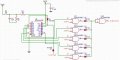
Sequential Float Charge Controller (Formerly: Long Delays with the 555 Timer)

Thread Starter

iONic

Joined Nov 16, 2007
1,662
The switches are wired incorrectly. Reset should occur on the "Q" output equal to the number of batteries. So if two batteries are being charged, reset should be connected to Q2 (count starts at 0), if three batteries, reset connects to Q3, four batteries Q4, and so on.

If you want, another circuit similar to the time selector could be use for the battery selector. But it would take another three chips, two AND gate chips and a 4017. This additional circuit would select which Q output would reset U4. Then the number of batteries could be selected with a single pushbutton. Just a thought...

eT
How did I know you would suggest the push button for the battery selector. I'm just worried bout my PCB. I don't know how to etch or create PCB layouts and would be relying on lots of wires to "get right."

The float charger(250mA max) will have an ____ output that will plug into the Float Charge Controller(what we are building.) On the controller will be the 6 battery outputs which I will connect wired alligator clips. I also need to add reverse voltage protection, to protect the MOSFETS and rest of the circuit.Would a fuse on each alligator clip suffice?

Fixed my battery select 4017 schematic. I did indeed have it wrong.
Is there a way to rename or repost this thread as the title really is close to meaningless for the topic. Should be Sequential Float Charge Controller, not long delays with the 555 timer.
revamp.JPG
 
Last edited:

danadak

Joined Mar 10, 2018
4,057
Do you have a floating reset pin when D1 is off ?

That's a problem if the case, should have a 10K pulldown on it....?


Regards, Dana.
 

eetech00

Joined Jun 8, 2013
4,705
How did I know you would suggest the push button for the battery selector. I'm just worried bout my PCB. I don't know how to etch or create PCB layouts and would be relying on lots of wires to "get right."
Yes, I was a little hesitant to suggest the battery selector.
But there's gonna be a lot of wires for any solution to this...:D
You'll probably need to make a PCB.

The float charger(250mA max) will have an ____ output that will plug into the Float Charge Controller(what we are building.) On the controller will be the 6 battery outputs which I will connect wired alligator clips. I also need to add reverse voltage protection, to protect the MOSFETS and rest of the circuit.Would a fuse on each alligator clip suffice?
A fuse would help but may not be fast enough. A diode would work but might cause too much of a voltage drop. Maybe a mosfet in series with each battery instead.

Foxed my battery select 4017 schematic. I did indeed have it wrong.
Is there a way to rename or repost this thread as the title really is close to meaningless for the topic. Should be Sequential Float Charge Controller, not long delays with the 555 timer.
You can email one of the moderators and make a request.
 

Thread Starter

iONic

Joined Nov 16, 2007
1,662
Yes, I was a little hesitant to suggest the battery selector.
But there's gonna be a lot of wires for any solution to this...:D
You'll probably need to make a PCB.
A lot of wires, yes. A lot of them for LED's, but without a PCB, many more. If I need a PCB, then I'd definitely go the additional push button route.

A fuse would help but may not be fast enough. A diode would work but might cause too much of a voltage drop. Maybe a mosfet in series with each battery instead.
I will "goooogle" MOSFET as fuse.

Realized that the Drain Current for the 2N7000 is only 200mA, unless of course, I limit the float current to 150mA-175mA. I have time to decide.

You can email one of the moderators and make a request.
I'll do that.
 

Thread Starter

iONic

Joined Nov 16, 2007
1,662
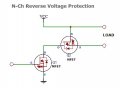
Very interesting, this MOSFET "fuse" or reverse voltage protection. I see designs for both N-Ch and P-Ch, but do not have six P-Ch's. Just trying to understand if the zener & resistor is actually necessary. Need to read more!

Update: No Zener and resistor required. These components are used to insure that the VDS of the MOSFET is higher than the supply voltage.
 
Last edited:

Thread Starter

iONic

Joined Nov 16, 2007
1,662
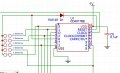
Hoping I am at least in the ballpark with my "Battery Select" logic. Question is where do the second inputs to the AND gates come from. Refer to post #55 for original circuit.

BattSelect.JPG
 
Last edited:

djsfantasi

Joined Apr 11, 2010
9,237
It looks as if they come from a selector switch. Such as a rotary switch that connects Vcc to each of the AND gate pins. I’d include a pull down resistor on each pin. 4.7K. And the unused AND gates should also have their inputs connected to ground.
 

Thread Starter

iONic

Joined Nov 16, 2007
1,662
I'm thinking they come from Q0 - Q4 of U4. The "Rotary switch" is being replaced by this logic. Also U4's six outputs should be five outputs since there is no need for the controller if only 1 battery is being floated(2-6 six batteries).
 
Last edited:

crutschow

Joined Mar 14, 2008
38,520
Hoping I am at least in the ballpark with my "Battery Select" logic. Question is where do the second inputs to the AND gates come from. Refer to post #55 for original circuit.

View attachment 169046
You need a pull-down resistor (e.g. 10kΩ) from the input of U8-2 to ground, otherwise its input can float (which is a no-no).
Better to eliminate the diodes and have all the U7 inputs go to a single OR gate (such as a 4078).
 
Last edited:

Thread Starter

iONic

Joined Nov 16, 2007
1,662
You need a pull-down resistor (e.g. 10kΩ) from the input of U8-2 to ground, otherwise it's input can float (which is a no-no).
Better to eliminate the diodes and have all the U7 inputs go to a single OR gate (such as a 4078).
So a 10k resistor to pins 4/5 of U8.2 will stop the levitation magic? Sounds about right. And this would not happen in the same configuration with an OR gate?

My understanding, though it may be wrong, is that the diodes block interference with the other AND gates that are tied together.
 

crutschow

Joined Mar 14, 2008
38,520
And this would not happen in the same configuration with an OR gate?
No, because the diodes are not there to block the low state of the output driving the gate input.
My understanding, though it may be wrong, is that the diodes block interference with the other AND gates that are tied together.
That's correct if you are tying the outputs together to make an OR function.
If the outputs each go to there own input of an OR gate, then there's obviously no interference.

Generally it's better to use digital gates to perform logic functions, and not try to kludge them with diodes.
 

Thread Starter

iONic

Joined Nov 16, 2007
1,662
No, because the diodes are not there to block the low state of the output driving the gate input.
That's correct if you are tying the outputs together to make an OR function.
If the outputs each go to there own input of an OR gate, then there's obviously no interference.
This is the part I am confused about, the tying together of AND outputs.

Generally it's better to use digital gates to perform logic functions, and not try to kludge them with diodes.
Kludge! That's a new word of the day for me. And it REALLY is a word. You might hurt eT's feelings...not worried about mine.

All good info.

And now for my NFET RVP Circuit.
For my circuit, which will be supplying a voltage via a N-CH MOSFET, to a 12V Lead-Acid Battery, this is my solution:
FET parameters to look out for(specific to protection FET)
1) Low RDSon
2) VDS voltage higher than supply voltage
3) ID greater than current consumption
Anything else I should be aware of?
N-Ch_RVP.JPG
 
Last edited:

crutschow

Joined Mar 14, 2008
38,520
Anything else I should be aware of?
I think that pretty well covers it.

The MOSFET current rating should be at least double, the maximum charging current.

To avoid requiring a heat-sink for the MOSFETs, the Rdson should be low enough that the maximum I²R loss in each MOSFET generates no more that about a watt of dissipation, depending on the MOSFET package type. A TO-220 type case will dissipate more power without a heat-sink than a surface mount type package, for example.
 

eetech00

Joined Jun 8, 2013
4,705
This is the part I am confused about, the tying together of AND outputs.


Kludge! That's a new word of the day for me. And it REALLY is a word. You might hurt eT's feelings...not worried about mine.
Hi

I hate when words are used like that:( it's rather rude...but an OR gate is a better choice. However...the diodes WILL work....I was just trying to save a chip.

eT
 

eetech00

Joined Jun 8, 2013
4,705
So a 10k resistor to pins 4/5 of U8.2 will stop the levitation magic? Sounds about right. And this would not happen in the same configuration with an OR gate?

My understanding, though it may be wrong, is that the diodes block interference with the other AND gates that are tied together.
That's correct. The AND gates are not perfectly matched so the output of one could possibly feedback into the other (depending on the prop delay, timing, etc.). That's the reason for the diodes. But a another chip (OR gates) could be used to replace the diodes and eliminate that possibility.
 

Thread Starter

iONic

Joined Nov 16, 2007
1,662
So I assume that an OR gate can do the same with the Time Selection section as well. Are Inverters also needed with the battery selection section. I would assume, yes. Not sure I have an OR gate. I have AND, NAND, XOR, and NOR. But ordering one is no big deal.

My friend used to use inductor wire to wire his perfboards. Not sure it is a viable alternative to coated wire.

Regarding my build substrate: I'd love a PCB, but fear that this would severely delay completion time due to the learning curve associated with the software. The one pro to this scenario would be that, given the winter is progressing to spring, I would not need the finished device till next Oct/Nov time frame. But, on the other hand, wiring this by hand could easily delay completion time as well. And cause a mess, to boot! So, really, no concrete decision yet.

Been using EasyEDA to create schematics, but am wondering if this is a good program to embrace for routing and PCB layout compared to other software like Eagle, LTSpice, etc.
 

crutschow

Joined Mar 14, 2008
38,520
So I assume that an OR gate can do the same with the Time Selection section as well. Are Inverters also needed with the battery selection section.
Not sure I understand. :confused:
The 8-input CD4078 would replace U6-2 and the diodes.
You still need the U7 AND gates.
Why do you need inverters?

You could could also replace the 2-input AND gates with 2-input NAND gates and feed there outputs into a CD4068 8-input NAND gate.
The input and output signal polarities would stay the same.
 
Top