Schematic Review Request - Graphic EQ

Thread Starter

Dr. Heinz Doofenshmirtz

Joined Jun 29, 2025
16
Hi. I'm designing an audio equalizer and I'd really appreciate if anyone could take a look at my schematic and give me any feedback they might have.

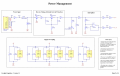
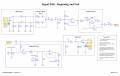
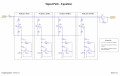
Here are images of the schematic sheets. A pdf is also attached.
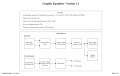
Graphic EQ Schematic - Version 1.1-1.png
Graphic EQ Schematic - Version 1.1-2.png
Graphic EQ Schematic - Version 1.1-3.png
Graphic EQ Schematic - Version 1.1-4.png

Links to datasheets for some of the components just in case:

Here are the design decisions that I'm most unsure about:
1. Whether I should be including pull-down resistors on the signal lines (R16, R17, R52), and if so, whether I've sized them correctly.
2. Whether it would degrade noise performance if I were to replace the film coupling capacitors (C13, C14, and C23) with electrolytics.

Also please note that I know I could be using IC's for the rail splitter and comparator (I'm trying to build something from just basic components) and I know that the clipping detector is crude.

Thanks for taking the time to look at this!


Edit: Cleaned up schematic and made post more succinct.
 

Attachments

Last edited:

Jony130

Joined Feb 17, 2009
5,593
I'm not an engineer, but I would consider adding a capacitor (3.3nF) at the input (in parallel with R21) to limit the input signal band to the audio frequency only. So that we do not amplify any RF noise signals.
Also, add a "big" capacitor (100uF) in parallel with R08.

Why did you change the R43 and R48 values 487Ω?
Why don't use in all stages the same resistor values?

1. Whether I should be including pull-down resistors on the signal lines (R16, R17, R52), and if so, whether I've sized them correctly.
You should leave them. 100k looks good.

2. Whether it would degrade noise performance if I were to replace the film coupling capacitors (C13, C14, and C23) with electrolytics.
You can use electrolytic without any problem if you set the 3dB roll-off much lower than the lowest frequencies of interest.
 
Last edited:

Thread Starter

Dr. Heinz Doofenshmirtz

Joined Jun 29, 2025
16
I'm not an engineer, but I would consider adding a capacitor (3.3nF) at the input (in parallel with R21) to limit the input signal band to the audio frequency only. So that we do not amplify any RF noise signals.
Also, add a "big" capacitor (100uF) in parallel with R08.

Why did you change the R43 and R48 values 487Ω?
Why don't use in all stages the same resistor values?


You should leave them. 100k looks good.


You can use electrolytic without any problem if you set the 3dB roll-off much lower than the lowest frequencies of interest.
Thank you so much! Those sound like good ideas, so I'll double-check a couple things and then add them to my circuit.

As for decreasing R43 and R48, it was the easiest way for me to level out the max magnitude gain/attenuation at each band. When I plugged the same resistor values (100kΩ and 500Ω) into the design equations for each stage, the max magnitude gain/attenuation was lower for the higher frequency bands. Since R33/R38/R43/R48 is inversely related to the max gain/attenuation, I decreased it (and then recalculated the capacitances) for a quick and dirty fix.
 

Ian0

Joined Aug 7, 2020
13,097
I would use U2a as a virtual earth mixer, rather than resistive mixing on the non-inverting input.
Then you would have a non-inverting signal path.
 

Thread Starter

Dr. Heinz Doofenshmirtz

Joined Jun 29, 2025
16
I would use U2a as a virtual earth mixer, rather than resistive mixing on the non-inverting input.
Then you would have a non-inverting signal path.
That's just an inverting summer, right? Something I've observed about these sorts of configurations is that unless buffered (like how I'm using U2A before the volume control), the frequency of the high pass filter becomes inversely correlated to the size of the resistors. So as I understand the tradeoff for reducing crosstalk by switching to active mixing is either using larger coupling capacitors or having more thermal noise. However, I haven't learned how to model and properly evaluate thermal noise tradeoffs so I could really be worrying about nothing.

I think I'm already going to replace the film output coupling capacitor with an electrolytic. Let's also assume I sufficiently ground and separate the channels in layout.

So now, I think my immediate options are:
1. Use active mixing with low resistances and replace film input coupling capacitors with a pair of anti-series electrolytics on each branch.
2. Use active mixing with high resistances.
3. Keep things the same if crosstalk isn't a big issue.

I should also note that with active mixing, I think I could save an op-amp, reducing my IC count. However, I am so behind on this project, that I'd rather get on to layout than spend a little more time to save an IC.

What is your advice?
 
Last edited:

bassbindevil

Joined Jan 23, 2014
918
When I had to run analog stuff off USB 5V, I used a DC-DC converter module to get +/- 12 or 15 volts (I forget which) and followed it up with positive and negative linear regulators, so there'd be plenty of headroom for the op-amp and no risk of noise coming from the USB. Please don't ask me for measurements that justify those choices, though. The prototype worked, and that was good enough.

Running audio circuits off USB power is risky; you're aiming for noise levels far lower than necessary for digital circuits. If you power it from a laptop or desktop, don't be too surprised if you hear mouse movements and drive accesses.
 

schmitt trigger

Joined Jul 12, 2010
2,027
Bassbindevil;
I also agree with your suggestion. Two thumbs up. ;)
Fortunately, many of those converters are isolated, and one would be isolating the digital and analog grounds. Preventing noise injection through ground loops.
 

Thread Starter

Dr. Heinz Doofenshmirtz

Joined Jun 29, 2025
16
When I had to run analog stuff off USB 5V, I used a DC-DC converter module to get +/- 12 or 15 volts (I forget which) and followed it up with positive and negative linear regulators, so there'd be plenty of headroom for the op-amp and no risk of noise coming from the USB. Please don't ask me for measurements that justify those choices, though. The prototype worked, and that was good enough.

Running audio circuits off USB power is risky; you're aiming for noise levels far lower than necessary for digital circuits. If you power it from a laptop or desktop, don't be too surprised if you hear mouse movements and drive accesses.
Thank you. I knew the lack of headroom was a problem but avoided stepping up/down because I wanted to try to avoid IC's other than op-amps. I think that or maybe not taking the time to learn discrete implementations was a silly idea.

I want to ask about the noise on USB without a regulator--is that just due to supply sag when other devices draw more power? I figured that bulk and bypass capacitors would be sufficient for handling small fluctuations and high-frequency noise but I could definitely be missing something here.
 

MisterBill2

Joined Jan 23, 2018
27,180
The choice to power the system with five volts is very limiting indeed. Powering the amplifiers with + and - 12 or 15 volts allows you to have signals of up to 20 volts peak to peak, with the same noise level. Then, when the signal is reduced to 2 volts peak to peak, the noise voltage is also reduced by that same 20dB.
 

bassbindevil

Joined Jan 23, 2014
918
I've used various USB sound devices that worked very well, but I'm sure the codec chips were carefully designed with internal regulators and noise filtering. Look for opamps that are designed to work from 5V or 3.3V single supply.
 

Thread Starter

Dr. Heinz Doofenshmirtz

Joined Jun 29, 2025
16
I went ahead with the layout because this project is mostly for my own learning and I needed to finish it up before the school year starts. However, I know it's a pretty flawed design. I think I might redo it sometime, with the proper headroom, regulation, and more sensible requirements.

I really appreciate everyone's help on this post and others I've made recently. I've learned a lot from you all and hopefully I'll apply what I've learned better in my next analog design. Again, many thanks.
 
Top