[S.T. 2] - Semester task 2

WBahn

Joined Mar 31, 2012
32,870
Do you know how to calculate the power that will be dissipated in the resistor and the diode for a given supply voltage? Do you know what the power ratings are for the resistor and the diode? If so, then you have the proper knowledge and can back up your concern with an appropriate calculation to justify that concern. If you haven't gotten far enough to know about power dissipation in components, then you don't have the proper knowledge yet and have to go on blind faith for now.
 

WBahn

Joined Mar 31, 2012
32,870
hi Psy,
A point I would make in testing a 'real' circuit with a resistor/diode combination, I would not consider it safe for a student to use a 100Vdc 1Amp power supply on the lab bench, without supervision.!:eek:
Any voltage source over 50V that can supply over a few ten's of milliamp is considered potentially hazardous.

E
I would tend to agree. Not to say that it isn't the case at wherever this happens to be, but the concern is definitely justified.
 

Thread Starter

PsySc0rpi0n

Joined Mar 4, 2014
1,786
hi Psy,
A point I would make in testing a 'real' circuit with a resistor/diode combination, I would not consider it safe for a student to use a 100Vdc 1Amp power supply on the lab bench, without supervision.!:eek:
Any voltage source over 50V that can supply over a few ten's of milliamp is considered potentially hazardous.

E
We are not goig to use 100V for that circuit... No, not at all... That was just for the simulation so that we could see all the diode's curve.
When testing the circuit in lab we will ask our teacher to check the breadboard before we power up the power supply!

Do you know how to calculate the power that will be dissipated in the resistor and the diode for a given supply voltage? Do you know what the power ratings are for the resistor and the diode? If so, then you have the proper knowledge and can back up your concern with an appropriate calculation to justify that concern. If you haven't gotten far enough to know about power dissipation in components, then you don't have the proper knowledge yet and have to go on blind faith for now.
I think I know how to do it! I'll replace the diode by an voltage source = 0.7V and a resistor (can't figure out the value of it) and would calculate the circuit's current, then I would be able to calculate each component's power dissipation!

I would tend to agree. Not to say that it isn't the case at wherever this happens to be, but the concern is definitely justified.
Sure... I think I'm aware the even small currents values can harm us!

What about the latest screens I've posted? Are they OK?
 

Thread Starter

PsySc0rpi0n

Joined Mar 4, 2014
1,786
Since we are dealing with different languages, there's a lot of guesswork involved.

Usually, in my experience, a "characteristic curve" relates to the interaction of parameters within a device, such as the voltage across a device and the current through it. A "transfer curve" on the other hand relates an input signal to the output signal that results from it.
That's my point! I'm not quite sure that we want to see here any transfer curve.
 

Thread Starter

PsySc0rpi0n

Joined Mar 4, 2014
1,786
Psy,
For your diode transfer curve this link will explain what is wanted.

http://www.ittc.ku.edu/~jstiles/312/handouts/Example Diode Circuit Transfer Function.pdf
That is pretty much the same as characteristic curve, right, Mr. EricGibbs?
That plot shows us that the diode only lets the current flow when the voltage drop across the diode is greater tan ~0.7V...


Edited;
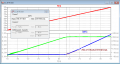
Ok, It's not the same but the plot is similar... The difference is that the quantities plotted are Vs in XX axis and Vo in YY axis. But I can't make the plot look like that in that link using Vs in XX axis and Vo in Y axis..

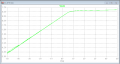
This is what I get!
 

Attachments

Last edited:

ericgibbs

Joined Jan 29, 2010
21,444
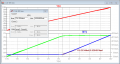
Do you mean like this image.?
If Yes, then place your cursor on a 'label value'' on the X axis, a short rule symbol will appear, left click then type in the box: V(in)
E
 

Attachments

Thread Starter

PsySc0rpi0n

Joined Mar 4, 2014
1,786
Do you mean like this image.?
If Yes, then place your cursor on a 'label value'' on the X axis, a short rule symbol will appear, left click then type in the box: V(in)
E
That is what I have i post #26.

My problem is that I don't understand what our teacher is asking us. His asking for the "characteristic transfer curve" which I don't know if it is the transfer function curve (Vo/Vi) of if is it the diode current related to Vo! I already sent him an email but got no answer so far!
 

ericgibbs

Joined Jan 29, 2010
21,444
the transfer function curve (Vo/Vi) of if is it the diode current related to Vo!
A transfer function for a 'diode' defined as Vo/Vi would be meaningless, its the diode forward voltage versus the diode current.
 

WBahn

Joined Mar 31, 2012
32,870
Are you talking about a transfer curve or transfer characteristic for the circuit in Post #10?

If so, then your plot would the voltage on the "out" node versus the voltage on the "in" node.
 

Thread Starter

PsySc0rpi0n

Joined Mar 4, 2014
1,786
A transfer function for a 'diode' defined as Vo/Vi would be meaningless, its the diode forward voltage versus the diode current.
Ok, so be it!

Are you talking about a transfer curve or transfer characteristic for the circuit in Post #10?

If so, then your plot would the voltage on the "out" node versus the voltage on the "in" node.
I also think it's the diode forward voltage versus diode current as EricGibbs said!

Tomorrow I'll finish those plots and move for the next problem of task 2!
 

ericgibbs

Joined Jan 29, 2010
21,444
hi Psy,
Its important that you determine if the question is asking for the transfer function of a 'diode' or the transfer function of the 'circuit'.

I would suggest that when you have a Eureka moment for a question, that you post your answer/results so that others can benefit.:)

E
 

Thread Starter

PsySc0rpi0n

Joined Mar 4, 2014
1,786
hi Psy,
Its important that you determine if the question is asking for the transfer function of a 'diode' or the transfer function of the 'circuit'.

I would suggest that when you have a Eureka moment for a question, that you post your answer/results so that others can benefit.:)

E
Sure Mr. EricGibbs...

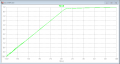
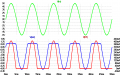
These were the plots that I've included in the answer:
 

Attachments

Thread Starter

PsySc0rpi0n

Joined Mar 4, 2014
1,786
One other small question...

When a regular diode is reverse biased, does it has a saturation current of around some uA or does it not have any current at all, and behaves as if it was an open loop circuit?
 

Thread Starter

PsySc0rpi0n

Joined Mar 4, 2014
1,786
hi Psy,
The d/s for diode gives the reverse leakage current value.
Reverse DC blocking voltage current, for the 1N4001

E
What means "d/s"???

When analysing circuits with diodes, when we "assume" diode - OFF or reverse biased, we replace the diode for an open circuit ( or open-loop circuit). Is this because the Is is so small that it can be neglected????
 

ericgibbs

Joined Jan 29, 2010
21,444
d/s is short cut way of typing data sheet.;)

I would assume an open circuit for a silicon diode when its reversed biassed.
Note: the reverse leakage current in the d/s, is for the maximum rated reverse blocking voltage, so for lower reverse voltages it will be less.
 

Thread Starter

PsySc0rpi0n

Joined Mar 4, 2014
1,786
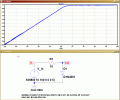
Another thing is the forward voltage relationship with temperature. We were said that the reverse saturation current increases by 7% for each ºC. For example, when temperature increases 10ºC, the Is is ~1.97 times greater. This will affect forward voltage in less ~2.2mV per ºC.

So, if Temp = 25ºC, the zener behaves as usual. If I set the Temp to 100ºC, there is a 75ºC raise, so if I multiply 2.2mV by 75 I'll get the new forward voltage for a Temp of 100 ºC, right? This will result in ~165mV.

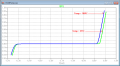
Well, this plot shows almost twice as 165mV for new forward voltage for 100ºC of Temp.
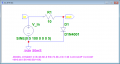
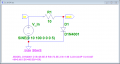
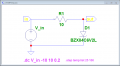
And shouldn't the forward voltage also be ~0.67V for 25ºC??? I'm getting in the attached plot and circuit ~10mA at ~0.400mV of V_out.

What is wrong?
 

Attachments

Top