[S.T. 2] - Semester task 2

WBahn

Joined Mar 31, 2012
32,852
I can't see the problem you're referring to. I have placed the zener in the opposite direction of the LED having in mind that to make the LED work, zener should be reverse biased!

The LED's Breakdown Voltage is 5V and the Zener's is 6V2.

What our teacher is asking is to purpose a circuit to make a LED light on using a Zener and get the characteristic curves for both the Zener and LED. So I suppose he only wants the plot of these curves when the LED is ON (Zener in reverse bias mode and LED e direct bias mode simultaneously).
But how are you going to see the behavior of the zener? When the zener is reverse biased, the LED is forward biased, right? So the LED is going to clamp the voltage at around 2V (whatever the LED forward voltage is).
 

Thread Starter

PsySc0rpi0n

Joined Mar 4, 2014
1,786
78
But how are you going to see the behavior of the zener? When the zener is reverse biased, the LED is forward biased, right? So the LED is going to clamp the voltage at around 2V (whatever the LED forward voltage is).
Won't I be able to see the Zener's curve (reverse biased) and the LED's curve (forward biased)????
 

WBahn

Joined Mar 31, 2012
32,852
Actually, in a simulator, you might; that's because a simulator doesn't let the magic smoke out of components and a simulator doesn't mind having a voltage source put out thousands of amps. But don't fall into the trap of thinking that what you can do in a simulator in any way translates into the real world. You said before that you had to be careful about damaging components in the lab -- so get in the habit of only doing in simulation things that are reasonable to do in the real world (unless, of course, you KNOW that what you are doing will not work in the real world and, for whatever reason, you want to do it in simulation despite that knowledge).
 

ericgibbs

Joined Jan 29, 2010
21,442
Ok, so firstly, in terms of math, what should I do to calculate the correct components values???
hi Psy,
If I consider using an unfamiliar device, either in simulation or the actual device, I would study the datasheet for the device.
Use the d/s parameters in the simulation, choose voltages/currents and power dissipation etc, that do not exceed the d/s values.

As for selection of .Temp for the simulation, choose a value that you expect the circuit to be operating over.
Most d/s quote a 25C typical but also state the parameters for a range of temperatures.

If you are doubtful about the dissipation in a sim component use the LTSpice 'thermometer' cursor and plot the power.
E
 

JoeJester

Joined Apr 26, 2005
4,390
psy,

Know the equipment you are working with. For instance, if your working with a 12V 1 amp supply in the lab, you can model that with an series resistance (Ri) of 12 ohms. Then your simulation power will NOT be capable of exceeding 12 watts. Your simulator will not be capable of producing 12.2 gigawatts into that low ohmic resistor.

Always start your simulation from a zero reference, just like turning on the power switch. You will see the transients as the circuit startup, and in some digital work, you can resolve some issues when you start to synchronize things like counters. It other works, you might need a power up reset to prevent anything from providing a false trigger for a future event.

Like Eric said, look at the datasheets.

For instance, if you were working with a 12V 7AH battery, you can find the internal resistance value on the datasheet. That could be useful when working with a circuit that is triggered, say to deploy a parachute, with a rocket club that sought out your expertise in electronics.
 

Thread Starter

PsySc0rpi0n

Joined Mar 4, 2014
1,786
hi Psy,
If I consider using an unfamiliar device, either in simulation or the actual device, I would study the datasheet for the device.
Use the d/s parameters in the simulation, choose voltages/currents and power dissipation etc, that do not exceed the d/s values.

As for selection of .Temp for the simulation, choose a value that you expect the circuit to be operating over.
Most d/s quote a 25C typical but also state the parameters for a range of temperatures.

If you are doubtful about the dissipation in a sim component use the LTSpice 'thermometer' cursor and plot the power.
E

I might have not explained my self correctly. I'm sorry for that... What I meant was what calcs should I do to find the correct LED and a suitable limit resistor, let's say, for a 12V power supply and for a 5V6 zener...
If I want to use a green LED I need to calculate the resistor I must use so that the LED works, and more important, so that the LED doesn't blow up or in the other hand , not having enough current to even light up!

So I was thinking about to check in any d/s of green LEDs for how much current they can handle. Then, calculate the resistor value so that I can have a current flowing on the circuit that makes the LED to work.

For instace, can I think this way:
Let's say I found a LED that handles, 12mA max current.

So, I'll assume that 6mA is enough to light up the LED and is still far away from the 12mA max current.
So, for the current to be 6mA, I need a 2K resistor.

Is this thinking correct?
 

Thread Starter

PsySc0rpi0n

Joined Mar 4, 2014
1,786
psy,

Know the equipment you are working with. For instance, if your working with a 12V 1 amp supply in the lab, you can model that with an series resistance (Ri) of 12 ohms. Then your simulation power will NOT be capable of exceeding 12 watts. Your simulator will not be capable of producing 12.2 gigawatts into that low ohmic resistor.

Always start your simulation from a zero reference, just like turning on the power switch. You will see the transients as the circuit startup, and in some digital work, you can resolve some issues when you start to synchronize things like counters. It other works, you might need a power up reset to prevent anything from providing a false trigger for a future event.

Like Eric said, look at the datasheets.

For instance, if you were working with a 12V 7AH battery, you can find the internal resistance value on the datasheet. That could be useful when working with a circuit that is triggered, say to deploy a parachute, with a rocket club that sought out your expertise in electronics.
Hi Mr. JoeJester...

For now I'm only trying to find the correct values theoretically. And also you're talking about some stuff that I think is still too much for me... Or I can't fully understand you explanations because of some technical therms used... I appreciate all your efforts, though.
 

JoeJester

Joined Apr 26, 2005
4,390
Ok...

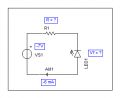
Your circuit shows the LED energizes when the supply is set for minus 7 volts. I'll assume you want the LED current to be 6 mA at that moment.

You need to know the Vf of the LED.

What is the Vf of the LED you chose? From there you can apply KVL ... and compute the resistance. Then choose the nearest E24 series value resistor.
 

Attachments

Last edited:

WBahn

Joined Mar 31, 2012
32,852
I might have not explained my self correctly. I'm sorry for that... What I meant was what calcs should I do to find the correct LED and a suitable limit resistor, let's say, for a 12V power supply and for a 5V6 zener...
If I want to use a green LED I need to calculate the resistor I must use so that the LED works, and more important, so that the LED doesn't blow up or in the other hand , not having enough current to even light up!

So I was thinking about to check in any d/s of green LEDs for how much current they can handle. Then, calculate the resistor value so that I can have a current flowing on the circuit that makes the LED to work.

For instace, can I think this way:
Let's say I found a LED that handles, 12mA max current.

So, I'll assume that 6mA is enough to light up the LED and is still far away from the 12mA max current.
So, for the current to be 6mA, I need a 2K resistor.

Is this thinking correct?
You are moving in the right direction. Let's start with just a 12V supply, a resistor, and a green LED that has a forward voltage of 2V (it will probably be closer to 1.8V, but let's use 2V for simplicity).

When it is forward biased, the LED will have 2V across it, meaning that the other 10V will appear across the resistor. So if you truly want 6mA then you need to use something a bit smaller than 2kΩ. But if you are looking for rough numbers then you can use the 2kΩ knowing that the actual current will be somewhat less than 6mA.

But now let's consider if this is an AC source with a 12V amplitude. When the LED is reverse biased it will have 12V across it, but the LED is only rated for 5V PIV, meaning that the diode will go into breakdown long before it gets to 12V. Depending on the specifics, namely the degree of current limiting, the diode might survive this or it might not. If it does survive it, it will act somewhat like a zener itself with a breakdown voltage something in excess of 5V.

Now let's place the zener across the LED such that it is reverse biased when the LED is forward biased. Let's further assume that the LED has 2V across it at 20mA. Depending on the quality factor of the diode, the current will increase by an order of magnitude for every, roughly, 100mV of additional voltage drop. So even going from 2V to 2.3V would result in an increase from 20mA to 20A. You can just imagine what it will be by the time you get to the breakdown voltage of the zener. Now, in reality, something will happen long before you get to that point. There is resistance in the zener leads and the diode itself which will, at some point, limit the current. But before that point is reached the thermal effects will destroy the device.

The simulator may or may not even attempt to model the resistive nature of the physical device, but even if it does the model will only be a reasonable approximation under conditions that are close to where the diode is supposed to be operated. Outside of that, all bets are off.
 

ericgibbs

Joined Jan 29, 2010
21,442
hi Psy,
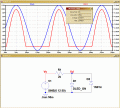
Its important to remember that a LTSpice AC voltage of 12Vac is the peak voltage, so the Vrms is approx 8.5V, which means the average current thru the LED is only approx 2mA.
This is for your circuit of 12V, series 2K , with a reverse diode across the Green LED.

So the LED will be dimmer than you expect.

E
 

Attachments

Thread Starter

PsySc0rpi0n

Joined Mar 4, 2014
1,786
Ok, guys. I'll look to this later...I'm trying to study now the other subject I posted in the other thread... Transformers and equivalent circuits...
 

Thread Starter

PsySc0rpi0n

Joined Mar 4, 2014
1,786
Back to finish this task... I need to finish it today...

Ok, the last exercise I said it was to purpose a circuit with a Zener and a LED and make the LED to light on and plot V_out (V_in), meaning V_in in XX axis and V_out in YY axis, the so called characteristic transfer curve of both diodes!

I have the circuit attached but I need to ask a few questions:

In the file 2.4.a.asc, I'm using a parallel setup to connect the LEDs. But I can have here another situation no analyse. When both diodes are in the same direction and the other is when the diodes are in opposite directions.

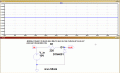
When they are in opposite directions, the plots are as expected and I can understand them (more or less), but when the diodes are in the same direction, why does the LED has no current flowing through it???

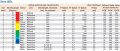
And how can I know, from LTSpice LED model specifications, the direct bias voltage? What is the value that says that? It's not Breakdown Voltage, right? So, what is it? Because I'm suspecting that LED has no current because the direct bias voltage of the diode (D1) is lower than the LED's one, so the LED wont have any current flowing through it!
 

Attachments

ericgibbs

Joined Jan 29, 2010
21,442
When they are in opposite directions, the plots are as expected and I can understand them (more or less), but when the diodes are in the same direction, why does the LED has no current flowing through it???
hi,
Repeat the simulation without the series LED, then you should understand why no current flows thru the 1N4001 diode.;)
 

Attachments

ericgibbs

Joined Jan 29, 2010
21,442
If you mean when the 1N4001 diode is forward biased [ pointing down in your circuit ] then its forward voltage drop is approx 0.7V, so the LED which is White and has a specified required forward voltage drop of approx 3V, it will never conduct.


E
 
Top