Remote detection of water flow through a pipe

Thread Starter

Ferdmonster

Joined Apr 22, 2017
13
Inexpensively detecting "on or off" water flow through a pipe is not an easy matter. There are sophisticated, very costly devices for doing same, but prohibitive by nature. Needed is an inexpensive device for non-invasively determining yes, water is flowing, or no, water is not flowing. Even a diy system is acceptable but its design escapes me. Any thoughts.....referrences?

Bob Hewlett
 

Reloadron

Joined Jan 15, 2015
7,867
Inexpensively detecting "on or off" water flow through a pipe is not an easy matter. There are sophisticated, very costly devices for doing same, but prohibitive by nature. Needed is an inexpensive device for non-invasively determining yes, water is flowing, or no, water is not flowing. Even a diy system is acceptable but its design escapes me. Any thoughts.....referrences?

Bob Hewlett
This would go much better if you defined "costly" and maybe a pipe diameter and anticipated flow rate? When you start looking at non-invasive the cost begins to add up. What you want is not a flow sensor as much as more commonly called a flow switch. There either is or is not flow above a pre determined rate. So you really need to define your idea of costly. Just keep in mind that any non invasive method of detecting flow will have more cost than placing a $150 flow switch in a line.

Also, per Carl what would you like for a response time?

Ron
 

drc_567

Joined Dec 29, 2008
1,156
What is the kind of water flow are you referring to? If this a typical city water pipe ... 40 psi or so ... there may be enough internal water pressure, such that a strain gage, oriented to measure circumferential stress, could be used to detect the difference between static pressure (40 psi or so) and dynamic ... i.e. flowing pressure ... (much less pressure).
... The other factor here is to ask what kind of output or response do you want?
 

Thread Starter

Ferdmonster

Joined Apr 22, 2017
13
Is the temperature of the water significantly different from the ambient temperature?

How fast a response do you need?
Temperature is not significantly different from ambient.
Response time is not critical. Under 2 seconds would be acceptable.
Cost goal would be under $50.00.
Pipe diameter 3/4" id.

What is the kind of water flow are you referring to? If this a typical city water pipe ... 40 psi or so ... there may be enough internal water pressure, such that a strain gage, oriented to measure circumferential stress, could be used to detect the difference between static pressure (40 psi or so) and dynamic ... i.e. flowing pressure ... (much less pressure).
... The other factor here is to ask what kind of output or response do you want?
We need to detect even a trickle.
Close of contacts would suffice as an output.
 
Last edited by a moderator:

drc_567

Joined Dec 29, 2008
1,156
In order to accomplish your objective, you are going to have to fabricate a propeller type device that can be inserted into the flowstream, similar to a union. The propeller should rotate if there is any significant water flow. The propeller will have maybe 4 blades, and the outer tip of each blade will be made of a magnetic material. Exterior to the propeller casing, there will be a Hall Effect sensor that will generate a pulse as each propeller tip traverses the sensor pick-up region inside the case. The Hall Effect sensor will signal a relay to alert that water is flowing.
The purpose of the rotating propeller is not to measure flow rate, as with a rota-meter, but only to detect water flow.
If fabrication of a prototype unit is successful, the per unit cost could be reduced with mass production.
 

DickCappels

Joined Aug 21, 2008
10,661
On Demand water heaters have a flow switch. If you can find one, perhaps from a used or scrapped heater and you have adequate pressure and flow then it could work for you.

Another approach is to have the water path flow through a chamber or jacket surrounding a low value resistor. Run a large enough constant current through it to make it very warm, then monitor the voltage across the thermistor.
 

Thread Starter

Ferdmonster

Joined Apr 22, 2017
13
In order to accomplish your objective, you are going to have to fabricate a propeller type device that can be inserted into the flowstream, similar to a union. The propeller should rotate if there is any significant water flow. The propeller will have maybe 4 blades, and the outer tip of each blade will be made of a magnetic material. Exterior to the propeller casing, there will be a Hall Effect sensor that will generate a pulse as each propeller tip traverses the sensor pick-up region inside the case. The Hall Effect sensor will signal a relay to alert that water is flowing.
The purpose of the rotating propeller is not to measure flow rate, as with a rota-meter, but only to detect water flow.
If fabrication of a prototype unit is successful, the per unit cost could be reduced with mass production.
Great idea Alec. I'll certainly consider it if I can't succeed with my goal of non-invasive. I would like to be able to strap on a device externally with dectection sensors much like the RSSA ultrasound technology.

On Demand water heaters have a flow switch. If you can find one, perhaps from a used or scrapped heater and you have adequate pressure and flow then it could work for you.

Another approach is to have the water path flow through a chamber or jacket surrounding a low value resistor. Run a large enough constant current through it to make it very warm, then monitor the voltage across the thermistor.
Thanks Dick!

In order to accomplish your objective, you are going to have to fabricate a propeller type device that can be inserted into the flowstream, similar to a union. The propeller should rotate if there is any significant water flow. The propeller will have maybe 4 blades, and the outer tip of each blade will be made of a magnetic material. Exterior to the propeller casing, there will be a Hall Effect sensor that will generate a pulse as each propeller tip traverses the sensor pick-up region inside the case. The Hall Effect sensor will signal a relay to alert that water is flowing.
The purpose of the rotating propeller is not to measure flow rate, as with a rota-meter, but only to detect water flow.
If fabrication of a prototype unit is successful, the per unit cost could be reduced with mass production.
DRC: I'll look into your interesting idea if my objective of non-invasive can't be achieved. Thank you so much for the reply!

Can the pipe be optically transparent?
Alec: sorry, no. The pipe will be either metal or pvc. Thanks.
 
Last edited by a moderator:

wayneh

Joined Sep 9, 2010
18,093
A pipe with water moving at a trickle through it looks like a pipe with static water in it. I'm having a hard time imagining any non-invasive way to tell them apart. Not cheaply anyway. I wonder if you could build your own magmeter somehow.
 

Tonyr1084

Joined Sep 24, 2015
9,744
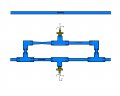
Well, here's a peanut gallery approach to this problem: The diagram below splits water flow into a natural path and a low flow bypass path with a restriction in the pipe. And it's possible the restriction might not be needed.

When water flows (left to right) there develops a difference in pressure in each pressure sensor (the green things). Using a comparator you can detect when there's a difference in pressure, indicating water flowing sufficiently to set up enough of a difference to be read. When water is not flowing the pressure will equalize on both sides and the comparator won't be able to see any difference between the two inputs. Perhaps not a comparator, but an OpAmp may serve better because when both sensors are reading the same thing, slight differences in the sensor can confuse the comparator. OR you could try it one way and if it doesn't work well, swap the sensors and see if that makes a difference. If you need some sort of offset or hysteresis - hysteresis is something I'm not good at - you can build that into a circuit and fine tune the sensitivity between the two sensors. And the way this is designed this doesn't impede normal water flow.

Like I said, this is a peanut gallery approach. This is just a theory on my part. But it IS cheap. Depending on the sensors you use. Mine shows three wire sensors, one for power, one for ground and one for the sensed signal. You probably could use two wire sensors that use a change in resistance to detect pressure. Like I said - theory - theory - theory. But I think this will work. AND you might not even have to kink one of the side flow pipes. There may be enough of a difference just with the tee's alonePressure Differential Flow Sensor.jpg
 

Tonyr1084

Joined Sep 24, 2015
9,744
Avoid the non-invasive dream for good results on a budget.
Good approach. However, it's been my experience with flow sensors and meters that they eventually hang up. Switches that protrude into the flow stream cause cavitation and can be noisy AND can reduce fluid flow. IF the pipe in question is a half inch pipe (for instance) and you adapt up to 3/4 inch for the flow switch then back down to half inch you can avoid flow restriction, but you are still creating cavitation.

I'm not knocking the approach. But in keeping with the requirements to be non-invasive - a pipe with a smaller side pipe (I think) will not impede the water flow AND will set up enough of a pressure differential that an OpAmp or Comparator can detect. Sensitivity could be electronically adjusted too. And no moving parts to hang up. No switch vanes, no turbines.

This is peanut gallery engineering. But I've been known to do some pretty goofy stuff that got results. Like a marble in a balloon. The marble seals the balloon, no need for tying it off. Drop it on the floor and the marble is knocked away from the opening. Air rushes out and blows the balloon upwards until the marble reseals it. Then it falls to the ground and does the same thing over and over and over. Grandchildren LOVE it.
 

Externet

Joined Nov 29, 2005
2,628
Tony : I believe non-invasive means not cutting the pipe to insert anything (tees, branches, sensors...) in the flow, leaving it as a continuous unaltered pipe. External thermal/ultrasonic sensors attached to the pipe exterior to read the flow are not cheap to do it non-invasive... There is several manufacturer$ of such shown at a search.

My municipal water meters have never stopped registering in any house I lived in, They know what works reliably well for decades, counting every 'tickle' flow. And for the remote sensing; that is the way they read the meter now. From a passing vehicle in full comfort of the operator. "tickle' also needs to be defined.
 

Tonyr1084

Joined Sep 24, 2015
9,744
@Externet

Agreed. I was assuming the TS did not want to impede the water flow. If he truly wants to detect water flow without doing anything to the pipe - i.e. cutting, sweating etc. then my approach is null and void. For me, I saw the posted problem and wanted to see if I could come up with a way to detect water flow. My solution - seen above. Works or not - I don't know. I'm clearly not the expert here. But I enjoy the challenge of engineering something - working or not.

[edit] Personally, I've seen two mechanical water meters hang up. One was a domestic water meter the other was a turbine water meter on a water softener. I didn't mind so much the domestic meter hanging up. It meant lower bills but it also impeded the water flow to a degree. Been years since then but I still remember it.
 

Thread Starter

Ferdmonster

Joined Apr 22, 2017
13
@Externet

Agreed. I was assuming the TS did not want to impede the water flow. If he truly wants to detect water flow without doing anything to the pipe - i.e. cutting, sweating etc. then my approach is null and void. For me, I saw the posted problem and wanted to see if I could come up with a way to detect water flow. My solution - seen above. Works or not - I don't know. I'm clearly not the expert here. But I enjoy the challenge of engineering something - working or not.

[edit] Personally, I've seen two mechanical water meters hang up. One was a domestic water meter the other was a turbine water meter on a water softener. I didn't mind so much the domestic meter hanging up. It meant lower bills but it also impeded the water flow to a degree. Been years since then but I still remember it.
Thanks to all of for your kind and prompt responses. Looks like I'll have to resort to invasive. Do any of you understand the mechanism of operation of the city/county water meter, specifically the little rotating red triangle device that spins in proportion to flow rate? This little dial will spin very slowly when there is only a slight trickle of water through the meter. It is located in the meter face adjacent to the digital gallon readout on our meter in our county.
 

Externet

Joined Nov 29, 2005
2,628
That spinning thinghy in the face of a municipal water meter is just a mechanical display/readout/extension of the metering moving vane to show it is consuming/working/leaking.
 
Top