I know it works for gas, Not sure if it works for water. Used to do it all the time for vacuum leaks. But anyway, you can look at pressure drop over time. I just don;t know what the sensitivity has to be. Even if water is incompressable, there would be air I the pipe, that would obey PV=nRT. Change in Volume from 0. n,R and T are constants. Anyway, you let air out of a tire, the pressure goes down. You let air into a closed pipe, the pressure goes down.
If you close off a segment of water that's at constant temperature. Measure the pressure and measure it sometime later, it can be due to temperature or a leak. Not sure what resolution you need.
The microphone leak detection method works for large leaks. When water is squeezing through an opening it cavitates. That produces a noise. However, a pin hole isn't likely to make very much noise, and I have no idea how far away a microphone could pick up the sound. Cavitation noise is used to pinpoint major leaks in underground lines. That's how repair crews know where to dig. They know the leak is between point A and point B. By measuring the sound they can determine how far away it is by calculating the difference in amplitude.
I know it works for gas, Not sure if it works for water. Used to do it all the time for vacuum leaks. But anyway, you can look at pressure drop over time. I just don;t know what the sensitivity has to be. Even if water is incompressable, there would be air I the pipe, that would obey PV=nRT. Change in Volume from 0. n,R and T are constants. Anyway, you let air out of a tire, the pressure goes down. You let air into a closed pipe, the pressure goes down.
If you close off a segment of water that's at constant temperature. Measure the pressure and measure it sometime later, it can be due to temperature or a leak. Not sure what resolution you need.
Only problem with that approach is that it would be affected by changes in temperature. One could use a thermometer, of course. But temperature wouldn't be constant throughout a long pipe.
I know it works for gas, Not sure if it works for water. Used to do it all the time for vacuum leaks. But anyway, you can look at pressure drop over time. I just don;t know what the sensitivity has to be. Even if water is incompressable, there would be air I the pipe, that would obey PV=nRT. Change in Volume from 0. n,R and T are constants. Anyway, you let air out of a tire, the pressure goes down. You let air into a closed pipe, the pressure goes down.
If you close off a segment of water that's at constant temperature. Measure the pressure and measure it sometime later, it can be due to temperature or a leak. Not sure what resolution you need.
If I'm imagining the scenario right, there's a water meter, several hundred yards of pipe, then a sprinkler control valve of some sort. If a leak develops before the valve but after the meter the leak will go undetected. So why not put another valve near the meter. That way, between both valves there should remain a residual pressure. If the pressure falls to zero - as a leak would do - you can get an alarm and have only wasted a gallon of water or less.
Someone before me mentioned their system had a main valve and satellite valves. The main valve is closed until one of the satellite valves opens. Therefore, between the two points there should be no drop in pressure except for that of temperature changes. As GohperT said, the change is huge even in a short length of pipe. I was watching the hydrostatic testing of a tank that was 12 foot diameter and 100 feet long. It was a cold morning and the tank was brought up to pressure. All of a sudden there was a huge drop in pressure and everyone was scrambling to find the leak. There WAS no leak. The sun had come up over the top of the building and began shining on the tank. As the sun got higher the pressure dropped lower. Yet there was no leak. It was all due to the radiant energy of the sun causing the tank to expand, which accounts for the drop in pressure.
Yes, unless it's intentionally part of the system. My pressure tank in my basement has an air bladder. The well pump runs when the pressure in the tank is less than 50 psi (just a guess) and stops when it hits 55 psi (another guess). That would happen almost immediately if the air wasn't there, since water in incompressible as you know. I can detect a "leak" in my system when I hear the well pump cycling late at night.
Yes, unless it's intentionally part of the system. My pressure tank in my basement has an air bladder. The well pump runs when the pressure in the tank is less than 50 psi (just a guess) and stops when it hits 55 psi (another guess). That would happen almost immediately if the air wasn't there, since water in incompressible as you know. I can detect a "leak" in my system when I hear the well pump cycling late at night.
I don't have a regulator. My Reverse Osmosis system has an incoming pressure gauge and an outgoing pressure gauge. My incoming fluctuates between around 60 and 68 PSI. I've seen homes as high as 80 PSI and even 100 is not unheard of. But that's rare. 50 would be the low end of what I've seen in my lifetime that I know of.
I don't have a regulator. My Reverse Osmosis system has an incoming pressure gauge and an outgoing pressure gauge. My incoming fluctuates between around 60 and 68 PSI. I've seen homes as high as 80 PSI and even 100 is not unheard of. But that's rare. 50 would be the low end of what I've seen in my lifetime that I know of.
Gosh, I just learned something new! ... down here water pressure is much lower, and I see no need for it to be any higher, at least for domestic applications. And no, we normally don't have water pressure regulators at home either.
Hi there! I saw this thread, did you find solution however ?
I saw some interesting things other guys do,
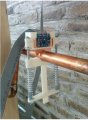
I think they use smth with Strain Gauge ( like in regular weight scales ) by measuring expansion of tube
I am curious if small amount of water ( or even drops ) could affect tube expansion what we could measure with strain gauge ( resistance difference )
Hi there! I saw this thread, did you find solution however ?
I saw some interesting things other guys do,
I think they use smth with Strain Gauge ( like in regular weight scales ) by measuring expansion of tube View attachment 164357
I am curious if small amount of water ( or even drops ) could affect tube expansion what we could measure with strain gauge ( resistance difference )
If that device is truly measuring the pipe diameter, an assumption I’m not ready to accept, it would respond to pressure in the pipe and to temperature changes. Neither is perfectly correlated to a small flow.
If that device is truly measuring the pipe diameter, an assumption I’m not ready to accept, it would respond to pressure in the pipe and to temperature changes. Neither is perfectly correlated to a small flow.
I agree and enter the problem. Unless the pressure in a line is enough to get something from a strain gauge I don't see it working. As shown it looks to be maybe a 3/4" or 1.0" copper pipe and I would think you could have plenty of flow before the pipe would expand enough to be measurable. It does look interesting though, whatever it is.
It's been a while since I've followed this thread, but I don't think measuring the diameter of the pipe is going to tell you anything. Copper changes dimensionally with the changes in temperature. So if the water is unusually cold or warm the pipe will react greatly.
Had a friend back in the 90's who wanted to make his own thermometer using a plastic hot sauce bottle, some colored water and a pen ink well as the indicator. His thinking was that as the water warmed it would expand. And physics tell us that's exactly what would happen. However, his thermometer worked opposite of what he expected. As the air temperature warmed the water level would drop in the tube. He never figured out that the water level dropped because the plastic bottle expanded, creating greater volumetric space for the water to occupy. As the space increased the water in the sight tube would drop.
I'm not up to reading four pages of entries to make a reply to a thread that has gone cold a year and a half ago. But for what it's worth, the way to measure water flow is with a positive displacement vane. As water moves the vane is forced to turn. As it turns it spins a shaft connected a chain of gears which moves the meter on the water meter outside my home. Seems they're able to detect even a slow drip.

 Facebook
 Google
 GitHub
 Linkedin