Re-winding of an old Brook Motors Ltd.

Thread Starter

Vakse Viggo

Joined Jun 15, 2017
51
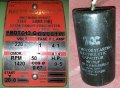
A few days ago, I got an old coffee mill home who had a bad capacitor and a burnt motor. I am doing a complete rebuild of the mill, and really want to do the re-winding myself.
The rebuild with youtube videos, can be seen here... http://www.home-barista.com/repairs/restoration-of-caravel-de-luxe-t47206.html

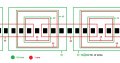
I made a diagram that shows how its connected, and the only thing I am missing is how the windings are connected to the small print, and the capacitor? I am not too sure, if the 1mm windings are 35...it was a little difficult to count the wires after the deconstruction. The others should be correct.

The reason the motor burned up, was that someone who greased the bearing pumped WAY too much grease in the valve, and blocked the small contact on the Speed Switch....thats my guess anyway.

Some of the Stator Core Plates are also very loose on each end, and need to glued together again. What is the best way of doing this?

Can you recommend some good quality Magnet Wire for the re-winding?

Any advice or help will be appreciated...thank you. :)
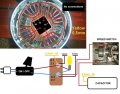

Caravel El Diagram.jpg
DSC_0138.JPG


cghf.jpg
 

MaxHeadRoom

Joined Jul 18, 2013
30,562
Most magnet wire sold now is suitable, if you have a motor winding shop near you they should sell you a drum or part of.
Usually the stator is dipped and baked after rewinding that takes care of lose laminations etc.
You will need to build a former and a simple winder for making up the coils.
You will also need insulation paper, prespahn etc.
Max.
 

Thread Starter

Vakse Viggo

Joined Jun 15, 2017
51
Most magnet wire sold now is suitable, if you have a motor winding shop near you they should sell you a drum or part of.
Usually the stator is dipped and baked after rewinding that takes care of lose laminations etc.
You will need to build a former and a simple winder for making up the coils.
You will also need insulation paper, prespahn etc.
Max.
Thank you Max

The space between the laminations are quite big, so I was thinking of doing it before the actual winding somehow.

Not sure what you mean by 'former'? The winder will likely be a board with four small plastic dowls of somekind, nails would properly not be a good idea.
 

MaxHeadRoom

Joined Jul 18, 2013
30,562
Not sure what you mean by 'former'? The winder will likely be a board with four small plastic dowls of somekind, nails would properly not be a good idea.
That is basically what is known as a Former.
A method of winding the coil of desired dimensions on a former that conforms to the coil shape/size etc.
Max.
 

Thread Starter

Vakse Viggo

Joined Jun 15, 2017
51
That is basically what is known as a Former.
A method of winding the coil of desired dimensions on a former that conforms to the coil shape/size etc.
Max.
Okay, got ya! ;)

You woulden't happen to know how the windings are connected to each other?

Am I right in saying that the 0,5mm is totally separated from the 1mm?

And thanks for the help Max...
 

strantor

Joined Oct 3, 2010
6,875
Rewinding a motor is best done by a rewind shop. Unless you have a varnish vat and an autoclave laying around. They usually prefer you bring the motor to them with the original windings in it so they can document it in their way. The way you have documented it may be good enough for them, but they might not warranty the work because they didn't get to see the original configuration first hand.

You can try to do it yourself, but I will be surprised if you can get a well running motor that doesn't overheat. I typically DIY everything, but this is one thing I would not DIY.
 

Thread Starter

Vakse Viggo

Joined Jun 15, 2017
51
Rewinding a motor is best done by a rewind shop. Unless you have a varnish vat and an autoclave laying around. They usually prefer you bring the motor to them with the original windings in it so they can document it in their way. The way you have documented it may be good enough for them, but they might not warranty the work because they didn't get to see the original configuration first hand.

You can try to do it yourself, but I will be surprised if you can get a well running motor that doesn't overheat. I typically DIY everything, but this is one thing I would not DIY.
Thank you for the warning strantor

Getting it rewind by a company, is not possible right now...so I will do my own attempt first. It seems pretty straight forward, and I have undertaken more complicated diy projects than this.
Next step is to find out, how the windings are connected...I am in no rush at all, so will just take it nice and slow with many pictures in here, as I progress.
 

MaxHeadRoom

Joined Jul 18, 2013
30,562
Part of my Electrical training was in a rewinding shop, I have not really done any since then, but I do use Electric Motor Repair by Robert Rosenberg.
First published 1946, but still sought after and still relevant today for motor re-winding.
I could post a couple of pages that could apply to your motor.
Max.
 

Thread Starter

Vakse Viggo

Joined Jun 15, 2017
51
Part of my Electrical training was in a rewinding shop, I have not really done any since then, but I do use Electric Motor Repair by Robert Rosenberg.
First published 1946, but still sought after and still relevant today for motor re-winding.
I could post a couple of pages that could apply to your motor.
Max.
That would be awesome Max...thank you! :)
 

Thread Starter

Vakse Viggo

Joined Jun 15, 2017
51
Thank you! ;)

I will try to draw how its winded from the side. It does not look like the 4 pole on page 2.
I am also going to ask Brook Motors Ltd if they should have any information of this motor.
 

tcmtech

Joined Nov 4, 2013
2,867
Rewinding a motor is best done by a rewind shop. Unless you have a varnish vat and an autoclave laying around. They usually prefer you bring the motor to them with the original windings in it so they can document it in their way. The way you have documented it may be good enough for them, but they might not warranty the work because they didn't get to see the original configuration first hand.

You can try to do it yourself, but I will be surprised if you can get a well running motor that doesn't overheat. I typically DIY everything, but this is one thing I would not DIY.

It's' not that bad if you know the technique and some cheats. I've done enough over the years to be comfortable with doing a hand rewind of most hard or expensive to find motors now.

Most motor rewind shops sell a spray can based widing varnish or if it's not a high heat application most any similar clear coat acrylic or such spray paint does surprisingly well in those applications. For higher heat applications use a high heat type automotive or BBQ grill spray paint but take into account you may have to put considerable more coats on to fill in the winding spaces with it.

The trick with the spray can paint is to saturate the windings with it not just coat them like when doing a normal spray can paint job. You want it laid on so heavy it runs down and soaks into the windings. It also tends to take doing that several times to get a good tight winding bond deep inside.

After that, for baking a motor just putting the nominal rated current or a bit above it into the winding sets with a Variac or variable DC source and letting it heat itself up to whatever curing temperature you are going for works pretty well.

That's all I have ever done and other than the occasional screw up on laying a winding in wrong, like getting a wire between the insulation paper and the core without seeing it, or forgetting to flip one of opposing pole winding sets over or mislabeling a lead I've never had any problems.
 

Thread Starter

Vakse Viggo

Joined Jun 15, 2017
51
Thank you very much tcmtech...all very usefull information.
Do you test the motor before all the clear coat comes on...just in case the windings need to be changed?
 

tcmtech

Joined Nov 4, 2013
2,867
Thank you very much tcmtech...all very usefull information.
Do you test the motor before all the clear coat comes on...just in case the windings need to be changed?
Yea. I learned that early on. Snap it together and do a quick spin up and no load current test. If the numbers look reasonable finish it off. If not figure out what I screwed up on. :oops:

If you have a high Pot tester hitting it with the 500 0r 1000 volt test before sealing things in and after is a good idea. Either way if done right it should read pretty high on the tests.

If not it might mean you have a winding out of the insulating paper in one or more core slots. That's surprisingly easy to do and overlook doing a hand wind job. Or at least I have done it a few times.
 
Top