Step Down Center-Tapped Transformer with Asymmetrical Primary Winding Resistance

Thread Starter

ared20

Joined Jan 9, 2023
4
Hi everyone,

I'm working with a step-down transformer and have encountered a few surprising characteristics in its construction that I would like to understand better. I would really appreciate any insights into why it might be designed this way.

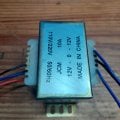
Transformer Specifications:
  • Primary Voltage: 220V / 110V
  • Secondary Voltage: 12V–0–12V
  • Secondary Current Rating: 10A

Primary Lead Color Code:
  • Black
  • Blue (center tap)
  • Red
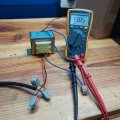
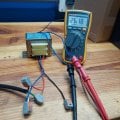
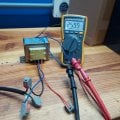
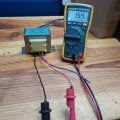
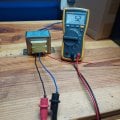
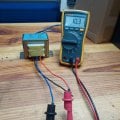
Measured DC Resistances (shown in pictures)
  • Black to Blue: 5 ohms
  • Blue to Red: 10 ohms
  • Black to Red: 15 ohms

Voltage Test:

Using a variac, I applied 110V AC between the black and blue leads first and then between read and blue leads, but I measured 26V AC across the full secondary (12V–12V terminals) in both cases, which is interesting considering the resistance between each winding segments is not the same.

I understand that even though the DC resistance differs between Blue–Black and Blue–Red leads, the number of turns must be the same to result in the same voltage ratio on both configurations. This implies that the wire gauge and winding length are likely different between the two primary sections, perhaps due to thermal or cost optimization — but I’d like to know more about the reasoning behind such a design and if there any drawbacks or any usage considerations when applying 110V — for instance, is there any reason to prefer using Blue–Black over Blue–Red, or vice versa?

Thank you in advance!
 

Attachments

Ian0

Joined Aug 7, 2020
13,097
It is designed for use on either a 110V or 220V supply, the 110V supply across black and blue, 220V supply across black and red.
The primary current would be half as much for the 220V supply. As the blue-red windings is only in use on the 220V supply, it only needs to be rated for half as much current. Winding it from thinner wire allows for thicker wire for the 110V winding, which reduces the overall losses.
 

Thread Starter

ared20

Joined Jan 9, 2023
4
It is designed for use on either a 110V or 220V supply, the 110V supply across black and blue, 220V supply across black and red.
The primary current would be half as much for the 220V supply. As the blue-red windings is only in use on the 220V supply, it only needs to be rated for half as much current. Winding it from thinner wire allows for thicker wire for the 110V winding, which reduces the overall losses.
Thank you, it makes sense now. Since you are only supposed to use the blue-red section in 220V, the current will be half and thinner wire is used to reduce costs.
 

Ian0

Joined Aug 7, 2020
13,097
Thank you, it makes sense now. Since you are only supposed to use the blue-red section in 220V, the current will be half and thinner wire is used to reduce costs.
Actually it doesn't reduce costs, because the wire still fills the bobbin, so there is the same amount of copper.
But it does mean you could get the same power from a smaller frame size.
It is even more efficient to have two identical windings which are connected either in series or in parallel, but that requires four terminals not three and a more complicated switching arrangement,
 

Thread Starter

ared20

Joined Jan 9, 2023
4
Actually it doesn't reduce costs, because the wire still fills the bobbin, so there is the same amount of copper.
But it does mean you could get the same power from a smaller frame size.
It is even more efficient to have two identical windings which are connected either in series or in parallel, but that requires four terminals not three and a more complicated switching arrangement,

Thanks again for your response. I understand your point, but I still think cost optimization might have played a role in this design.

If both halves of the primary (from blue to black, and from blue to red) need to produce the same number of turns, but only one half is expected to handle half the current, it makes sense to use a thinner (and therefore cheaper) wire on that section. Thinner wire also requires less copper length to achieve the same number of turns because it can be wound more tightly, which further reduces material use and space.

So from my perspective, the section between blue and red could have been designed with smaller gauge wire intentionally, since it's expected to carry lower current, ultimately lowering the cost and size of the winding.
 

Ian0

Joined Aug 7, 2020
13,097
The 5Ω winding would take two thirds of the space on the bobbin and the 10Ω winding would take a third.
With two identical windings, each taking up half the space, each would have a resistance of 6.67Ω.
For 220V operation the total resistance is reduced from 15Ω to 13.3Ω, and for 110V operation, it reduces from 5Ω to 3.75Ω, so the power capacity could be increased. It is also easier for the winding machine to use two gauges of wire instead of three.
So, I think, it is to reduce the complexity of the switching.
 

MisterBill2

Joined Jan 23, 2018
27,180
It appears that the number of turns is the same and so the ratio remains the same, exactly as has been stated. There is another explanation, which applies to the constant voltage transformers, which is that the transformer core is driven far into saturation, so that as the supply voltage changes over some range, the secondary voltage stays constant. The secondary voltage is still a bit dependent on the load current, but it remains constant as the input changes.
 

Ian0

Joined Aug 7, 2020
13,097
It appears that the number of turns is the same and so the ratio remains the same, exactly as has been stated. There is another explanation, which applies to the constant voltage transformers, which is that the transformer core is driven far into saturation, so that as the supply voltage changes over some range, the secondary voltage stays constant. The secondary voltage is still a bit dependent on the load current, but it remains constant as the input changes.
I've seen that done for really small transformers (2VA and lower), and they do run hot. With a 15Ω winding resistance on 220V and effectively no inductance (because of saturation), it would be molten.
 

MisterBill2

Joined Jan 23, 2018
27,180
The older SOLA brand of "constant voltage" transformers use a capacitor to resonate at the mains frequency. So they are not at all universal, and may suffer terribly when used with an engine-driven "emergency power" generator that does not hold the specified frequency very closely. There are some newer ones that seem to use a different scheme, I have not investigated them.
 

Thread Starter

ared20

Joined Jan 9, 2023
4
The 5Ω winding would take two thirds of the space on the bobbin and the 10Ω winding would take a third.
With two identical windings, each taking up half the space, each would have a resistance of 6.67Ω.
For 220V operation the total resistance is reduced from 15Ω to 13.3Ω, and for 110V operation, it reduces from 5Ω to 3.75Ω, so the power capacity could be increased. It is also easier for the winding machine to use two gauges of wire instead of three.
So, I think, it is to reduce the complexity of the switching.
Sounds good. How were you able to calculate the 6.67Ω value? Are there any books that you recommend about transformer construction?
 

Ian0

Joined Aug 7, 2020
13,097
Assume that the 10Ω winding has the same number of turns as the 5Ω and each turn is half as thick. So the 10Ω winding occupies a third of the available area. A winding taking half the available area will occupy ½/⅓ times the area of the 10Ω winding so the wires will be 3/2 times the thickness, so will have a resistance of 2/3 times the 10Ω winding. It‘s not perfectly accurate as the turns get longer as they get further from the centre.
 
Top