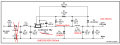
Is it OK to Step down from 800V to 24V with Emitter Follower like this?

Thread Starter

Mussawar

Joined Oct 17, 2011
157
I've around 800V dc source and want to step it down at 24V. Output requirement is max 24V 1Amp. First thought about Resistor divider but ended up with massive resistors :) . Buck convertors for such high voltage input are not easily available. I've just simulated it yet and need some good advice before practical implementation. Any other approach and recommendations are is highly appreciated.
Regards.
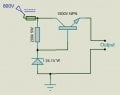
800V.jpg
 

BobTPH

Joined Jun 5, 2013
11,463
Are you serious? Drawing 800W to get 24W of output? Could work if you also needed a space heater!

A buck converter is the easiest solution, another possibility is an inverter, transformer, and rectifier.

Do you really only have 800 VDC available for power?
 

Thread Starter

Mussawar

Joined Oct 17, 2011
157
Do you really only have 800 VDC available for power?
Yes, it's true in a way.
I'm thinking of a Dynamic Brake Unit that deals with VFD's dc bus (800V dc). A separate small SMPS module can be used to power the circuity as the easiest way but it will become an additional Power supply requirement.
I'm not in a practical situation so far. The main curiosity behind the question it that how many ways we can step down such high voltage. Consider this a learning question.
Regards.
 
Last edited:

Irving

Joined Jan 30, 2016
4,996
How do you know that? I don’t see it in this thread.
It isn't - I did say 'If' as 800v is a common battery voltage for full EVs. Anyway, the TS has clarified the reason.

@Mussawar 800v -> 24v isn't practical in one step. You need a transformer isolated output to avoid any possibility, under fault conditions, of the 800v finding its way onto the low voltage circuits. This is best done with a 800v -> 380v non-isolated synchronous buck converter and then any AC-DC isolated 24v/1A integrated SMPS controller, such as the TNY278 or similar, but without the input EMI filter and bridge rectifiers of the AC design.

The reason for not doing it in one step is the need for transformer isolation. In a flyback down converter, during the MOSFET off phase, the drain pin sees a voltage spike of Vin plus the reflected voltage from the secondary x the transformer turns ratio. Assuming a duty cycle of around 30%, the turns ratio would be typically around 15:1, giving a voltage spike of 800 + 24 x 15 = 1160v requiring a 1500v MOSFET; these don't come cheap!

If you fancy a go I can sketch something out for you...
 

schmitt trigger

Joined Jul 12, 2010
2,027
As Irving has mentioned, a dual conversion topology would be the optimal approach.
There are plenty of off-the shelf solutions to convert from 380 to 12V. The real challenge will be in the 800 to 380V stage. Although with the increased population of EVs, I am sure nowadays that there is an increase in the availability of HVDC solutions.
 

Thread Starter

Mussawar

Joined Oct 17, 2011
157
It isn't - I did say 'If' as 800v is a common battery voltage for full EVs. Anyway, the TS has clarified the reason.

@Mussawar 800v -> 24v isn't practical in one step. You need a transformer isolated output to avoid any possibility, under fault conditions, of the 800v finding its way onto the low voltage circuits. This is best done with a 800v -> 380v non-isolated synchronous buck converter and then any AC-DC isolated 24v/1A integrated SMPS controller, such as the TNY278 or similar, but without the input EMI filter and bridge rectifiers of the AC design.

The reason for not doing it in one step is the need for transformer isolation. In a flyback down converter, during the MOSFET off phase, the drain pin sees a voltage spike of Vin plus the reflected voltage from the secondary x the transformer turns ratio. Assuming a duty cycle of around 30%, the turns ratio would be typically around 15:1, giving a voltage spike of 800 + 24 x 15 = 1160v requiring a 1500v MOSFET; these don't come cheap!

If you fancy a go I can sketch something out for you...
Thanks for this good reply. After going through all the answers, it became obvious that converting 800v to 24v in one step is not suitable and safe by any means.
As I think and @schmitt trigger also pointed, higher conversion stage (800v to 380v) would me more challenging than the lower one. It would be nice if you could provide a drawing. Although currently I'm out station (in another country), and test bench not available right now for practical but any relevant drawing would be great not only for me but also for many others.
Regards.
 

crutschow

Joined Mar 14, 2008
38,316
If its for a full EV, the 12v auxiliary battery is often quite puny as it doesn't have to power a starter motor.
Which ones?
My Hyundai Ioniq 5 had a size H5 battery with >500CCA (not needed of course), and a 60Ah capacity, not that different from many ICE powered cars.
 
Last edited:

ronsimpson

Joined Oct 7, 2019
4,646
Dealing with 800V is difficult. Using a flyback supply increases the need for high voltage MOSFETs. (1500V)
Here is something I have done. The LMK3296 has a 900V MOSFET inside. Only good for 360mA. (I know that is not enough) In this buck application the MOSFET sees only 801 volts.
Diode needs to be fast 1000V 1A. Like the old UF4007. Use a higher current L1. Change R3 for higher voltage. R5 probably should be increased 2X.
This is not isolated!
1773249851606.png
The data sheet for this part is hard to find. The company makes downloading it hard. If you can't get it, I could attach my copy.
--------------------------------------------------------
Here is a new thought. While I have never used this part above 12V, I think it could make a much higher voltage.
It could make 72V at 300mA. Then use a simple Buck to reduce the voltage to 1/3 at 3x the current.
 

MisterBill2

Joined Jan 23, 2018
27,164
How do you know that? I don’t see it in this thread.
THERE ARE HUGEamounts of knowledge not connected with these threads!! E.V.s are well known to have 800 volt battery packs in some models and versions.
BUT in this case I see it is in a VSD system. My choice would be a step-down inverter with a transformer, using PWM regulation. It could operate at several kilohetrtz so to avoid a heavy transformer. I suggestthat because transformers are a "very mature technology" with both products and information widely available, at least in my part of the world.
 

Thread Starter

Mussawar

Joined Oct 17, 2011
157
Dealing with 800V is difficult. Using a flyback supply increases the need for high voltage MOSFETs. (1500V)
Here is something I have done. The LMK3296 has a 900V MOSFET inside. Only good for 360mA. (I know that is not enough) In this buck application the MOSFET sees only 801 volts.
Diode needs to be fast 1000V 1A. Like the old UF4007. Use a higher current L1. Change R3 for higher voltage. R5 probably should be increased 2X.
This is not isolated!
View attachment 364551
The data sheet for this part is hard to find. The company makes downloading it hard. If you can't get it, I could attach my copy.
--------------------------------------------------------
Here is a new thought. While I have never used this part above 12V, I think it could make a much higher voltage.
It could make 72V at 300mA. Then use a simple Buck to reduce the voltage to 1/3 at 3x the current.
Thanks for reply.
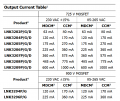
I've found a good and detailed datasheet here even with some PCB layouts. LNK3296 seems suitable for low current with 900v MOSFET for this application.
Untitled.png
I design in Proteus. It doesn't have LNK3296 but I found a model at snapEDA which can be imported in Proteus. I will try to simulate it with different part values. Any practical details about L1?
Again thanks for your precious time.
Regards.
 
Last edited:

AnalogKid

Joined Aug 1, 2013
12,043
Power conversion is a.l.l. about them little magnets.

A forward converter is way more complex than a simple buck regulator, even one with a very high voltage input and relatively small duty cycle. One-off switch-mode magnetics are not for the weak of heart (or newbs).

I know this increases the overall complexity, but consider a two-stage system. First is a fixed ratio buck or hysteretic converter to take the 800 V down to something more commercial like 300 V. Second is something like a Power Integrations part to provide a regulated low voltage output. Several of their converters have catalog standard transformers available.

ak
 
Last edited:

ronsimpson

Joined Oct 7, 2019
4,646
I design in Proteus.
Power Integrations has or maybe had good software. I have not used it in years. But they have software where you fill in the data and it hands you the design. Now days I get lost in the web information. It is no longer clear.

but consider a two-stage system.
Then use a simple Buck to reduce the voltage to 1/3 at 3x the current.
There are two of us thinking two stages.
220Vac rectified and filtered makes 300V. There are 100s of designs for 220Vac to 24V 1A "wall-wort".
A 300Vdc @ 100mA to 24Vdc @1A supply is easy and most are isolated. Power Int. has many designs for you.
We need an 800V to 300V @ 0.1A buck. Use the LNK3296 or 3294, should do that job. You could just fix a 40% duty cycle and no regulation. Let the second state do that. Most of the small supply designs will work from 120 to 240. Most of mine will do 100 to 285Vac.
I would not do fixed duty cycle because I like current limit in all supplies.
 
Last edited:
Top