Winding Space for a Bobin and Required Winding Space for Calculated Windings

Thread Starter

__mr_harsh_patel

Joined Jul 14, 2024
9
Hey There , I am working on a step down transformer from say 270V to 16V . I have designed the transformer windings, guage bobinsize and all that. Now I am confused about the winding space in the bobin and winding space i will require for the windings.
I am using the F-15 Stamping and 1 * 1 inch bobin . Please help me out with the formulas of the winding space and how to measure it.
 

MrAl

Joined Jun 17, 2014
13,667
Hey There , I am working on a step down transformer from say 270V to 16V . I have designed the transformer windings, guage bobinsize and all that. Now I am confused about the winding space in the bobin and winding space i will require for the windings.
I am using the F-15 Stamping and 1 * 1 inch bobin . Please help me out with the formulas of the winding space and how to measure it.
Hi,

There are various approximations you can apply to this problem starting with concentric circles, then Archemedes spirals. They give a good picture of what is happening on that bobbin.

However, I find that intersecting circles is the best way to go because layers do not lay on top of each other in an order that puts one wire immediately on top of the other. Instead, the second layer would end up having each wire diameter sit partly lower than the thickness of one wire diameter because each turn end up sitting slightly between two turns under it because the wires are normally of round cross section. This means you can use intersecting circles to find out how the second layer turns fit onto the first layer turns, then how the third layer turns fit onto the second layer turns, etc. This kind of also means that if the first layer had N turns, the second layer would have N-1 turns unless the first layer did not fit exactly across the entire width of the bobbin (remember we are dealing with integer turns for the most part of the winding).

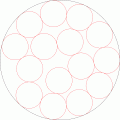
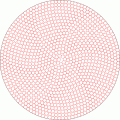
I believe there are approximations that are simpler for bobbins with rectangular cross sections, but for round cross sections I am not sure. I have provided three drawings that show how the windings sit wound in a toroid core window. These drawings are all theoretical of course, and made using the geometry of intersecting circles on a 2d surface where they are packed close.

A couple other things to note is the enamel insulation which adds to the diameter of the wire, and the bobbin material thickness, and there should be places where the layer is just one or more layers of high temperature tape. You have to keep in mind that if you had one layer that had 1v on one of the windings by the time a second layer turn ended up immediately on top of the lower layer turn the second layer turn may have 1000v on it at that point, meaning two wires right next to each other would have a voltage differential of 999 volts. A layer of tape prevents that from happening and gives the wires room to expand inside the bobbin.

All of this should give you some way to approach this although you still have to do the math. The best bet though is to estimate and leave a little wiggle room, then test it to make sure it works as expected.

The drawings show windings of 15 turns, 1080 turns, and 4328 turns inside a toroid that fill the entire round window area. There are no tape layers for these though and a real construction would have some layers of tape added, including around the bare core itself.
I can't believe I made these drawings over 20 years ago :)
 

Attachments

Last edited:
Top