Facebook
 Google
 GitHub
 Linkedin

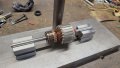
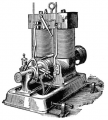
I intend to repurpose the motor armature pictured for the construction of a miniature Edison dynamo.
The only difficulty I am encountering is the requisite math for determining the size, length and number of turns of wire needed to form each of the field poles.
The armature was removed from a damaged vacuum cleaner motor. It was the universal type, being series wound for 120 volts, having a nameplate current of 7 amps and having 71 turns of wire around each field pole for approximately 500 ampere-turns. It presumably ran at several thousand RPMs.
I wish to derive 125 volts from the finished dynamo armature, and I wish to have the field poles shunt wound for slightly less than that (i.e. 90 volts) so I can regulate the armature voltage via PWM or rheostat. I would prefer to run the dynamo within the 1750-3500 RPM range by belting it to a small 4-pole induction motor.
Can someone point me in the right direction?
The only difficulty I am encountering is the requisite math for determining the size, length and number of turns of wire needed to form each of the field poles.
The armature was removed from a damaged vacuum cleaner motor. It was the universal type, being series wound for 120 volts, having a nameplate current of 7 amps and having 71 turns of wire around each field pole for approximately 500 ampere-turns. It presumably ran at several thousand RPMs.
I wish to derive 125 volts from the finished dynamo armature, and I wish to have the field poles shunt wound for slightly less than that (i.e. 90 volts) so I can regulate the armature voltage via PWM or rheostat. I would prefer to run the dynamo within the 1750-3500 RPM range by belting it to a small 4-pole induction motor.
Can someone point me in the right direction?