RC circuit give a 1 sec delay

Thread Starter

Gouthama Priyan

Joined Jul 27, 2018
50
Hello @Crutshow,
i would like to ask you certain details regarding the bjt delay circuit u have posted,
because im actually in need of a simple delay circuit which could delay on by around 1.6 secs, receiving signal from ECU
can you use the delay signal for variable dc voltage source??? the voltage from ECU is varied from 12-24v

MOD: Created TS new Thread, this is the link to the old Thread.

https://forum.allaboutcircuits.com/...rcuit-give-a-1-sec-delay.124999/#post-1009439
 
Last edited by a moderator:

Thread Starter

Gouthama Priyan

Joined Jul 27, 2018
50
ohhhh thats good then, preferably to make an delay independent of the voltage
because for me the voltage source is ECU, I'm suspecting some fault in sensor due to lack of delay, thats why wanted to check adding delay does it completely solves the problem
i have done with micro controller as well adding delay. But wanted to check adding delay without micro controller and check the response as well.
So to make the delay circuit independent of voltage what should be the changes made in the prescribed circuit.
 

Thread Starter

Gouthama Priyan

Joined Jul 27, 2018
50
This is with Timer right. I wanted to check on automotive platform. this increases the components and size of PCB board, possibly hectic to place within, that's why preferring an simple circuit which could help in checking the problem whether it is due to delay or not.
Actually i wanted to add some delay without micro controller, since I'm uncertain whether the problem caused is particularly due to delay or not.
Anyways thanks for sharing your thought!! that too clear enough with the response as well.
 

Bordodynov

Joined May 20, 2015
3,431
If you use elements for surface mounting, then everything can be placed on a square PCB with a side of 10mm. This timer I used to get a delay of 11 seconds.
 

Thread Starter

Gouthama Priyan

Joined Jul 27, 2018
50
If you use elements for surface mounting, then everything can be placed on a square PCB with a side of 10mm. This timer I used to get a delay of 11 seconds.
Actually its a process of evaluating an error in the developed sensor,which itself is about 25mm size, so to test whether delay is the required modification 10mm will be too much. That's why interested in a small simple delay circuit my delay requirement is just 1-2 secs.
 

Thread Starter

Gouthama Priyan

Joined Jul 27, 2018
50
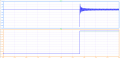
Crutschow great work!!! exactly this 1% variation for 12 to 24V is what is very good.
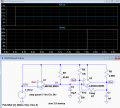
Here delay is caused by R1 and C1, which delays and gives the required threshold for the first MOSFET 2N7000 which out produce the output with the delayed interval, why is the additional MOSFET and other components?
Could you give some explanation regarding their functioning for the delay circuit. Is it for additional purpose or mandatory?
BTW, which software are you using to test these circuits?
 

crutschow

Joined Mar 14, 2008
38,509
why is the additional MOSFET and other components?
The second MOSFET is to invert the signal so that the output goes high at the end of the delay.
The first MOSFET output (drain terminal) starts high and goes low after the delay.

The zener D1 clamps the input voltage at 5.1V so that the RC delay is largely independent of the input voltage.

C2 eliminates a very short glitch that occurs when the input goes high. If that's not a problem in the system, then it can be eliminated.
BTW, which software are you using to test these circuits?
It's the free LTspice software download from Analog Devices.
It's one of the best free Spice simulation programs available. It has a somewhat steep learning curve, but the tutorials and example circuits help the process.
Several on these forums use it.
 
Last edited:

crutschow

Joined Mar 14, 2008
38,509
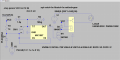
Another alternate delay circuit using only one IC, five resistors, and two capacitors, that has only about a 0.1% variation in delay time for the input voltage change.

R5 and C2 determine the delay time.

U1 provides a fast discharge of C2 when ECU goes to zero.

upload_2018-7-29_11-47-43.png
 
Last edited:

Thread Starter

Gouthama Priyan

Joined Jul 27, 2018
50
P
The second MOSFET is to invert the signal so that the output goes high at the end of the delay.
The first MOSFET output (drain terminal) starts high and goes low after the delay.

The zener D1 clamps the input voltage at 5.1V so that the RC delay is largely independent of the input voltage.

C2 eliminates a very short glitch that occurs when the input goes high. If that's not a problem in the system, then it can be eliminated.
It's the free LTspice software download from Analog Devices.
It's one of the best free Spice simulation programs available. It has a somewhat steep learning curve, but the tutorials and example circuits help the process.
Several on these forums use it.
Perfect Crutschow. Now the circuit is crystal clear about its functionality. I couldnt get proper time plots on multisim platform, that's why were asking which platform are you using to perform these simulations. Thanks for your kind and clear explanations.
 

Bordodynov

Joined May 20, 2015
3,431
Thanks for the circuit Bordodynov, could you come up with a brief explanations about the functionality of the circuit.
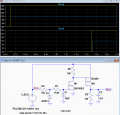
The first transistor performs the function of a comparator. Resistors R1 and R2 are voltage dividers and determine the switching threshold of the comparator (transistor). The second transistor amplifies the current and is the controlling device for the relay winding (do not forget to shunt the relay winding with a diode). The additional diode D1 introduces hysteresis, i.e. sharpens switching.
 

Thread Starter

Gouthama Priyan

Joined Jul 27, 2018
50
The first transistor performs the function of a comparator. Resistors R1 and R2 are voltage dividers and determine the switching threshold of the comparator (transistor). The second transistor amplifies the current and is the controlling device for the relay winding (do not forget to shunt the relay winding with a diode). The additional diode D1 introduces hysteresis, i.e. sharpens switching.
Bordodynov, here you have mentioned about the switching and controlling, btw our main goal is about delay na.
in what manner this circuit controls the delay and switching and control of delay is not mentioned about.
That was the area which was looked for explanation.
 

Bordodynov

Joined May 20, 2015
3,431
Bordodynov, here you have mentioned about the switching and controlling, btw our main goal is about delay na.
in what manner this circuit controls the delay and switching and control of delay is not mentioned about.
That was the area which was looked for explanation.
Good.
At the initial time (before the supply voltage is applied), the capacitor is discharged. When the power was applied, the first transistor is open. The capacitor is charged via a high-resistance resistor. The transistor starts to turn on when the voltage on the capacitor is 1/3VCC+0.5V. Then the second transistor starts to turn on. The voltage on the relay increases and when the voltage reaches 1/3VCC+1V, the diode opens and the voltage on the relay rises quickly to the supply voltage (minus the voltage drop across the output transistor).
Delay~ RCln(VCC/(2/3VCC-1V))
 
Last edited:
Top