R15 Voltage

Thread Starter

Panacea_25

Joined Jun 13, 2025
6
Hello,
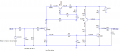
I have a circuit for which I have both a simulation and a Mathcad calculation. The circuit is designed so that the output signal (UFB_Diag) should be low (<50 mV) when the input voltage EX_in is greater than or equal to 9 V.
Currently, I rely on simulation to estimate the voltage drop across R15 and use this value in my calculations to make sense of the circuit’s operation across a temperature range of -50°C to 150°C (corresponding to an EX_in range of 2.6–8.3 V). The actual operating range is -40°C to 105°C (EX_in between 4–8.5 V).

My goal:
I want to adjust the circuit so that the threshold range for EX_in is 5.5–8.5 V for the operating temperature range of -40°C to 105°C.

Fixed parameters:
  1. R16 = 3.3 kΩ
  2. V_BE = 0.62 V for BC846BPN-QX at 30°C
  3. R8 = 4.7 kΩ
  4. R13 = 15 kΩ

Questions:
  • How can I derive a formula or expression for the threshold condition (when UFB_Diag goes low) in terms of EX_in, using the above parameters?
  • Is it possible to analytically calculate the threshold (EX_in) at which UFB_Diag goes low, or is simulation the only practical approach due to circuit complexity?
  • Can someone explain the roles of R9, R14, R15, and R13 in the circuit, and how they influence the threshold and current measurement?
  • What changes to the resistance or capacitance values would help shift the operating range to my desired threshold (5.5–8.5 V for -40°C to 105°C)?
Any formulas, explanations, or step-by-step guidance would be greatly appreciated to help me better understand the circuit and make the necessary adjustments.

Additional context:

  • The BC846BPN-QX is a dual NPN/PNP transistor with V_BE ≈ 0.62 V at 30°C, and is rated for operation from -55°C to +150°C.
  • I am using simulation tools to estimate voltage drops and circuit behavior, but would prefer to have an analytical understanding if possible.
Thank you!
 

Attachments

Thread Starter

Panacea_25

Joined Jun 13, 2025
6
Yes my task is to better an already implemented circuit. I cannot change the circuit just use other values of resistors. Thus BJT cannot be replaced or changes due to design relevance
 

Ian0

Joined Aug 7, 2020
13,131
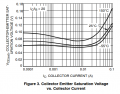
So how do you expect to achieve that 50mV target when the Vce(Sat) of the transistor is never less than 55mV at any collector current and any temperature?
Screenshot from 2025-06-13 17-23-07.png
Seems like a lost cause to me.
Yes my task is to better an already implemented circuit. I cannot change the circuit just use other values of resistors. Thus BJT cannot be replaced or changes due to design relevance
Where did these stupid requirements come from?
 

Thread Starter

Panacea_25

Joined Jun 13, 2025
6
have you simulated the circuit i provided. Because the simulation UFB_Diag value is 15 mV and in practice also i have measured 30 mV.
This requirement is due to new requirement of an already released Product. They found on field that it is causing problem at high temperature, thus require to improve circuits temperature response.
 

Ian0

Joined Aug 7, 2020
13,131
have you simulated the circuit i provided.
No - I looked in the datasheet. The simulation will probably give you the result for a typical device. When you buy devices, you are not supplied typical devices, you are supplied devices that can be anywhere between minimum and maximum.
The datasheet will give you the facts.
This requirement is due to new requirement of an already released Product. They found on field that it is causing problem at high temperature, thus require to improve circuits temperature response.
I'm not surprised. There is no temperature compensation. You can fiddle with the resistor values until the cows come home, but it always going to vary with temperature by about 10mV/°C, or 1.5V over your specified temperature range.
Why is there no supply to Q1 collector apart from the brief moment as the circuit starts up? (Q3 turns off as soon as C1 charges up)
 

Thread Starter

Panacea_25

Joined Jun 13, 2025
6
The short circuit has to be detected as soon as the device is ON. When device is ON 7.8 V is system generated and will be provided and if EX_in >= 9V, then UFB_Diag should be low and an error has to be detected. Sorry, High can be defined as 7.8 V and low can be 1V. As UFB_Diag is a signal further connected to microcontroller, range can be adjusted.
 

Irving

Joined Jan 30, 2016
5,120
I am using simulation tools to estimate voltage drops and circuit behavior, but would prefer to have an analytical understanding if possible.
As has already been said, you cannot have an analytical solution to a random physical attribute.

What you can do is use the simulation to predict results by randomly assigning values to all components within their temperature and tolerance boundaries (Monte-Carlo analysis) and, after a few thousand or more simulations, from that predict what values of the components are acceptable and then pre-select them prior to manufacture.; Its not perfect but it'll get you closer to a solution. The alternative is to 100% test all manufactured devices under failure conditions to weed out those that will have problems in the field.
 

Thread Starter

Panacea_25

Joined Jun 13, 2025
6
As has already been said, you cannot have an analytical solution to a random physical attribute.

What you can do is use the simulation to predict results by randomly assigning values to all components within their temperature and tolerance boundaries (Monte-Carlo analysis) and, after a few thousand or more simulations, from that predict what values of the components are acceptable and then pre-select them prior to manufacture.; Its not perfect but it'll get you closer to a solution. The alternative is to 100% test all manufactured devices under failure conditions to weed out those that will have problems in the field.
This circuit is my best simulation result. Hence shared, i wanted to know if there is any scope for improvement or this is the best solution to this issue.
 

MisterBill2

Joined Jan 23, 2018
27,514
Since the TS did not provide the circuit in a format other than a simulator file, there is no way I can see the circuit. NOT ALL FOLKS USE THAT SIMULATOR!!! Which, by the way, is at best sort of OK.
 

MisterBill2

Joined Jan 23, 2018
27,514
It would be very interesting to see an attempt at an explanation as to how that circuit, finally shown in post #12, actually functions.
Also, given that it includes an external voltage source of 7.8 volts, a hint as to how that voltage would be supplied in a real world application.
AND, Thank You to Crutschow, for posting the actual schematic. (My good simulator is still on that lightning damaged computer, along with my good CAD software.)
 

MisterBill2

Joined Jan 23, 2018
27,514
Now for my questions: What is the purpose of the circuit?? What is that monitored power source??
A much simpler and much easier to understand circuit providing a similar function will be an adaption of the CLASSIC "CROWBAR" circuit used for protection of devices powered by (usually) a regulated power supply.
 

AnalogKid

Joined Aug 1, 2013
12,129
Yes my task is to better an already implemented circuit. I cannot change the circuit just use other values of resistors. Thus BJT cannot be replaced or changes due to design relevance
This greatly restricts the range of solutions we can suggest. To help us better understand the circuit, please explain the function of Q3 and its associated components.

ak
 
Top