Questions about 8 pin RGBW power LEDs

ArakelTheDragon

Joined Nov 18, 2016
1,366
Why can it not work without a heat sink? If you do put a heat sink, thermal paste is mandatory. Use a phone charger to supply the voltage. Even an old phone charger at 5V, 500mA or 1A will do.
 
You have not made your goals clear. I think you want to make two different devices, one a reasonably sized flashlight with one of your RGBW LEDs and a separate, much larger unit with 10 of them.

First, since you are buying in units of 10, why not make the second one use only 9--1 for the small one and 9 for the larger one?

Second, you have not indicated what degree of color control you want--any one of four colors or a variable range from one end to the other. That gets a lot more complex.

Third, I don't see how you are going to power the large unit and still have it easily portable.

Please give us more specific info on your goals.
 

RichardO

Joined May 4, 2013
2,270
So how necessary is a heat sink when they are being operated at full power, and would a random steel washer or bolt suffice? I really don't want to spend too much
Steel is a *very* poor conductor of heat -- not much better than no heat sink.

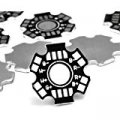
Your link claims that the LED is rated for 4 watts maximum. The only way this is possible is if there is a metal pad on the bottom of the LED and that pad is thermally connected to a large aluminum heat sink. By "large", I mean a heat sink with less than 10 degC per watt thermal resistance.
 

Thread Starter

-live wire-

Joined Dec 22, 2017
959
You have not made your goals clear. I think you want to make two different devices, one a reasonably sized flashlight with one of your RGBW LEDs and a separate, much larger unit with 10 of them.

First, since you are buying in units of 10, why not make the second one use only 9--1 for the small one and 9 for the larger one?

Second, you have not indicated what degree of color control you want--any one of four colors or a variable range from one end to the other. That gets a lot more complex.

Third, I don't see how you are going to power the large unit and still have it easily portable.

Please give us more specific info on your goals.
I want to control them both with an arduino nano (I have a few and am very familiar with coding them). The USB one would incorporate other sensors and a few micro servos, so I don't think a PSOC makes sense, as others have suggested. I know 9-1 would make more sense, but I would like to have a few multicolor power LEDs laying around that I could use for future projects anyways. For both of them, I want to be able to control all 4 colors independently through the microcontroller. There would be some buttons and stuff as inputs. So that means I would need 4 mosfets.

I know with all the heat sinks and the large battery it will not be the most portable. But I want a very bright RGBW flashlight that is customizable.

Steel is a *very* poor conductor of heat -- not much better than no heat sink.

Your link claims that the LED is rated for 4 watts maximum. The only way this is possible is if there is a metal pad on the bottom of the LED and that pad is thermally connected to a large aluminum heat sink. By "large", I mean a heat sink with less than 10 degC per watt thermal resistance.
Would these heat sinks, with thermal paste, not suffice then?
 

danadak

Joined Mar 10, 2018
4,057
The USB one would incorporate other sensors and a few micro servos, so I don't think a PSOC makes sense, as others have suggested. I know 9-1 would make more sense, but I would like to have a few multicolor power LEDs laying around that I could use for future projects anyways. For both of them, I want to be able to control all 4 colors independently through the microcontroller. There would be some buttons and stuff as inputs. So that means I would need 4 mosfets.
PSOC 5LP has USB for starters. Plenty of PWMs to control servos. How many do you need to control ?
Virtually all analog needed to handle sensors, including the com interfaces like SPI, One Wire, I2C. All
on one chip. And not to forget capsense to handle buttons, sliders.....also onchip.

http://www.cypress.com/documentatio...d-psoc-5lp-introduction-implementing-usb-data

AN49943 - PSoC® 1 USB-to-UART Bridge02/19/2018
AN57294 - USB 101: An Introduction to Universal Serial Bus 2.007/14/2017
AN57473 - USB HID Basics with PSoC® 3 and PSoC 5LP04/27/2017
AN58726 - USB HID Intermediate with PSoC® 3 and PSoC 5LP05/04/2017
AN73503 - PSoC® USB HID Bootloader08/01/2017
AN82072 - PSoC 3 and PSoC 5LP USB General Data Transfer with Standard HID Drivers05/11/2017

Attached, a list of components onchip PSOC. A component is a HW resource
onchip.


Regards, Dana.
 

Attachments

Thread Starter

-live wire-

Joined Dec 22, 2017
959
PSOC 5LP has USB for starters. Plenty of PWMs to control servos. How many do you need to control ?
Virtually all analog needed to handle sensors, including the com interfaces like SPI, One Wire, I2C. All
on one chip. And not to forget capsense to handle buttons, sliders.....also onchip.

http://www.cypress.com/documentatio...d-psoc-5lp-introduction-implementing-usb-data

AN49943 - PSoC® 1 USB-to-UART Bridge02/19/2018
AN57294 - USB 101: An Introduction to Universal Serial Bus 2.007/14/2017
AN57473 - USB HID Basics with PSoC® 3 and PSoC 5LP04/27/2017
AN58726 - USB HID Intermediate with PSoC® 3 and PSoC 5LP05/04/2017
AN73503 - PSoC® USB HID Bootloader08/01/2017
AN82072 - PSoC 3 and PSoC 5LP USB General Data Transfer with Standard HID Drivers05/11/2017

Attached, a list of components onchip PSOC. A component is a HW resource
onchip.


Regards, Dana.
I already have some arduino nanos and I am very familiar with them. I know that PSOCs may be faster and may have a better ADC, but I don't really see why they would be necessary here.
 

danadak

Joined Mar 10, 2018
4,057
Definitely stick with Arduino. If you find you need a bunch of external
components, non passive, then take another look at PSOC, otherwise
go with your experience.

Regards, Dana.
 

Thread Starter

-live wire-

Joined Dec 22, 2017
959
I don't see the thermal resistance specified in you link -- Do you? If not then the answer is obviously, no.

Never, ever, try to use a part that does not have complete specifications.
So what you're saying is I can't get away with smaller, cheaper heatsinks? :(
 

Reloadron

Joined Jan 15, 2015
7,908
These are your LEDs. You may want to take note where they mention "
Chanzon 10 pcs High Power Led Chip 4W RGBW 8 pins (300mA-350mA for Each Color 4 Watt) Multicolor Super Bright Intensity SMD COB Light Emitter Components Diode 4 W Bulb Lamp Beads DIY Lighting.
That's 4 Watt per color so if you run more than a single color you exceed 4 watts.

Ron
 

ebeowulf17

Joined Aug 12, 2014
3,307
These are your LEDs. You may want to take note where they mention "
Chanzon 10 pcs High Power Led Chip 4W RGBW 8 pins (300mA-350mA for Each Color 4 Watt) Multicolor Super Bright Intensity SMD COB Light Emitter Components Diode 4 W Bulb Lamp Beads DIY Lighting.
That's 4 Watt per color so if you run more than a single color you exceed 4 watts.

Ron
Are you sure? It lists Vf ranges per color around 1.8-3.2V. Multiply that by 300mA and you get ~1W per color, or <4W total.
 

RichardO

Joined May 4, 2013
2,270
I know it's a different color, but it's still about the same dimensions and 4W to dissipate is still 4W. And in the reviews, people said they worked well with the RGBW LEDs.
The so-called specifications are nonsensical. For one thing, it is *not* really a heat sink. It is a heat spreader intended to be mounted to a heat sink. There is absolutely no way this small surface can dissipate several watts. Again, physics gets in the way.
 
Top