Questions about 8 pin RGBW power LEDs

ebeowulf17

Joined Aug 12, 2014
3,307
As a simple demonstration for the non-believers, add 50C plus 50C. It's pretty obvious that the result will be 100C...

But if you use the online conversions as quoted earlier, you might be tempted to convert each 50C into 122F. So 50+50C becomes 122+122F = 244F. Now convert 244F back to C with your online calculator and you get 117.78C.

Obviously 100C is not the same as 117.78C, so there's a problem with this method.

The problem is that the formula the online calculators use, F = (C * 1.8) + 32, is for absolute temperatures, not temperature changes. For temperature changes, F = C * 1.8, with no additional constant.

So, back to our 50 + 50 example, one 50 is the actual temperature, so it uses the original formula and becomes 122F. The other 50 represents a temperature change, so it uses the second formula and becomes 90F. 122 + 90 = 212F, which of course converts directly back to 100C (the correct answer.)
 

Audioguru

Joined Dec 20, 2007
11,248
Did somebody say, "90 degrees C ambient"? That is almost the temperature of boiling water. It doesn't get that hot on Earth.
Oh, inside a parked car in the sunshine?
 

Thread Starter

-live wire-

Joined Dec 22, 2017
959
Did somebody say, "90 degrees C ambient"? That is almost the temperature of boiling water. It doesn't get that hot on Earth.
Oh, inside a parked car in the sunshine?
I don't think so. But it may become the ambient temperature if we don't put a stop to global warming. ;)
 
In post 81 the author says "For temperature changes, F = C * 1.8, with no additional constant."

Plug 100 degrees into C and get F = 180; hmmm?

Actually, F = C * 1.8 +32.

His comment about the folly of adding two converted figures is correct.
 

RichardO

Joined May 4, 2013
2,270
This heatsink says it has a thermal resistance of 6.4C/W. That should be more that enough. But given that it's a TO220 heatsink, will I actually get around that thermal conductivity?
https://www.digikey.com/product-det...oyd-corporation/504222B00000G/HS104-2-ND/5833
You might get enough dissipation *if* you can get the heat from the LED into the heat sink.

How are you going to transfer the heat from your LED to the heat sink? Are you planning on mounting your LED to the star-shaped heat spreader from your earlier post? Will the heat spreader completely fit in the heat sink?
 

ebeowulf17

Joined Aug 12, 2014
3,307
In post 81 the author says "For temperature changes, F = C * 1.8, with no additional constant."

Plug 100 degrees into C and get F = 180; hmmm?

Actually, F = C * 1.8 +32.

His comment about the folly of adding two converted figures is correct.
Perhaps my wording was unclear, but hopefully the math is. Here are a few other ways of describing it in different terms.

This is from https://www.internet4classrooms.com/F2C.htm:
  • Fahrenheit to Celsius ratio = 180 : 100 = 1.8 : 1
    This means that for every 1.8 degrees that temperature changes on the Fahrenheit scale, temperature will change 1 degree on the Celsius scale. Thus the ratio of F º to C º is 1.8 : 1
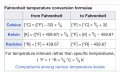
Wikipedia describes the differences as "temperature intervals"
On the Fahrenheit scale, the freezing point of water is 32 degrees Fahrenheit (°F) and the boiling point is 212 °F (at standard atmospheric pressure). This puts the boiling and freezing points of water 180 degrees apart.[6] Therefore, a degree on the Fahrenheit scale is 1⁄180 of the interval between the freezing point and the boiling point. On the Celsius scale, the freezing and boiling points of water are 100 degrees apart. A temperature interval of 1 °F is equal to an interval of 5⁄9 degrees Celsius. The Fahrenheit and Celsius scales intersect at −40° (i.e., −40 °F = −40 °C).
2C000196-6133-4DBA-9A5A-667DD5C3F21E.jpeg
 

ebeowulf17

Joined Aug 12, 2014
3,307
Plug 100 degrees into C and get F = 180; hmmm?
Yes! ...but only when you're talking about temperature intervals, or differences.

So, if you're adding 100C to an existing temperature, that's the same as adding 180F to that temperature.

If you start with 77F (which is 25C) and you add 100C to it, you need to add 180F to it, not 212F, resulting in 257F (which is 125C.)
 

Thread Starter

-live wire-

Joined Dec 22, 2017
959
You might get enough dissipation *if* you can get the heat from the LED into the heat sink.

How are you going to transfer the heat from your LED to the heat sink? Are you planning on mounting your LED to the star-shaped heat spreader from your earlier post? Will the heat spreader completely fit in the heat sink?
Will thermal paste suffice?
 

MisterBill2

Joined Jan 23, 2018
28,062
I recently found these 8 pin RGBW LEDs. It looks like a good deal. I may get them soon to use in a DIY flashlight. It's surprising that you can get them without a common gnd. So how necessary is a heat sink when they are being operated at full power, and would a random steel washer or bolt suffice? I really don't want to spend too much. Also, what is the cheapest way to drive them reliably? Is there any way to make a current source that can supply 300mA for less than the cost of an LM317 or other linear regulator? Would a BJT work, or is the gain too unreliable?
An ADEQUATE heat sink is VITAL!!! Heat can kill big LED devices in a hurry. The good news is that if you know the manufacturers name, usually they are happy to provide application information for their products, including heat sink requirements. They will also be able to tell you exactly what voltage and current they use at full output, from this you can calculate just how much heat you need to remove to limit the temperature rise to within specifications. I suggest reading the information before purchasing the devices, since often times returns are not accepted on electronics.
 

RichardO

Joined May 4, 2013
2,270
I would just mount the LED directly to the heatsink, with thermal paste or something.
"or something" isn't good enough. Give details on what you plan on doing. Not just how you will heat sink it but how you will wire it. And don't forget that you also have to deal with optics.
 

MisterBill2

Joined Jan 23, 2018
28,062
Once again I am suggesting to see what the manufacturer intends their product to work with. Often they have a quite detailed description of exactly how they get the impressive performance figures that they brag about. Like those incredibly bright LED headlights that require a very serious blower to keep from melting down. That is certainly true for LED makers. Of course, if you are purchasing a product from an unknown source then there is no clue what you are actually getting. But you will still need some serious heat removal.
 

Reloadron

Joined Jan 15, 2015
7,908
Like those incredibly bright LED headlights that require a very serious blower to keep from melting down. That is certainly true for LED makers.
A little off topic but last year I replaced the incandescent headlight and spots on my bike with LED, the ones I used are called Daymaker and they are really very bright and while they do not use a blower they have really huge heat sinks on the spots and the headlight. I love the things as they do not have the yellow cast like my old headlight and they produce a nice white light.
DOT approval, legal on the road; Power: 40W; Headlight Type: 7" round, Black inner bezel Input Voltage: DC12V~24V; Current Draw: 3A@12V,1.5A 24V LED
Like I mentioned, no fan but one heck of a heat sink. I also know there are plenty of cheap versions also called Daymaker which seem to fail pretty fast off the boat from China. Quickest way to kill a LED is high heat and no heat or inadequate heat removal.

Ron
 

MisterBill2

Joined Jan 23, 2018
28,062
A friend of mine just showed me his new LED 100Watt IR floodlight. The heat sink is similar in size to those on a gaming computer, and it has a fan built onto the heat sink. So for an LED "flashlight" a heat sink from a scrapped computer CPU might work. If the light was only on for short bursts. AND, this IR light is about an inch 1/4 diameter. A whole lot of power in a fairly small space.
 

Reloadron

Joined Jan 15, 2015
7,908
A friend of mine just showed me his new LED 100Watt IR floodlight. The heat sink is similar in size to those on a gaming computer, and it has a fan built onto the heat sink. So for an LED "flashlight" a heat sink from a scrapped computer CPU might work. If the light was only on for short bursts. AND, this IR light is about an inch 1/4 diameter. A whole lot of power in a fairly small space.
Ya know I have a few old heat sinks including fans from old Intel processors which would likely work pretty well. Now that you mention it I got to thinking about that misc. junk. Using in a flashlight would make for one large flashlight, sort of bulky.

Ron
 

MisterBill2

Joined Jan 23, 2018
28,062
A really high powered flashlight would indeed be bulky if the battery would last for very long. That very bright light does not come for free, you know. Watts delivered is always a bit less than watts consumed, with the difference being the heat that must be disposed of. You could use a 6 volt 3.5 amp-hour gell cell and have a rechargable light that was bright and only weighed a couple of pounds.

As an instance, I have a MAG brand LED flashlight that uses "D" cells, and while it is incredibly bright with fresh batteries, it uses them up quite rapidly.. So in battery powered lighting, you pay for what you get,
 
Top