question for the seasoned

Thread Starter

fredric58

Joined Nov 28, 2014
252
so with the LED connected to pin 5. when power is applied the LED will go ON. allowing me to use TRIM 1 to adjust the seconds. example: power up, time light, adjust trim, turn off and then power again, measure time to get to approx. 12 seconds?

if that is correct, THEN can I connect the LED to Q4 to test the hour portion?

thanks!
 

Alec_t

Joined Sep 17, 2013
15,119
At power-up the LED driven by pin 5 should be off. After N sec it should start turning on for N sec, off for N sec, on for N sec ...... Adjust Trim1 (starting at its mid-point setting) so that N=12. That will ensure the Q4 output will occur after ~1 hour, so you won't need to test that (but you can if you want ;), though the 10k resistor at Q4 base would result in a very dim LED indication.
 

Thread Starter

fredric58

Joined Nov 28, 2014
252
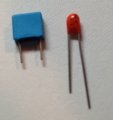
I was checking my circuitry and found I didn't understand a couple things. Not checking to be SURE in other projects resulted in smoke and that funny smell. so, I posted a pic of the caps, 100n is the blue one and the orange is 100u. you note in the design PLASTIC not electrolytic. the blue one is definitely plastic. the orange I can't be sure as it is rather small. though I do know it is NOT an electrolytic. in other instances where I use the small caps they are NOT polarity sensitive. however, like the LED's the orange one has a longer .wire. should this be of concern?

on the schematic, isolating the trim circuit. PINS 9,10 &11 of the 4060. R2 goes to 1 of the trim pot, R3 goes to 3 of the trim pot (these are the 2 pins that when put on the ohm meter and the sweeper is moved don't change) C3 goes to the sweep, WHY is the sweep connected to 1 of the trim pot???

Also, I could swap the 10k that goes to Q4 base temporarily with a 1k and a LED and test the circuit as a whole??
 

Alec_t

Joined Sep 17, 2013
15,119
The orange, 100uF cap is a tantalum type. It is VITAL that you connect it with the correct polarity or it will self-destruct, probably with a BANG! The positive side should be clearly marked with a '+' sign (but your pic is too blurred to show that). The longer lead should also indicate the positive side.
Don't disconnect the AND gates when checking at pin 5. CMOS gates (such as the AND) must neverhave their inputs 'floating', or they will give unpredictable results.
 

Thread Starter

fredric58

Joined Nov 28, 2014
252
I'm glad I checked. So...for C3. In other schematics the 2 bars that indicate a cap, usually one is curved and one straight showing pos and neg. these are both straight. will the pos connect to the 9 pin or the sweep?
 

Alec_t

Joined Sep 17, 2013
15,119
In the post #169 circuit C3 is a non-polarised 1uF cap, as shown by a symbol with two straight bars. It doesn't matter which way round you connect it. But where are you using the 100uF tantalum cap? The circuit in post #169 doesn't have a 100uF cap :confused:.
 

Thread Starter

fredric58

Joined Nov 28, 2014
252
my bad, it is a 1u not 100, I "thought" all the little ceramic and plastic caps were non polarized. kerrrrraapp. I guess I am on my way to the electronics store. what kind of cap/name should I get????
 

Thread Starter

fredric58

Joined Nov 28, 2014
252
ok, I am back with the right cap. Alec....I have to hand it to you! I set the trim pot at the half way mark as instructed and powered it up. nothing happened for THE PERFECT 11 seconds, then the LED came on for 11 seconds then off and repeats. stupendous job!!! does exactly what you said it would. I set a digital timer to remind me to come back and watch the next event that should occur at or around the hour mark. THIS is the FUN part. and I didn't burn anything up this time and learned lessons as well. a great day in my book. thanks Alec!
 

Thread Starter

fredric58

Joined Nov 28, 2014
252
well...the first part works, pin 5 to an led starts OFF 11 sec later goes ON. but an hour later nada.... timing it again. any tests I can run?
 

Thread Starter

fredric58

Joined Nov 28, 2014
252
I have let it run for 75 minutes 2 times. I am using a 330 ohm @ R4 and a LED. I have my gates set like this.
U1a: in 11,12,13-out is 10
U1b: in 3,4,5-out is 6
U1c: in 1,2,8-out is 9
PIN 7 GND
PIN 14 Vdd
also using a 330 ohm and LED on PIN 5 of the 4060. it turns on and off at 11 second intervals.
using 9v power supply
band on the diode is toward the 4060
all resistors were metered before use
NOT using PINS 7,6,14,1,3
 

Thread Starter

fredric58

Joined Nov 28, 2014
252
well....................................what I like about electronics is... it isn't forgiving. it MUST be precise. ALL rules must be followed. and you check your work over and over and over! till you find your mistake. found mine, it was a ground. didn't quite make it to an hour. however it made it to 56 minutes and 47 seconds. which is close enough for this experiment. Alec, I REALLY appreciate your mentoring. to me, to take 4.00 worth of parts and make it do something specific is fascinating. to see it WORK..... priceless. THANK YOU for all the lessons learned in this project and the previous ones.
 

Alec_t

Joined Sep 17, 2013
15,119
.what I like about electronics is... it isn't forgiving. it MUST be precise. ALL rules must be followed. and you check your work over and over and over! till you find your mistake. found mine, it was a ground.
Yes, electrons abide by the rules :). Well done in finding the solution. It's so easy to overlook a missing/wrong connection. We've all been there, done that.
 

Thread Starter

fredric58

Joined Nov 28, 2014
252
Hi Alec. I have a system failure, I think. It involves the LDR. (not the circuit itself, just the resistor), It is a cadmium sulfide type. I am not sure how it equates to the circuit but here is what happened. the LDR got wet (rained on) and looks as if it swelled up. Usually, when I turn on the project as a whole I cover the LDR with my finger and the unit will beep because the PIR takes awhile to balance. That doesn't happen now. If I plug in a new LDR and turn on the power with the LDR covered it will again beep. It will also beep if I completely disconnect the LDR and power up. If I unplug the LDR resistor completely the unit works as if there were no comparator circuit and operates on the PIR and the CLOCK ques. I can't seem to wrap my head around WHY it works without the LDR. or what could have happened to the LDR when it got wet that kills the circuit/renders it inoperable. Its like, what could possible break in an LDR? Must it be put in a water tight box with a clear glass face? Other than this every thing seems, or was working fine.
 

Thread Starter

fredric58

Joined Nov 28, 2014
252
scenario: light sensor circuit.
1. if you were to unplug the photo resistor from the circuit it will work day or night by PIR trigger or clock, believed true, by testing
2. if you were to put a jumper wire in place of the LDR the system will NOT work. ?? tried it and the system doesn't work
3. is it possible (a conclusion) that water on the base of the LDR allowing both of its contacts to connect acted as a jumper wire?
notes: the LDR did not swell, they all look like the one in question.
water had something to do with it failing to operate, now dry it seems fine.
the back of the LDR is the only component exposed to weather. (which will be fixed)
 

Alec_t

Joined Sep 17, 2013
15,119
If the LDR absorbs moisture its resistance will almost certainly drop. That is equivalent to it being exposed to light, so accounts for why the dark sensor part of the circuit failed. Shorting out the LDR with a jumper wire has the same effect.
 

Thread Starter

fredric58

Joined Nov 28, 2014
252
Hi Alec. How are things in Cardiff? Question: Is it possible that there can be continuity in a circuit and the circuit still not work? Is it possible that a solder joint could present too much resistance, causing the circuit to fail? All connections have been checked and there IS continuity. However, the pulse from the timing circuit doesn't make it to the base of B4. The PIR pulse DOES make it to the base of B4. Standalone, both circuits perform as designed.

I haven't messed with the "to Q4" connection from the timer to the light/reg circuit because I don't want to de-solder if possible.
 

Thread Starter

fredric58

Joined Nov 28, 2014
252
the answer is a definite YES! like I said, UNFORGIVING. but that is what makes it so challenging. Amazing how a solder joint can look great but there be bad or even no contact with the wire it surrounds. This is way more challenging than I thought it would be, but sure is FUN!
 
Top