I take it that you've re-soldered something and it's now working? Excellent. 'Dry' solder joints can be tricky to spot. One of Life's little challenges . All's fine here in Cardiff, thanks.
Mr. Alec, Hope all is well. Finally returned home and of course I have a question. From experience, I think you can answer. In the last experiment we added the timer. Which works very well. I made 3 and there are slight differences in each. They run at 55 minutes, 51 minutes and 57 minutes. I believe the difference may be caused by the (+-) tolerances of the other components involved????? as in a 10K resistor may actually be 9.7K just an example. would I be correct in this assumption?
Challenge I face now with the addition of the clock is power consumption, even though it isn't much. so another question/project I am considering is a very small solar panel that will charge the 9v battery during the day. from what I have gathered, lithium batteries are rechargeable? but require something called a "smart charger"
Would this be a difficult item to make? given what I have already been able to accomplish with your assistance so far? there is a box of little solar panels at my electronics outlet store. if I want to use one to charge my battery would it matter how many volts the panel puts out.
Alec, are you still alive and electronicing? I think? I found the challange....? In the schematic you presented, the PIR is in the front. meaning it runs continuously along with the dark sensor switch. However the PIR won't pulse unless it is dark because the dark sensor circuit won't allow it?. Is it a waste of energy???? in other words, which takes more power to run, the PIR, or the dark sensor circuit? SORRY, I can't stop thinking about it. I build this stuff, I test the stuff, and I think...OK, how, or what's wrong with this picture? It is simply a craving to know. "is THIS the right way"? Why isn't the dark sensor switch at the beginning? Wouldn't there be less power consumption if "NOTHING" happened until it was dark? VERSE, running the PIR along with the dark sensor circuit at the same time???? Am I wrong to think? Dark sensor switch runs....(I do NOT know how to figure power draw YET!. THEN....when it gets DARK, the PIR takes its place in the picture. as well as the CLOCK. I know for you this is a teeny project. FOR ME... it's huge. it's like my OCD analytical mind won't shut off! It's like you're the dealer, and I'm the addict! I THINK... nothing should happen unless it's DARK. and..actually, nothing does, BUT... the PIR runs and consumes power. WHAT do you think??
Not all lithium cells are rechargeable. You gathered correctly regarding those that are. Yes, it would be difficult. Visit www.batteryuniversity.com to see what the charging requirements are.
I don't know. The dark sensor takes about 1mA standby current. If the PIR takes less standby current than that (check the datasheet) there's no point in shuffling the circuit around.
Hi Alec, glad you are doing well! here's my thoughts on optimization. when turned on. the clock starts running, the PIR starts PIR'ing and the dark sensor switch starts waiting for the (hyperthiesis?) don't know how it is spelt! that allows current to go to it's respective place.....
so all (3) are drawing current. however...nothing will happen until the comparator circuit says, "it's dark, you can go now"
if the comparator circuit was to be placed in front of everything. though "minimal" would not there be less power consumption????
meaning, the dark sensor would run "alone" and at dusk/dark, it would then allow current to the clock to begin its countdown, AND allow current to the PIR to facilitate operation detected by movement?
I know we are talking fractions of amps...BUT!!! would any power be saved? anything at all?
As I said, the dark sensor draws about 1mA. So if you put that 'up front' to control power supplied to the other things then you have a constant 1mA being drawn. If the PIR draws less than 1mA then it is more power-efficient to use that (as now) to control the power. What is the PIR current draw?
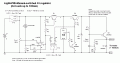
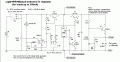
Here you go.
Note the addition of D1,D2 and that some components have been renumbered.
Since the PIR will now be powered up only during the dark period it's average current will be roughly halved.
THAT'S really cool. it will take me a while to wrap my head around it. I understand most of what is happening. however I have couple questions. "the clock"... that can still be powered and grounded with the PIR Vcc and it's ground? and its output will still go to the base of Q1?
S1 B I get that. that goes around everything and gives the regulator portion a ground, its a bypass.
S1 A completely confuses me. I just don't see it. it looks like to me that R and T go to the same place.
in a previous lesson you taught me how to go around everything directly to the 5v regulator circuitry. wherein R4 temporarily went to ground, as does this one. and the 9v+ supply temporarily went directly to the collector of Q2. which is now Q3. when in test mode.
What clock? My posted circuit doesn't have one.
S1 is a 3-throw switch having part S1a ganged with part S1b.
S1a simply connects the positive supply to the dark sensor in both the Run and Test positions, but not in the Off position.
In the Test position only, S1b connects the cathodes of diodes D1,D2 to ground. This allows base current to flow in both Q1 and Q2 via R4 and R6, thus switching on Q1 and Q2 irrespective of the state of both the dark sensor and the PIR.
your post #169 the clock....a cd 4060 along with an "AND" gate, CD4073B. to Q4 base. where you taught me that the relay circuit in the original concept, would not support an hour long delay. you stated it would require an "and" gate. which I made and referred to in a recent post. "IT", the AND GATE triggers every 51, 53, 57 minutes. I determined that the variance was attributed to the + _ tolerances of the other components. in which you agreed. when it gets DARK, the "clock" would start, along with the PIR, and every 51-57 minutes power is supplied to the PCB for 10 to 12 seconds based on the TRIM 1 of the CLOCK circuit. it would be cool to see both of them merged. but don't have the kind of software you have....the clock is a really cool circuit, and it works very well. I know I just have to take into consideration the + and - attributes of the other components. regarding their tolerances. I have also noticed that there are components with smaller variances, like 1%, but they also increase in price...
yes that's what I thought, the PIR and the clock activate the base of Q4, but only when the LDR circuit allows.
I can't find it in the threads, but you taught me how to go straight from my battery to the V reg circuit. D1 and D2 (which used to be R4) go to ground. the 9v bypassed everything and went to Q3 collector. allowing me temporary constant power to the PCB so I can work with/set it up. and then when in RUN power goes back to the LDR.
what I believe is this circuit simply by passes the LDR. I need to go straight to the regulator.
I believe this will require deleting D1 and D2, ground goes between C1 GND and REG 1 GND, and power 9v goes to Q2 collector??????
configured like this will give 5v till switched off??????

 Facebook
 Google
 GitHub
 Linkedin


 . All's fine here in Cardiff, thanks.