question for the seasoned

Thread Starter

fredric58

Joined Nov 28, 2014
252
or it can at the same time, currently in my experiment, power goes to the PCB AND....a mechanical relay used as a switch to ground the on board circuit. the PCB has power and the relay closes and it runs. now... the relay stays closed the entire time until the power goes off, that opens the contact of the relay and then the next time power is sent it cycles. in this configuration, if power goes off of course it stops, but as soon as power goes on, it starts at the beginning.in other words you can shut off the power half way through the program or after it completes, it doesn't matter when you turn it off. it restarts from beginning as soon as power is re-established. and this would be fine, except I don't know if keeping the circuit to ground the entire time will result in the PCB failure.
 

Thread Starter

fredric58

Joined Nov 28, 2014
252
btw, I have looked through this site and others for a "sleep circuit" schematic. don't think I am ready to build one but would like to familiarize my self with one, a simple one if such a thing.
 

Alec_t

Joined Sep 17, 2013
15,121
I don't know if keeping the circuit to ground the entire time will result in the PCB failure.
Well if, as you said, "the relay stays closed the entire time until the power goes off" and the PCB has survived so far, then it likely will survive in the future. But a circuit to just ground that input for a brief period would be straightforward to build.
I'm not clear what you understand by "sleep circuit"? What does it control? What starts/stops it?
 
Last edited:

Thread Starter

fredric58

Joined Nov 28, 2014
252
sleep circuit also called stand by and probably something else as well. I do not know how much power the PIR draws (when it isn't doing anything) but I am sure it draws some. so say nothing happens for a couple minutes, I would like it to go to sleep like my computer does. leaving just enough power to kick it on. miniscule power when not in operation.

and agreed, a circuit to go to ground IS easy to build. I can make it go to ground with the circuits you and others have provided. that's not my challenge though. there is SOME anomaly. wherein it has to break contact. I can't explain it "YET" but I will figure it out. it's a bugger! the transistor circuit when activated, turns it on, but the transistor has to be activated again to reset it, the when the transistor is activated again, it turns on. the PCB has a PUSH ON/PUSH OFF switch. there is something on the PCB that requires a COMPLETE disconnect as you would get with this type of switch, a momentary switch. (frustrating part) bit still a BLAST!
 

Alec_t

Joined Sep 17, 2013
15,121
I do not know how much power the PIR draws (when it isn't doing anything)
According to its datasheet (see post #67 link) the standby current is only 50uA. I wouldn't bother with a 'sleep circuit'; it might not save much current draw.
the PCB has a PUSH ON/PUSH OFF switch
Is it a latching type or a momentary action type?
 

Thread Starter

fredric58

Joined Nov 28, 2014
252
momentary action type. and it is that complete disconnect that appears to be the key, says that with a ? mark. I saw an example, I will look for in which a shaker switch was used and it over rode the start stop. I don't know if it will be helpful but it may have clue into the operation that you would understand much better than I. so no sleep circuit....that's good. I know to you this is a simple project. for me however it has taught me a lot and is tons of fun and very rewarding. many thanks!
 

Alec_t

Joined Sep 17, 2013
15,121
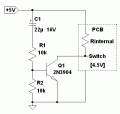
This may do the trick. It would act like the momentary switch (or relay), when the 5V power is applied, to ground the '4.5V input' of the PCB for about 0.5 secs.
PCB-switch.gif
Alternatively, and simpler still, you could try just connecting a capacitor (say 22uF) directly between that PCB 4.5V point and ground.
 
Last edited:

Thread Starter

fredric58

Joined Nov 28, 2014
252
Hi Alec, took a while but I actually found the schematic of the PCB, it is a newer model than I was using and much better suited. I have learned it is a HIGH signal that starts it. Can you determine what FT is used for? Also, a question about resistors. At the moment I am using 1/2 watt. The circuit board material is rather expensive so I would like the circuit I am making have a smaller foot print. 1/4 watt resistors are half the size of the 1/2 watt. Would it be OK to use 1/4 instead of 1/2?
 

Attachments

Alec_t

Joined Sep 17, 2013
15,121
I have learned it is a HIGH signal that starts it.
OK, but on your PCB is that signal applied to pin 2 or pin 3 of the ISD1820P chip? From what I can gather, if pin 2 is used (PLAYE) play will continue until the +5V supply is removed. If pin 3 is used (PLAYL), play stops when pin 3 goes LOW.
Can you determine what FT is used for?
According to Google's translation of www.atvoc.com/rjxz/isd1820.pdf ,
"◆ Direct Mode (FT) connected to this terminal allows external voice signal input through the MIC chip AGC circuit, filter and horn drive and run directly to the speaker output. FT end is usually low to achieve straight-through functions, the FT termination high while the REC, PLAYE".

1/4W resistors will be fine.
 
Last edited:

Thread Starter

fredric58

Joined Nov 28, 2014
252
I believe if not mistaken that PLAYE is play END and PLAYL is play LOOP or perhaps vice versa. I don't need it to loop! they both just need a signal to start. playe will just run one time and the "loop" I AM GUESSING.....you have to send another signal (push to END) to get it to stop.

NOTE: neither will stop when the signal is turned off, it is push (momentary) it starts and plays to the end. the loop how ever I "think" you have to (momentary ) push to stop. not worried about the loop though. here is an English version :)

EDIT: I thought wrong....


http://www.eimodule.com/download/EIM353_ISD1820_Module_Manual_V01.pdf

http://learn.linksprite.com/pcduino...ice-recording-and-playback-module-on-pcduino/
 
Last edited:

Thread Starter

fredric58

Joined Nov 28, 2014
252
so Alec, do you think I can use a darlington pair to activate the play circuit with a pulse from the PIR. (OR, would the voltage need to be higher than the 3.5v from the PIR OUT) It would seem it is much the same principle as the trigger for the PIR to power the system?
 

Alec_t

Joined Sep 17, 2013
15,121
A Darlington pair (used primarily for high current gain) won't do it, but a PNP-NPN pair (similar to the Q3/Q4 set-up in the add-on already posted) will. But simply a capacitor from the 5V rail to pin 2 might work if you want to use the edge-triggered playback mode.
 

Alec_t

Joined Sep 17, 2013
15,121
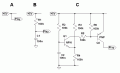
Here's 3 options, in order of complexity, which might be ok to trigger the playback at power-up, depending on any in-built delays and set-up-time of the sound-recorder PCB :-
PlayTrigger.gif
 

Thread Starter

fredric58

Joined Nov 28, 2014
252
cool, I will experiment. I would like to make SURE I am wiring my trim pots correctly as I am ABOUT to etch my first board. I have seen it done several ways. the way I have it is like this.....3 pin pot, pin 1 to power, pin 2 to what I am controlling, and pin 3 I have been sending to gnd. EXAMPLE: reference voltage on this project. pin 1 to power, pin 2 to pin 4 of lm339 and pin 3 to gnd. AND is it OK to switch pins 1 and 3, 1 to gnd and 3 to power, I have seen people put the power on 1, use 2 to go to what they are controlling and THEN they JUMP 2 and 3????
 

Alec_t

Joined Sep 17, 2013
15,121
Assuming pins 1 and 3 are the two ends of the resistive track of the pot and pin 2 is the wiper then yes, you can swap 1 and 3.
The reason that you see pin 2 connected to either pin 1 or pin 3 in some circuits is that the pot is then being used as a rheostat (variable resistor) instead of as a true potentiometer (potential divider).
 

Thread Starter

fredric58

Joined Nov 28, 2014
252
which should I be using? my schematic is for a ? variable resistor no? and another question now that I am much more familiar with this project. based on learning you can regulate voltage with a " voltage divider " EX: 9v in with (2) resistors of equal value will give you 4.5 v out. the OUT can be increased or decreased dependent on the upper and lower resistor values. why? did you elect to make the voltage regulator in the manner in which you did verses just a v divider? are the results of the two identical?
 

Thread Starter

fredric58

Joined Nov 28, 2014
252
WHAT A GREAT DAY! my first etched board WORKS!!!! THANK YOU ALEC! I have learned a great deal. the only thing that isn't on the money is the out put voltage. in either mode, ON or BYPASS the OUT voltage is only 2.73v. the reg portion is a bit difficult to understand, because it is not a "simple" voltage divider, but I believe that the change to get this to output 5v is dependent on R6 and R8?
 

Alec_t

Joined Sep 17, 2013
15,121
which should I be using? my schematic is for a ? variable resistor no?
Trim1 is a potentiometer (voltage divider).
why? did you elect to make the voltage regulator in the manner in which you did verses just a v divider? are the results of the two identical?
If you draw any significant current from a simple voltage divider it pulls the output voltage down. A regulator ideally holds the voltage constant, regardless of current drawn.
in either mode, ON or BYPASS the OUT voltage is only 2.73v.
That suggests either R6 or R7 (latest circuit) is the wrong value, or that R7 isn't actually connected. Check the circuit in that area.
 

Thread Starter

fredric58

Joined Nov 28, 2014
252
YOU are correct (again) : ) R7 was dismissed, or R8. POST 103. my bad, it is 5k6 over 5k6, I placed 5k6 over 56k. NO WONDER, but only ONE mistake this time!!!!! and this can be easily corrected.
 
Top