PWM For High Frequency Transformer

Thread Starter

rwfwef

Joined Sep 14, 2025
68
The inductor voltage is driven by the rate of change of the current. How fast are you switching off the transistor?? Probably very fast. Try having the snubber across the mosfet. THAT is the item that the snubber would be used to protect.
Frequency is 73.5kHz. When you say put it across the mosfet, do you mean instead of snubber going from drain to positive, go from drain to source?
 

Justloadit

Joined Sep 17, 2024
14
Insert the 47 ohm resistor in series with the 1N914 so that you reduce the gate current .

There is no load, where is the magnetic energy going to go to?
You need the secondary to absorb the energy in the inductor. This part of the reason for the overshoot. Since there is no load it builds up on itself and hence you see the over shoot. This is typical of a fly back power supply.

The purpose of the snubber is to absorb small amounts of 'switching' energy, not to take out the voltage peaks you are seeing. You could effectively remove the over shoot voltage, but effectively your snubber would become the load and have to dissipate the energy of the inductor when discharging. Had you not had the snubber in circuit, those voltage would be higher.

Have you not felt a minor shock when playing with relay coils and crocodile clips when having your fingers across the coil wires? this is the same phenomena, you see a spark when you disconnect the coil. The reason that diodes are used in DC circuits and relay coils, to absorb this voltage when the coils are switched off.

Get your secondary on, load it, and you will see a change.
 

MisterBill2

Joined Jan 23, 2018
27,587
Oh Wow!!! I had not realized that there was no load connected!
Certainly Just is correct!! Connect the intended load, or at least a similar resistance, and then let us know what is happening.
An incomplete system will seldom function the same as a complete version. That is especially true in power circuits like this!!
 

Thread Starter

rwfwef

Joined Sep 14, 2025
68
Thx both of you. I have my secondary wound, just need to epoxy it. I’ll put in the 47 ohm resistors as well (if the store I go to isn’t sold out).
 

Justloadit

Joined Sep 17, 2024
14
Anything between 47 and 100 ohms will work for your application, the value is not critical. When you start with kW designs, the value will make a difference on the performance.
 

Thread Starter

rwfwef

Joined Sep 14, 2025
68
I was able to get the 2, 47 ohm resistors and also hopefully the correct valued parts for the snubber circuit. Probably wont have results for a few days, still want to epoxy the transformer bobbin before plugging it in. I wasn't able to fit as many windings as I was hoping (added a lot of insulation and took up space) but I was able to get 426 turns on the secondary so at 19Vin, over 1.3kVout according to calculation.

Thx again for all the help from everyone!
 
Last edited:

Thread Starter

rwfwef

Joined Sep 14, 2025
68
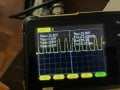
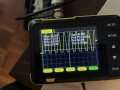
Transformer seems to work. I don't hear any noise coming from it plus no visible arcing. However theres a new problem. My duty cycle is completely different when comparing the gate of the MOSFET vs the Drain.

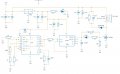
Circuit in attachments.

Osc Pic 1: Waveform at Gate
Osc Pic 2: Waveform at Drain

Also I notice that the waveform is more rounded when looking at the drain. I also swapped a resistor value to compensate for the changed duty cycle so I get it closer to 50% at the drain.
 

Attachments

Justloadit

Joined Sep 17, 2024
14
Welcome to the world of power electronics, where things rarely behave as you'd expect at first glance.

There’s no such thing as an instantaneous transition from high to low or vice versa. Every switching event involves a delay between the gate signal and the drain’s response, governed by gate charge, driver strength, and parasitic elements.

Now, remember why switching frequency matters. At 75 kHz, you're operating in a regime where edge behavior and timing are critical and the device delays may impact on the wave times.

Another point is your scope’s 200 kHz bandwidth is limiting what you can actually see. Rounded wave forms at the drain aren’t just circuit behavior, they’re partly artifacts of your measurement setup.

Scope bandwidth directly affects signal fidelity. With only ~2.7× the switching frequency, you're likely seeing attenuated edges and smoothed transitions. To truly capture switching dynamics, especially rise/fall times and ringing, you need at least 5–10× bandwidth, ideally more.

Also, while voltage is easy to probe, it’s highly susceptible to probe loading including probe capacitance, ground bounce, and bandwidth limitations. Current measurement, especially through a low-inductance shunt or current probe, offers a more accurate picture of switching behavior.

Adjusting resistor values to correct duty cycle at the drain is a clever move, but keep in mind, what you see at the drain is a combination of gate timing, device characteristics and measurement distortion. Always validate with current wave forms and higher-bandwidth tools when possible.
 

Thread Starter

rwfwef

Joined Sep 14, 2025
68
Welcome to the world of power electronics, where things rarely behave as you'd expect at first glance.

There’s no such thing as an instantaneous transition from high to low or vice versa. Every switching event involves a delay between the gate signal and the drain’s response, governed by gate charge, driver strength, and parasitic elements.

Now, remember why switching frequency matters. At 75 kHz, you're operating in a regime where edge behavior and timing are critical and the device delays may impact on the wave times.

Another point is your scope’s 200 kHz bandwidth is limiting what you can actually see. Rounded wave forms at the drain aren’t just circuit behavior, they’re partly artifacts of your measurement setup.

Scope bandwidth directly affects signal fidelity. With only ~2.7× the switching frequency, you're likely seeing attenuated edges and smoothed transitions. To truly capture switching dynamics, especially rise/fall times and ringing, you need at least 5–10× bandwidth, ideally more.

Also, while voltage is easy to probe, it’s highly susceptible to probe loading including probe capacitance, ground bounce, and bandwidth limitations. Current measurement, especially through a low-inductance shunt or current probe, offers a more accurate picture of switching behavior.

Adjusting resistor values to correct duty cycle at the drain is a clever move, but keep in mind, what you see at the drain is a combination of gate timing, device characteristics and measurement distortion. Always validate with current wave forms and higher-bandwidth tools when possible.
So if at the drain my oscilloscope is reading 50% duty cycle, then is it 50%? Also that's the only oscilloscope I have. Wish I had a better one, but that costs money.
 

Justloadit

Joined Sep 17, 2024
14
So if at the drain my oscilloscope is reading 50% duty cycle, then is it 50%? Also that's the only oscilloscope I have. Wish I had a better one, but that costs money.
Yes you can accept what the scope shows as a 50% provided that the internal analogue circuit of the scope has a well designed amplifier. Bear in mind that the scope probe is also part of the measuring circuit. For power electronics, and for minimum loading on circuits a x100 probe is required, but then again the scope must be able to amplify this very small signal it is presented with.

I am not sure the reason that you want a perfect 50% duty cycle.
 

Thread Starter

rwfwef

Joined Sep 14, 2025
68
Yes you can accept what the scope shows as a 50% provided that the internal analogue circuit of the scope has a well designed amplifier. Bear in mind that the scope probe is also part of the measuring circuit. For power electronics, and for minimum loading on circuits a x100 probe is required, but then again the scope must be able to amplify this very small signal it is presented with.

I am not sure the reason that you want a perfect 50% duty cycle.
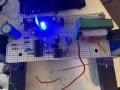
I wanted 50% duty cycle but it doesn't have to be. Anyway I put it together on a perf board and it works! Thx

Turns out I also had the pin outs wrong on the 494 based on the schematic I posted.

Here’s a pic of the somewhat finished product.

Thx for all the help from everyone!
 

Attachments

Thread Starter

rwfwef

Joined Sep 14, 2025
68
So the circuit works well. However this first one I made I ended up making it frequency and duty cycle adjustable so I can tune the transformers and figure out at what frequency and duty cycle they run best at (circuit in attachments). When tuning the transformers, depending on settings, voltage across the drain pin will increase or decrease.

A new problem I have is that something goes wrong at the 7812 or that's what I think. If the 7812 fails, should anything come out of the 3 pin or is it like a resistor in the sense that when it burns out, no current or voltage can pass through because it's literally burnt out? In my case, anything that's after the 7812 like the 2 ic's, instead of getting 12V are now getting pretty much the same voltage as my power supply.

Things go wrong when the voltage at the drain was over 60V I think and the L2 was shorted (I'm using this to make plasma arcs). I think once it got up to near 100V if not more. These are not voltage spikes btw, the waveform is really reaching that much voltage. The shunt circuit works great.

Any idea's on what the problem is? Any fixes?

Also ignore the primary inductance and turns
 

Attachments

Last edited:

MisterBill2

Joined Jan 23, 2018
27,587
Be sure to have the 0.1 mFd capacitors right at the 7812 regulator, as that application notes describe. Those 2 capacitors are not optional. ALSO, have a good heat sink properly attached to the regulator, also.
AND, no comment about that circuit in post #55
 
Last edited:

Thread Starter

rwfwef

Joined Sep 14, 2025
68
Be sure to have the 0.1 mFd capacitors right at the 7812 regulator, as that application notes describe. Those 2 capacitors are not optional. ALSO, have a good heat sink properly attached to the regulator, also.
looks like the issue wasnt the regular but the 0.1uF capacitor at the TL4426. For some reason it was causing something like a short circuit and my ground was around 9V if I remember right.
 

Thread Starter

rwfwef

Joined Sep 14, 2025
68
So let’s say after tuning the transformer, the voltage across the drain pin from the primary coil is 50V. To calculate the voltage output (voltage x turns ratio) am I still calculating based on my Vin (19V) or am I calculating based off my primary coil voltage (50V)?
 

MisterBill2

Joined Jan 23, 2018
27,587
Back to the question, again.
With no load current the voltage ration is close to the turns ratio, provided that the core is not becoming magneticly saturated. And normal transformer designs choose to avoid saturation of the core. As soon as current flows, the secondary voltage will drop a bit, though. But still the voltage ratio is close to the turns ratio.
 
Top