The reputable cube relay manufacturers I have used in the past, where there is either, or both a BEMF diode and/or a LED indicator internal, display this on the cover with a small diagram.
And as for the slower slew rate, just increasing the switching time to one millisecond instead of one microsecond should be enough, and for any application driving a small relay the heat generation will not be an issue. And it may only require selecting a slower transistor or possibly adding a small (0.001mfd) capacitor, base to emitter. Since most relay response times are over TEN milliseconds chatter should not be an issue.
Never having tried this I thought I'd run a simulation....
I used an Omron G2R-2-S12 relay (a plug-in DPDT unit I've used many times before). Rated at 12v, it typically pulls in at 30mA and drops out at 6mA. With an inductance of 0.98H its a relatively slow relay, needing 30mS+ to pull in.
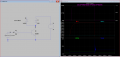
So here's what it looks like with no diode... with a voltage peak of 5kV - lot of energy stored in that 1H coil, and some ringing after turn off. but the relay turns on after about 5mS and off immediately after the drive is removed. Transistor dissipation is 10mW.
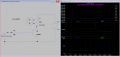
With a diode the peak voltage is 12.7v as expected and diode current is 43mA. Relay turns on and off about 5mS lagging the drive.
Without a diode, a 4.7u capacitor base-emitter is needed to keep the turn off spike < 30V. Turn on is delayed by 10mS and off by 6mS and transistor dissipation rises to 25mW over the 100mS.
so, slew rate control works but adds at least one extra component, as the diode is still needed, and performance depends much more on component tolerances. I'll carry on with flyback diodes, they're more predictable!
So there are some interesting ways to eliminate that spike, or at least to reduce it to a trivial level, without using any suppression diode or shunt device across the coil.
Way back when, some relay manufacturer (I don't remember who) added a shorted coil with a high resistance, wound on the same core as the relay coil winding.
This shorted wire acted rather as a flyback winding to suppress the primary coil spike when the relay was turned off.
When the primary current suddenly stopped, the current was transferred by transformer action to the shorted suppressor winding.
The relative number of turns and the suppressor winding resistance determined how much it suppressed the spike at the primary.
Don't remember how much that was (I would guess about equal to the supply voltage).
That also reduced the turn-off time of the relay, similar to the way a Zener in series with a conventional diode would, but with no diodes or transistors to fail.
I think it may have been used on high-reliability relays for the military.
Certainly was an interesting way to perform the suppression function.
First, a 1 henry relay coil is a whole lot more inductance than is usually present in a small relay. And the simulation transistor switches off instantly. Just examine the simulation parameters and you will see that. In addition, that simulated relay coil has zero resistance and no loses at all. IT will be interesting if you can plot the contacts opening or closing and see how rapidly that simulated relay moves. Probably colse to instantly.
So most simulations do not seem to match reality as close as they should. This is typical!
And quite a few relays also have a single-turn "shading coil" around the pole that affects the operating as well.
A diode across a relay connected backward accidentally will cause a huge amount of grief, I discovered a few years ago when the replacement relay provided by a customer had an internal diode that I was not aware of.
Agreed. Especially plug-in relays, where you think two models are equivalent, but one has a built in diode, and you have wired the panel thinking that the two coil pins are interchangeable, and put your own diodes on the relay base. Unplug the relay to test it, and it tests OK. Plug it back in and it doesn’t work. Annoying.
In this case I would think it is the responsibility of the one replacing the relay to confirm that it is equivalent and will suit the application, in the case of those that have internal BEMF diode, they coil terminals are typically marked, + & - .
First, a 1 henry relay coil is a whole lot more inductance than is usually present in a small relay. And the simulation transistor switches off instantly. Just examine the simulation parameters and you will see that. In addition, that simulated relay coil has zero resistance and no loses at all.
I beg to differ. The 0.98H is the data sheet inductance as is the 278ohm series resistance I used in the simulation - else you wouldn't get the classic L/R curve or the final current of 12/278 = 43mA. Incidentally the data sheet also notes that the inductance rises to 2.7H when the armature is pulled in. I've not tried to model that (I'm not sure if you could). I chose this relay because unlike little PCB signal relays it draws appreciable current. The switching times are based on the pull-in and release currents derived from the listed pull-in and release voltages in the datasheet. AFAIK it doesnt list mechanical switchover times; I could probably measure them from an actual relay.
The actual transistor switching time is modelled quite well, you just can't see it on a time-base of 10mS/div!
Anyway, no-one's mentioned the good old snubber.
Use R as the same value of the relay resistance, and C=L/(R^2)
The combination of relay and snubber appears as a pure resistance.
I've never seen it used - there appears to be no advantage over the 1N4001. There's two components, the capacitor is quite large (470nF for a 1H/1500Ω relay), you have to measure the relay inductance because it's never on the datasheet, and the switch-off speed is no faster than the diode.
But there is a lot less ringing when the transistor switches off and the circuit oscillates with the inductance, its self-capacitance and the transistor output capacitance.
The zener circuit to speed up the switch-off generates much more ringing, about 10 times as much as the 1N4001 circuit.
Another circuit which produces fast switch-off and no ringing is to put a resistor of the same value of the coil resistance in series with the 1N4001. The effect is the same switch-off speed as the zener circuit, but with no ringing whatsoever.
Some relays change their reluctance when the contacts close. I don't quite know how this would affect the switch-off spike, switch off speed and ringing.
Way back when, some relay manufacturer (I don't remember who) added a shorted coil with a high resistance, wound on the same core as the relay coil winding.
This shorted wire acted rather as a flyback winding to suppress the primary coil spike when the relay was turned off.
When the primary current suddenly stopped, the current was transferred by transformer action to the shorted suppressor winding.
The relative number of turns and the suppressor winding resistance determined how much it suppressed the spike at the primary.
Don't remember how much that was (I would guess about equal to the supply voltage).
That also reduced the turn-off time of the relay, similar to the way a Zener in series with a conventional diode would, but with no diodes or transistors to fail.
I think it may have been used on high-reliability relays for the military.
Certainly was an interesting way to perform the suppression function.
Interesting idea, and I've not come across it before. But a quick simulation shows it works quite well and the transistor losses are reduced to less than 2mW. To keep the peak voltage in check, the secondary winding needs to be around 10% of the inductance/resistance of the primary...

 Facebook
 Google
 GitHub
 Linkedin