Facebook
 Google
 GitHub
 Linkedin

Very much a beginner here and trying to learn as much as I can. Hoping that the folks on this forum can help point out the error of my ways 
I am (re)building a circuit to take the signals coming from a motorcycle's speed sensor and coil, dividing these by two, and feeding them to a cruise control module. I built this circuit before with no protection using the MC14024B and it lived for a couple years. This time I would like to add some protection in the hopes that it will live longer. The tach portion of my current board has become unstable, so I suspect that I have damaged the input to the clock pulse (CP) of the MC14024B ripple counter, or its output pin Q0.
Also thinking of changing the power supply circuit for conditioning the power to the board. I previously used a 7812 with the appropriate caps before and after and I think it did OK. The datasheet for the 7812 calls for 2V+ over its rated 12V regulation. That is very close to the voltage seen on this motorcycle. So this time instead of the 7812 I was thinking about using a different approach. Not sure if this is really necessary or if I should just stick with a 7812.
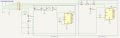
On the schematic below I have the two different options for conditioning/protecting the CP of U1 & U2. Option #1 uses a design I took from Digikey's website in a paper titled "Protecting Inputs in Digital Electronics". Option #2 uses a much simpler approach. Not sure if option #1 is overkill or if option #2 is too weak to provide the needed protection.
Any suggestions are greatly appreciated.
I am (re)building a circuit to take the signals coming from a motorcycle's speed sensor and coil, dividing these by two, and feeding them to a cruise control module. I built this circuit before with no protection using the MC14024B and it lived for a couple years. This time I would like to add some protection in the hopes that it will live longer. The tach portion of my current board has become unstable, so I suspect that I have damaged the input to the clock pulse (CP) of the MC14024B ripple counter, or its output pin Q0.
Also thinking of changing the power supply circuit for conditioning the power to the board. I previously used a 7812 with the appropriate caps before and after and I think it did OK. The datasheet for the 7812 calls for 2V+ over its rated 12V regulation. That is very close to the voltage seen on this motorcycle. So this time instead of the 7812 I was thinking about using a different approach. Not sure if this is really necessary or if I should just stick with a 7812.
On the schematic below I have the two different options for conditioning/protecting the CP of U1 & U2. Option #1 uses a design I took from Digikey's website in a paper titled "Protecting Inputs in Digital Electronics". Option #2 uses a much simpler approach. Not sure if option #1 is overkill or if option #2 is too weak to provide the needed protection.
Any suggestions are greatly appreciated.