Facebook
 Google
 GitHub
 Linkedin
Hello everyone,
I’ve been working on a circuit to emulate a sensor in my car and would like to see if anyone can review it and offer any suggestions for improvement or just a better way to do it. So far my bench testing works as expected and a short field test proved successful. My main question with this current design is the reverse breakdown voltage of the emitter-base junction on Q2. The datasheet spec is -7V and during operation it will receive -10V. The amount of current flow is minuscule so I’m not entirely sure if this will be a problem. I can put a Zener Diode across Q2 base to ground and limit Q2 Veb to a respectable amount, but I’m not sure I have enough current flow to active the Zener. I have not bench tested this yet. I tried another resister in place of the Zener, but the additional path to ground caused issues with the capacitor being able to keep the Q2 active during the 80ms 0V PWM cycle (explained below). I also know the placement of the transistors is not standard, but this is the only way that I have been able to get the circuit to behave like I need it.
All inputs and outputs are directly connected to the ECU so power filtering has already been done. The INPUT is a motor controller H-Bridge (I assume) that will change polarity based on the engine throttle load to open or close a valve with a motor. The input can be 10V to 14.5V based on battery voltage/engine running. When the valve should be closed, the INPUT is constant ground. When the valve should be open the INPUT is PWM to ~16ms positive voltage and ~80ms ground, validated with an oscilloscope. The valve has a sensor (it’s basically a 5V potentiometer voltage divider) that will OUTPUT ~0.8V closed and ~3.7V open. This output is fed to the ECU for measurement, I assume through some form of ADC.
To simplify, I need to create an OUTPUT of ~0.8V when the INPUT is a constant 0V and an OUTPUT of ~3.7V when the INPUT is 10-14.5V. To complicate this the INPUT when high is PWM and I need the OUTPUT to stay a constant ~3.7V until the INPUT remains a constant 0V. I hope that’s not confusing.
I have tried many different circuits and so far this is the best one I have come up with. Any thoughts on improvements or redesigns are appreciated.
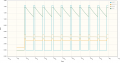
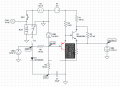
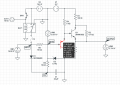
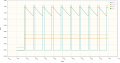
The clock and relay are used to emulate the PWM cycle of the INPUT during simulation as seen in the graph. They do not exist in production. Q2 is the red PNP. The diagrams are in a state of 14.5V on the INPUT even though the relay looks grounded. I have chosen high values for resistors to purposely keep power dissipation as low as possible. This will be in an engine bay (not touching the engine) and subjected to ambient temps possibly around 100c, so I have done my best to derate everything.
I have also built a simpler version of this using a relay and voltage divider. This has been running in my car without any issues but I want to replace the mechanical relay for better longevity and so far this is my solution.
Without the Zener.
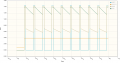
With the Zener
I’ve been working on a circuit to emulate a sensor in my car and would like to see if anyone can review it and offer any suggestions for improvement or just a better way to do it. So far my bench testing works as expected and a short field test proved successful. My main question with this current design is the reverse breakdown voltage of the emitter-base junction on Q2. The datasheet spec is -7V and during operation it will receive -10V. The amount of current flow is minuscule so I’m not entirely sure if this will be a problem. I can put a Zener Diode across Q2 base to ground and limit Q2 Veb to a respectable amount, but I’m not sure I have enough current flow to active the Zener. I have not bench tested this yet. I tried another resister in place of the Zener, but the additional path to ground caused issues with the capacitor being able to keep the Q2 active during the 80ms 0V PWM cycle (explained below). I also know the placement of the transistors is not standard, but this is the only way that I have been able to get the circuit to behave like I need it.
All inputs and outputs are directly connected to the ECU so power filtering has already been done. The INPUT is a motor controller H-Bridge (I assume) that will change polarity based on the engine throttle load to open or close a valve with a motor. The input can be 10V to 14.5V based on battery voltage/engine running. When the valve should be closed, the INPUT is constant ground. When the valve should be open the INPUT is PWM to ~16ms positive voltage and ~80ms ground, validated with an oscilloscope. The valve has a sensor (it’s basically a 5V potentiometer voltage divider) that will OUTPUT ~0.8V closed and ~3.7V open. This output is fed to the ECU for measurement, I assume through some form of ADC.
To simplify, I need to create an OUTPUT of ~0.8V when the INPUT is a constant 0V and an OUTPUT of ~3.7V when the INPUT is 10-14.5V. To complicate this the INPUT when high is PWM and I need the OUTPUT to stay a constant ~3.7V until the INPUT remains a constant 0V. I hope that’s not confusing.
I have tried many different circuits and so far this is the best one I have come up with. Any thoughts on improvements or redesigns are appreciated.
The clock and relay are used to emulate the PWM cycle of the INPUT during simulation as seen in the graph. They do not exist in production. Q2 is the red PNP. The diagrams are in a state of 14.5V on the INPUT even though the relay looks grounded. I have chosen high values for resistors to purposely keep power dissipation as low as possible. This will be in an engine bay (not touching the engine) and subjected to ambient temps possibly around 100c, so I have done my best to derate everything.
I have also built a simpler version of this using a relay and voltage divider. This has been running in my car without any issues but I want to replace the mechanical relay for better longevity and so far this is my solution.
Without the Zener.
With the Zener