Protect Central Locking System from Back E.M.F

Thread Starter

HadyShaltout

Joined Oct 14, 2024
30
Good Day!

First of all I'm a junior so take it easy with me, I'm doing my best as well as I can :) I bought a new local Central Locking system for my car to replace the old one, The new one has only 4 actuators for doors and I already have one actuator for the trunk which has two terminals (Green - Blue) like others.

My issue is, The new central locking unit has one wire (Gray) for the trunk so the trunk button in the remote control will open the trunk only, Now if I connect the trunk actuator (Green - Blue) parallel with doors, The remote control's trunk button won't work.

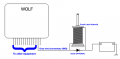
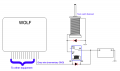
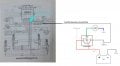
I made a diagram and need to know is it correct or not, and should I use a Diode to protect the Central Locking unit or not and if yes, Which diode should I use and which wire (Brown or What)?

Thank You, at this point, I made my best after a lot of search.
Central-Locking-System-with-Trunk.jpg
 

Ya’akov

Joined Jan 27, 2019
10,226
Welcome to AAC.

Unfortunately that wiring diagram is a mess but it raises a question. Because (it appears) the portion showing the relay for the trunk has been repurposed, the original’s connection to ground should been removed, but wasn’t. Just to confirm: you haven’t connected terminal 85 of the relay to the grey wire and ground, have you?
 

Thread Starter

HadyShaltout

Joined Oct 14, 2024
30
Welcome to AAC.

Unfortunately that wiring diagram is a mess but it raises a question. Because (it appears) the portion showing the relay for the trunk has been repurposed, the original’s connection to ground should been removed, but wasn’t. Just to confirm: you haven’t connected terminal 85 of the relay to the grey wire and ground, have you?
No still not, I'm asking before wiring
 

Ya’akov

Joined Jan 27, 2019
10,226
I don’t understand your answer—or maybe your initial post, is this correct:

  • You bought a new module for central locking which included for actuators for door locks.
  • You have an existing actuator for the trunk lock.
  • When you connect the relay that operates the trunk lock actuator to the grey wire from the module, the doors stop working.

Is this correct?
 

Tonyr1084

Joined Sep 24, 2015
9,744
[edit] I missed the fact that the WOLF provides a momentary ground.

Your WOLF has four door locks and an isolated trunk latch (the TL) - (to pop the trunk). If you connect the trunk latch when you lock (and possibly unlock) the doors the trunk will open every time. I take it this is not what you want.

IF my summation is correct then the grey wire that goes to the TL needs to provide either a positive voltage OR Ground. Before anyone can say if your diagram is correct this critical information is needed. IF you were to wire it up the way you show your relay would be ON all the time. Or until the battery runs dead or the relay burns out. So don't wire it the way you show.

On the premises that the WOLF will provide a positive pulse then it needs to be wired directly to (probably) one of the two wires of the TL actuator. It SHOULD be capable of providing sufficient current to do the job.

On the premises the WOLF provides Ground then the TL actuator needs to have a constant power source. I don't think you need a relay at all. BUT I DON'T KNOW THAT FOR A FACT. This is why more information is needed.

1) Does the WOLF provide a positive pulse to actuate the TL?
2) Does the WOLF provide a momentary ground for the TL?

3) Can the WOLF handle the amount of current the TL requires? Either positive or ground.

OK, the WOLF provides a momentary ground. ALL you need is to provide the TL a constant source of power. No relay is needed.
[end edit]
 

Tonyr1084

Joined Sep 24, 2015
9,744
Based on what I've read so far, this is likely the way you need to wire it. But if you're uncertain and want to do an actual test, use a 12V turn signal bulb as the load in place of the TL solenoid. IF the bulb lights when you push the TL key on the fob then that's the right way to go. Since none of the other actuators seem to have a diode it may not be necessary. But for the sake of keeping your WOLF alive, I'd go with the optional diode exactly as shown. The direction is not a mistake.

Screenshot 2024-10-15 at 8.56.33 AM.png
 

Ya’akov

Joined Jan 27, 2019
10,226
Based on what I've read so far, this is likely the way you need to wire it. But if you're uncertain and want to do an actual test, use a 12V turn signal bulb as the load in place of the TL solenoid. IF the bulb lights when you push the TL key on the fob then that's the right way to go. Since none of the other actuators seem to have a diode it may not be necessary. But for the sake of keeping your WOLF alive, I'd go with the optional diode exactly as shown. The direction is not a mistake.

View attachment 333710
I believe the relay is to reduce the load handled by the grey wire.
 

DC_Kid

Joined Feb 25, 2008
1,242
Reverse diode as mentioned, this freewheels the coil until joules drop off.
You can also zener it to ground using zener a few volts above the max supply voltage.
Many times the coil and the switching silicon form an oscillator (ringing) when power is cutoff, so you can also add a properly tuned snubber to flatten any ringing, usually need a scope to see the ringing though.
 

Thread Starter

HadyShaltout

Joined Oct 14, 2024
30
I don’t understand your answer—or maybe your initial post, is this correct:

  • You bought a new module for central locking which included for actuators for door locks.
  • You have an existing actuator for the trunk lock.
  • When you connect the relay that operates the trunk lock actuator to the grey wire from the module, the doors stop working.

Is this correct?
No :) I didn't wiring the relay yet, I'm asking about the correct wiring and how to protect the Central locking unit because I saw a video mentioned a diode should be added on the Brown wire.

I believe that the battery (+) should be connected to 30 and 87a but this diagram came from Nilight Relay.
 

Thread Starter

HadyShaltout

Joined Oct 14, 2024
30
Based on what I've read so far, this is likely the way you need to wire it. But if you're uncertain and want to do an actual test, use a 12V turn signal bulb as the load in place of the TL solenoid. IF the bulb lights when you push the TL key on the fob then that's the right way to go. Since none of the other actuators seem to have a diode it may not be necessary. But for the sake of keeping your WOLF alive, I'd go with the optional diode exactly as shown. The direction is not a mistake.

View attachment 333710
I believe it needs a a 5pn relay (30A or 40A) because the company's technician himself told me that, the 30 and 87a should connected to the 12V directly.
 

Ya’akov

Joined Jan 27, 2019
10,226
A Back EMF protection diode, also called a freewheeling diode will always be placed directly across source (a coil). In this case the coil is the one in the relay. Back EMF is caused by the collapse of the magnetic field around it caused by the EMF that was applied to it.

When there is a change in current through an inductor, the magnetic field will change in proportion. If the current is increased the mangetic field increases using some of the power that would otherwise make it through the circuit. When the current decreases the magnetic field shrinks, and through induction, a voltage of the opposite polarity to the original appears at the terminals of the inductor. When current is suddenly falls to zero, the entire magnetic field collapses and the voltage can rise to extremely high levels.

This sudden spike can easily do damage. For example, if a transistor is being used to energize the coil of a relay a large voltage spike will appear at the transistor’s output coming from the relay, unless measures are taken to prevent it. The primary protection is the freewheeling diode. A diode, placed across the relays coil with its polarity such that the current of the power supply will not flow through it, then it will conduct the back EMF spike through the coil itself harmlessly dissipating it.
 

Thread Starter

HadyShaltout

Joined Oct 14, 2024
30
A Back EMF protection diode, also called a freewheeling diode will always be placed directly across source (a coil). In this case the coil is the one in the relay. Back EMF is caused by the collapse of the magnetic field around it caused by the EMF that was applied to it.

When there is a change in current through an inductor, the magnetic field will change in proportion. If the current is increased the mangetic field increases using some of the power that would otherwise make it through the circuit. When the current decreases the magnetic field shrinks, and through induction, a voltage of the opposite polarity to the original appears at the terminals of the inductor. When current is suddenly falls to zero, the entire magnetic field collapses and the voltage can rise to extremely high levels.

This can sudden spike can easily do damage. For example, if a transistor is being used to energize the coil of a relay a large voltage spike will appear transistors output coming from the relay, unless measures are taken to prevent it. The primary protection is the freewheeling diode. A diode, placed across the relays coil with its polarity such that the current of the power supply will not flow through it, will conduct the back EMF spike through the coil itself harmlessly dissipating it.
Thank You, I'm not a pro so I can't determine which diode do I need and what's the correct direction. Anyway I think I made a huge mistake and the remote control's trunk button opening the latch of the trunk .. sorry for that, I may need another post for this issue :)
 

Tonyr1084

Joined Sep 24, 2015
9,744
MORE CORRECTIONS COMING: Solenoid wire should NOT be wired to 87a. SHOULD be wired to 87!

Pin 87 is NO (Normally Open). Pin 87a is NC (Normally Closed).
After researching more about automotive relays I realized yet another error in my drawing. The drawing has been corrected again. It's NOW correct.
 

Thread Starter

HadyShaltout

Joined Oct 14, 2024
30
Based on what I've read so far, this is likely the way you need to wire it. But if you're uncertain and want to do an actual test, use a 12V turn signal bulb as the load in place of the TL solenoid. IF the bulb lights when you push the TL key on the fob then that's the right way to go. Since none of the other actuators seem to have a diode it may not be necessary. But for the sake of keeping your WOLF alive, I'd go with the optional diode exactly as shown. The direction is not a mistake.

View attachment 333710
Thank you my friend, Are you sure about that? can you give me a hint about the diode ID or number?
Anyway, I'll use the (Green-Blue) wires to open the central lock and will add a new actuator to open the trunk's latch.
 

Ya’akov

Joined Jan 27, 2019
10,226
Thank You, I'm not a pro so I can't determine which diode do I need and what's the correct direction. Anyway I think I made a huge mistake and the remote control's trunk button opening the latch of the trunk .. sorry for that, I may need another post for this issue :)
OK, but do post here rather than making a new thread. My explanation was intended to give you enough information so you can understand why the diode is needed and why it would go in a particular place and particular direction. It might seem a bit dense, but is simple enough if you read it a few times.

@Tonyr1084 provides a nice, clear dia gram for yoju.
 

Tonyr1084

Joined Sep 24, 2015
9,744
As I'm perusing 5 pin relays I'm finding pins 85 and 86 wired to battery and ground. Some show pin 86 to ground, some show pin 85 to ground. If you find this confusing, so do I. In the end, an electrical current through the relay will produce the magnetic force needed to change the state of the armature in the relay from not active to active (off to on, depending on which pins you use). In a standard automotive relay it doesn't matter which pin (85 or 86) gets power and which gets ground. When the relay is powered the NO contact will become active and conduct current from pin 30.
 
Top