Protect Central Locking System from Back E.M.F

Tonyr1084

Joined Sep 24, 2015
9,744
can you give me a hint about the diode ID or number?
1N40XX diodes will suffice. Personally I'd opt for a 1N4004. Plenty of current capability for the ever so brief period of time it needs to conduct.

Ya’akov was explaining the need for the diode. Think of a bicycle wheel. When power flows through the coil of the relay the wheel begins to spin. When you remove power from the relay that spinning wheel (Back EMF) or inertia keeps the wheel spinning for a moment. The diode takes that BEMF and shorts it to itself so nothing else in the circuit has to deal with a sudden high voltage.

When a magnetic field in a coil breaks down it produces a high voltage spike (BEMF). The diode channels it safely back to itself where the coil's own resistance turns that BEMF down to zero volts. All other components in the circuit are protected. In this case - your WOLF module. The module itself may have BEMF protection. But since diodes are so cheap and plentiful, why not be sure your system is safe from BEMF.
 

Ya’akov

Joined Jan 27, 2019
10,238
1N40XX diodes will suffice. Personally I'd opt for a 1N4004. Plenty of current capability for the ever so brief period of time it needs to conduct.

Ya’akov was explaining the need for the diode. Think of a bicycle wheel. When power flows through the coil of the relay the wheel begins to spin. When you remove power from the relay that spinning wheel (Back EMF) or inertia keeps the wheel spinning for a moment. The diode takes that BEMF and shorts it to itself so nothing else in the circuit has to deal with a sudden high voltage.

When a magnetic field in a coil breaks down it produces a high voltage spike (BEMF). The diode channels it safely back to itself where the coil's own resistance turns that BEMF down to zero volts. All other components in the circuit are protected. In this case - your WOLF module. The module itself may have BEMF protection. But since diodes are so cheap and plentiful, why not be sure your system is safe from BEMF.
He did say the technician he spoke to said the diode was needed.
 

Tonyr1084

Joined Sep 24, 2015
9,744
He did say the technician he spoke to said the diode was needed.
Yes. I recall that. Not only for that reason but also for BEMF protection is why I drew in the diodes. Smart protection.

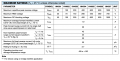
Here's a data sheet from vishay:
Screenshot 2024-10-16 at 7.51.41 AM.png
A 1N4004 will provide Max repetitive peak reverse voltage of 400 volts. The Max rms voltage is 420. For the brief period of the spike this should be sufficient. But if one wants to be more sure of protection then go with a 1N4007. You can see it has higher max's. And they're going to be the same cost. The 1N40XX is a general purpose diode. I would advise against using a signal diode as they're not designed to handle such high currents and voltage spikes.

Source: https://www.vishay.com/docs/88503/1n4001.pdf
 

DC_Kid

Joined Feb 25, 2008
1,242
Just adding more chatter.
I wonder what "temp gnd" in on that controller wire. Does it float when it's not to gnd?
If it's a gnd (sink) control wire, then maybe swap out the mechanical relay for a properly size pFET, add 1-5k pullup resistor on it's gate (if that control wire floats), and ditch that extra diode on the relay. Cleaner, smaller, more reliable, less emf, etc.
 

Tonyr1084

Joined Sep 24, 2015
9,744
I wonder what "temp gnd" in on that controller wire. Does it float when it's not to gnd?
We don't know. Assuming it either floats or sits at a very high resistance. It makes more sense that it floats. Otherwise even if there's a high resistance there would continue to be a drain on the battery. My guess - I said "Guess" - is that it floats. Seeing as how I don't read Egyptian I couldn't tell you. By "Temp gnd" are you referring to the "Momentary Ground"?
 

DC_Kid

Joined Feb 25, 2008
1,242
Yes, temp and momentary.
Floats should have the "not connected" impedance, no? Not really a path for current there.

I bet ya it's a common collector NPN or the like. That should make the wire pull up when the silicon turns off, when it's on you get very close gnd at collector.
 

MisterBill2

Joined Jan 23, 2018
27,540
Did either of you two stop and consider that UNLESS the instructions demand a diode, and describe which way to connect it, that the system is undoubtedly already protected internally. Consider all of those folks barely competent to pump gas into the tank who will also be installing the systems. Certainly I would never sell a system that needed external protection added, because way too many would get it backward. And never trust technical advice shown on the cartoon channel, ALWAYS verify it.
The advice to check it with a light is good. Safe and easy to do.
 

Tonyr1084

Joined Sep 24, 2015
9,744
Did either of you two stop and consider that UNLESS the instructions demand a diode, and describe which way to connect it, that the system is undoubtedly already protected internally.
your WOLF module • • • may have BEMF protection.
Um, yes, it's been considered. An EXTRA diode will hurt nothing.
He did say the technician he spoke to said the diode was needed.
Since much of the module instructions are written in Greek, we haven't looked at the manual. Have you?
The advice to check it with a light is good. Safe and easy to do.
Good of you to say so. Thank you for quoting me. Sort of.
 
Last edited:

Thread Starter

HadyShaltout

Joined Oct 14, 2024
30
Just adding more chatter.
I wonder what "temp gnd" in on that controller wire. Does it float when it's not to gnd?
If it's a gnd (sink) control wire, then maybe swap out the mechanical relay for a properly size pFET, add 1-5k pullup resistor on it's gate (if that control wire floats), and ditch that extra diode on the relay. Cleaner, smaller, more reliable, less emf, etc.
We don't know. Assuming it either floats or sits at a very high resistance. It makes more sense that it floats. Otherwise even if there's a high resistance there would continue to be a drain on the battery. My guess - I said "Guess" - is that it floats. Seeing as how I don't read Egyptian I couldn't tell you. By "Temp gnd" are you referring to the "Momentary Ground"?
I think it's close, because even I don't know about ground pulse so Momentary Ground make sense to me, The main idea (I guess) it Connect/Disconnect like signal pulse on a ground wire.
 

Thread Starter

HadyShaltout

Joined Oct 14, 2024
30
OK, if you want a relay in the circuit - this is how I'd do it:
{UNDER EDIT}. OK, this is now correct.
View attachment 333769
That's wonderful, Thank You .. in my diagram I just took the relay wiring from Nilight Relay on Amazon .. There's a diagram called "Normally OFF Relay with a Ground Trigger" so, since the Gray wire is momentary ground I just complete the diagram as you saw. but I'm very confused about connect the 12V to 30, 85 and 86 with Gray wire, Is it really safe?

Thank You
 

DC_Kid

Joined Feb 25, 2008
1,242
The diagram in post #1 still has head-scratcher in it. The right side shows the neg side of relay coil pegged to gnd, it shows the gnd symbol. I suspect just bad diagram'ing, that gnd symbol should not be there. Next is, I bet ya the gray wire is common emitter or source, which means it likely is at +Vbatt when idle. Even if it's CE , that gray wire could have a series resistor on it within the controller to protect the silicon if the load becomes a short. Many times not, the loads are expected to be fused. ;)

Don't do setup in post #6, controller sink not hefty enough, but setup in post #12 makes sense. An upgrade would be to swap out the relay with silicon, "SSR" is simplest way for a direct swap out.
 
Last edited:

DC_Kid

Joined Feb 25, 2008
1,242
but I'm very confused about connect the 12V to 30, 85 and 86 with Gray wire, Is it really safe?
30 85 86 87 with optional 87A is a common automotive relay scheme.
30-87 with 87A is SPDT, 30 being the common, 87 is NO, 87A is NC. 85-86 is the coil. Some are made as SPST NO thus 87A is missing.

As far as gray wire, the wiring of relay in post #1 and #12 appear to be "correct", but notice the relay coil is driven opposite between the two. I forget if it matters, I believe that relay is a axial mag pull/push type, so driving the coil +85 86- vs -85 +86 might make a diff in order to get the throw to move. It's an easy test, try it with batt, see if it clicks one way, then flip the batt over and see what happens. If you hear it click only one way then that's the way you wire it, put gray wire on whatever relay # was the batt neg.

"Is it safe" was your question? Inside that controller is a silicon switch. If the relay coil is low ohms you could burn the silicon switch in the controller. The relay coils are typically higher ohms (low current), but it would be good for you to verify with an ohm meter.

In post #12 you see two diodes. The one on the relay is good idea because we really don't know what the silicon is inside that controller. This diode helps to protect that silicon. The diode on the latch solenoid (coil) is optional, but induced voltage from that coil degrades the relay contacts, how much so would be TBD, but that diode helps the longevity of the relay contacts.
 
Last edited:

Tonyr1084

Joined Sep 24, 2015
9,744
I bet ya the gray wire is common emitter or source, which means it likely is at +Vbatt when idle. Even if it's CE , that gray wire could have a series resistor on it within the controller to protect the silicon if the load becomes a short. Many times not, the loads are expected to be fused.
We are forced to making assumptions about what's inside. A good design would already have taken into account the amount of current the TL would draw. Also a good design would have adequate protection against BEMF.

The TS (Thread Starter) said he was instructed by a manufacturing tech to use a relay and stated that the grey wire will not sink enough current to ground, therefore a relay would be necessary. This is what we're being told and what we have to go on. But if this is anything less than a "Good" design then taking the extra safety measures of using a diode makes sense. Should it NOT be necessary, having it can't hurt but can only help.
As far as gray wire, the wiring of relay in post #1 and #12 appear to be "correct", but notice the relay coil is driven opposite between the two. I forget if it matters, I believe that relay is a axial mag pull/push type, so driving the coil +85 86- vs -85 +86 might make a diff in order to get the throw to move. It's an easy test, try it with batt, see if it clicks one way, then flip the batt over and see what happens. If you hear it click only one way then that's the way you wire it, put gray wire on whatever relay # was the batt neg. (italics / underline edited by Tonyr1084)
MOST automotive relays do not have a polarity. However, many do. I have some old automotive relays out of an 1989 Toyota Celica. A few of them have diodes built into them. One of them even has a capacitor in it. If you get the polarity wrong you'll burn something out. Preferably a fuse, but if not fused you could burn up a wire or internal components.

The TS linked us to the relays he is considering. I saw nothing in the description that indicated a polarity. And since a coil is just a coil, polarity would not be critical. HOWEVER, if one wants to check a relay for an internal diode then using a multimeter set on ohms would likely indicate the presence of a diode. Resistance one way would be different from resistance the other way.

We are working with a lot of missing information. Best we can do is give general answers. As for using an SSR (Solid State Relay), yeah, the TS could do that. But in that case polarity matters.
 

Tonyr1084

Joined Sep 24, 2015
9,744
I believe that relay is a axial mag pull/push type, so driving the coil +85 86- vs -85 +86 might make a diff in order to get the throw to move.
That's actually a latching relay. A momentary positive pulse will set the relay even if power is completely removed. Then a negative pulse will flip the relay (or reset). Power or not, the relay holds its last position.
 

Tonyr1084

Joined Sep 24, 2015
9,744
What sort of degenerate evil fool would package a latching relay in a standard package with standard markings?
I believe that relay is a axial mag pull/push type, so driving the coil +85 (-86) vs +86 (-85) might make a diff in order to get the throw to move. [edited with parentheses for clarity]
That sort of relay is likely to be a latching relay. I wasn't suggesting that you could find a latching relay in what is standard format for a regular off the shelf automotive relay. As I said:
That's actually a latching relay.
No need for the "Degenerative evil fool" comment.
{FYI: I found the comment somewhat denigrating and unnecessary}
 

DC_Kid

Joined Feb 25, 2008
1,242
What sort of degenerate evil fool would package a latching relay in a standard package with standard markings?? There is a good reason that such devices are excluded from allowable components in some big companies.
I think Tony was just saying, the relay I described, would be a "latching" type. The OP's relay is std momentary.
 

MisterBill2

Joined Jan 23, 2018
27,540
Consider the unexpected results if a polarity sensitive latching type relay in a momentary relay package was accidentally used in a typical circuit. And certainly with the same standard connection designations that could happen. THAT was my point.
 

Tonyr1084

Joined Sep 24, 2015
9,744
Consider the unexpected results if a polarity sensitive latching type relay in a momentary relay package was accidentally used in a typical circuit. And certainly with the same standard connection designations that could happen. THAT was my point.
A latching relay would have three coil wires, one for set, one for reset and one common. Unless you find a latching relay with a single DC coil and use an H-Bridge arrangement to set and reset it - you're not going to have the same configuration of connections. And they certainly would not be labeled 30, 85, 86, 87 & 87a.
 

MisterBill2

Joined Jan 23, 2018
27,540
The suggestion of a two-terminal polarity sensitive was made in post #33. It was questioning if reversing the coil polarity would reverse the relay logic. THAT is what I was responding about. It was then discussed in a few following posts.

Especially in a control circuit operating an automotive power solenoid, a latching relay would be a way to cause fires, or at least solenoid burn outs. THAT seems unlikely to be a good design feature. So thinking about the relay use, why would a latching type of relay even be even considered???
AND, I suggest, for education, opening one of those relays and observing how it functions.
 
Top