Problems reversing a field-wound motor driven by an electronic speed controller...

shortbus

Joined Sep 30, 2009
10,049
For example, the IRF520 datasheet says Vgs(th) may be as low as 2V but could be as high as 4V
This talking point, the gate threshold, was the sticking point for me when learning mosfets. And took a long time to sink in that for most things it should be ignored or very seldom ever brought up in conversation about circuits. It is the effective turn of voltage of the gate, the point where there is so little current flowing through the mosfet that it can/should be ignored. Can you explain why you even mentioned it in this circuit? Not trying to be confrontational but to understand, learn, more.
 

Thread Starter

Dodgy Geezer

Joined Nov 30, 2009
181
A logic-level one will turn on (almost) fully at 5V, but a non-logic-level one will only give a trickle of current at 5V and needs about 10V to turn on fully. For example, the IRF520 datasheet says Vgs(th) may be as low as 2V but could be as high as 4V (there is a wide manufacturing tolerance) and the drain current then would be only 250 microAmps!
The IRL540 is a reasonably-priced logic-level type.

Ah, yes - the IRL range have a threshold of 1-2V, while the IRFs have 2-4V. I thought that was when they were fully turned on. Does the datasheet give a specific figure for full-turn-on - I can't see anything that might be that figure?

A 5V signal would be the lowest for a flattening 6V supply. In practice most people will use either standard 7.2V or 12V batteries. I have measured the voltage at the signal pin on both the LM393 comparator and the LM358 op-amp with the same flattish 7.2V battery. The comparator came out at 5.5V (with the pull-up resistor), while the op-amp came out at 6.5V. I wonder how much current an IRF540 would pass at 6.5v gate, given that it can put out 20A when full on, and the datasheet graph seems to show (though I'm not sure how to read it) that at 6.5V it's about half on. The current we need from it is a max of 500mA - it might deliver that at 6.5V?

The reason I ask is that I have found a couple of IRF540s, while I would need to wait over Christmas for the IRL540s. I assume that the IRFs would do fine for a 12v circuit, with a 10-47 ohm gate resistor. They MIGHT work on a 6/7.2V circuit without a gate resistor? Once I get an example relay, would it be safe to try that? I assume that if the relay closes unreliably and the NOSFET is hot, that's an indication that an IRL series is needed....
 

Thread Starter

Dodgy Geezer

Joined Nov 30, 2009
181
This talking point, the gate threshold, was the sticking point for me when learning mosfets. And took a long time to sink in that for most things it should be ignored or very seldom ever brought up in conversation about circuits. It is the effective turn of voltage of the gate, the point where there is so little current flowing through the mosfet that it can/should be ignored. Can you explain why you even mentioned it in this circuit? Not trying to be confrontational but to understand, learn, more.

I don't mind confrontational - that's standard conversation for philosophers - in fact we know very few other ways of communicating! See http://www2.csudh.edu/ccauthen/576f12/frankfurt__harry_-_on_bullshit.pdf or Schopenhauer's sarcastic little piece on how to win arguments - http://xenopraxis.net/readings/schopenhauer_artofalwaysbeingright.pdf It wouldn't be much use here, though - because I don't know enough to recognise a confrontation in electronics.... :)

I am thinking in logic diagrams. Get two voltages, compare them, switch on a relay when one is higher. For the 'switch' I simply know that there are solid state devices which can do this so long as they are provided with the right inputs. For a switching transistor, it needs to be able to carry enough current, and given enough current to switch. I have been told that the op-amp probably won't do this, and a MOSFET which switches on voltage would be better. Not too sure what happened to the Darlingtons - do you think 500mA was a bit much for them? Anyway - if we need to switch on voltage, it's important to have enough volts, and a 6V circuit is right down at the point where things may or may not work. To my mind, that point is a critical one, and so I wanted to get it pinned down.

The impression I have from here is that the point where switching starts is not a critical single figure, but a vague area, and one where we cannot be sure about proper operation. So it's better to operate at a position where we are sure that things will work. Hence the advice to go for IRL logic series components where 5V will still offer reliable operation?
 
Last edited:

Alec_t

Joined Sep 17, 2013
15,120
So it's better to operate at a position where we are sure that things will work.
That's how circuits are usually designed, especially if intended for commercial use / mass production. It's best to assume worst case scenarios, unless frequent failures are acceptable :).
 

Thread Starter

Dodgy Geezer

Joined Nov 30, 2009
181
This is intended for some of my boats, but also to put up on a web site to suggest ways of reversing the motors to other hobbyists. It wouldn't be commercial since it would be offered for free - but it might be used in circumstances beyond my control, so I wanted to have it as foolproof and safe as possible.

The 'standard' way of reversing these motors is to feed either the armature of the field coils (but not both!) through a bridge rectifier. That way when there is a polarity reversal the rectified current stars as one polarity. http://taycol.tk/Rectifier.html refers. The downside of this is that you may lose a couple of volts through the diodes (though only for one bit of the motor), and you turn the motor into a shunt-wound one. If a connection comes adrift you could burn out the part of the motor still connected, so fuses are rather important. You can't do much about a model boat catching fire in the middle of the lake except watch it sink... :(

This circuit should provide more original wiring and be inherently safer.
 
Last edited:

Thread Starter

Dodgy Geezer

Joined Nov 30, 2009
181
You can reduce the voltage loss by using Schottky diodes for the bridge.

Not necessarily. Why can't the bridge go in series with the armature?
Both interesting ideas, which I had not thought about before! It's 'traditional' to use the big single bridge rectified components - you will see the wiring on the reference I gave you. I suspect that part of the reason is that here we are talking about modellers installing motors rather than electronics specialists, and so everything is made simple. A single component - most people can cope with. The requirement to wire up 4 components together - not so much, and they would be prone to making mistakes. Remember that many of them would only have a dim idea of what was happening...

I see from the Digikey product list that you can't get Schottky bridge rectifiers larger than 3.2A. You can get Schottky Carbide ones at 15A or more - but they cost a lot!

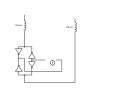
The same consideration probably applies to your second idea - the wiring would be more complex. There would be a grave danger of connecting the fields in opposite directions. It would look a bit like this, I suppose? Nevertheless, it would work, and would be safer than the current parallel approach...

So it sounds as if using Schottkys would work, but might suffer acceptance issues in a traditional environment! I have seen Taycol users looking for electronics specialists in the boating clubs to solder up leads to a straight bridge rectifier, so that is the level of understanding we are dealing with. A circuit like this would only be for the club electronics specialist anyway - so it might be worth mentioning the ideas on a web site. Thanks for the comments!

P.S - thinking about it - all that series connection requires is to connect the AC points of the rectifier, not at the point where power goes into the motor, but at the point where the field coils come out. That should be easy enough....
 

Attachments

Last edited:

shortbus

Joined Sep 30, 2009
10,049
Because the circuit supply voltage is only 7.2V. Many FETs need at least 10V Vgs to turn on fully.
Then why not just say to be sure to pick a logic level to begin with? Instead of even mentioning the threshold voltage. This is what didn't make sense to me.
 

Thread Starter

Dodgy Geezer

Joined Nov 30, 2009
181
Then why not just say to be sure to pick a logic level to begin with? Instead of even mentioning the threshold voltage. This is what didn't make sense to me.
I think it was MaxHeadRoom who first suggested that logic level MOSFET switching might be needed - but the initial issue was one of reliably recognising the polarity change, so that got put to one side. I had not provided much (or any!) of the base data about the problem that Alec_t needed - such as the actual format of the PWM, and while we were working that out he assumed that a low-power relay would be used - so he assumed a Darlington switch. Only when we came to consider the actual switching requirement did it become apparent that a current of about 500mA might be needed, and that MaxHeadRoom's initial guess was right.

Logic level MOSFETs are a bit more expensive than standard ones, and my requirement is sufficiently close to not needing them for it to be worth discussing the actual figures which go to make up that decision. I had thought that the switching process was immediate, once the threshold voltage of 2V was passed. I have now learned that there is a wide tolerance - that 2V - 4V is the point at which standard MOSFETs stop working (cheap ones probably nearer 4 than 2?) and that the full switch only happens at about 10V. And that is mentioned in a little box right at the top of the datasheet, and not down in the Electrical Characteristics, which is where I was looking for it...

That info indicates that I can use standard MOSFETs for a 12V circuit, and that I may be able to get away with them on a 7.2V circuit, depending on the current requirement, so long as it is intermittent... But that at 6v or below I really need the Logic ones....
 

Thread Starter

Dodgy Geezer

Joined Nov 30, 2009
181
You haven't been here very long.:) Many here don't like to be questioned on their statements. And take affront of someone as dumb as me entering a discussion.
Ah! To a philosopher, claiming that you are dumb sounds like boasting! Or at least channelling Socrates, who used to claim that he was both stupid, and the wisest man in Athens. When asked how this could be he replied that at least he KNEW that he was stupid, whereas the rest of the citizens hadn't yet found out that they were as well....
 

Thread Starter

Dodgy Geezer

Joined Nov 30, 2009
181
Not necessarily. Why can't the bridge go in series with the armature?
I've tried this out - the wiring is very easy. With that single sentence you have removed a major reason for creating the polarity detection circuit in the first place! And given me a lot more work re-writing the web site :(

There still might be some minor issues about motor control. I find that my test setup has rather a large dead band around centre stick. That is to be expected, of course, and I suppose it would be less of an issue with Schottkys. The KBU I am using seems to drop 1V per diode....so a polarity detection will still have some advantages....
 

Alec_t

Joined Sep 17, 2013
15,120
And given me a lot more work re-writing the web site :(
Sorry about that ;).
I find that my test setup has rather a large dead band around centre stick. That is to be expected, of course, and I suppose it would be less of an issue with Schottkys.
I don't think the Schottkys would do much to reduce the dead-band, which I assume is more to do with the motor needing a fair bit of voltage to overcome stiction/inertia.
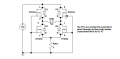
In principle you could make an ideal-diode bridge to reduce voltage drop even further. Here's the concept :-
FieldIdealBridge.PNG
In practice, with only 7V supply and the unknown distribution of voltage between the field and the armature, the choice of FETs with particularly low Vgs(th) values would be critical to success.
 

Thread Starter

Dodgy Geezer

Joined Nov 30, 2009
181
Sorry about that ;).

I don't think the Schottkys would do much to reduce the dead-band, which I assume is more to do with the motor needing a fair bit of voltage to overcome stiction/inertia.
In principle you could make an ideal-diode bridge to reduce voltage drop even further.........
I compared a machine running with the series rectifier against the same machine running with no diodes. There was an obvious difference. The motors are specced as being able to turn on around 1V, so there should not be a very wide dead band (having said that, these motors are 40-80 years old, and careful maintenance/part replacement can only do so much....). So centre-detection has a strong place in the option set for reversing these motors.

I am leaning towards offering three separate options for reversing these motors:

a) - mechanical option for those who like brass, paxolin and knife switches. Uses centre detection or second channel with detent to operate a servo which moves brass switchgear on the motor.

b) - simple, quick option. Uses the bridge rectifier.

c) - original design option. Uses relay switching driven by centre detect.
 
Last edited:

Thread Starter

Dodgy Geezer

Joined Nov 30, 2009
181
No boast, just what I've been told here many times. Mostly because I am not formally trained, and like to think out of the box.
Usually the only way to get a new angle on things is to come at them from a 'non-expert' angle. That's why so many game-changing advances are made by youngsters. Arthur Clarke's First Law refers:

"When a distinguished but elderly scientist states that something is possible, he is almost certainly right. When he states that something is impossible, he is very probably wrong."
 
Top