Picture this...

schmitt trigger

Joined Jul 12, 2010
2,156
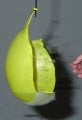
I am a fan of Harold Edgerton's motion-stopping images by means of an electronic flash. The key with this type of photography is to provide flash synchronization with the actual event.
Almost 25 years ago, I built a sound-activated hot-shoe adapter. The noise of the balloon popping would trigger the flash connected to the hot-shoe at the correct time.
Love how the water appears suspended mid-air for those fleeting milliseconds.

globo y agua 2.jpg
 
Last edited:

schmitt trigger

Joined Jul 12, 2010
2,156
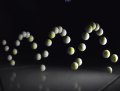
A much more difficult photography was capturing fleeting repetitive events. I could not find a way to recharge the flash capacitor fast enough, and thus I experimented with the then new high power white LEDs. While this worked, this posed another photographic problem, the cumulative flashes would eventually white out the background. I had to use a video camera, with a monitor output of analog composite video. With an LM1881 video sync separator, I would trigger the LED at each frame, and using an ISA-slot video frame grabber card, capture the successive frames and then using photoshop overlay them.
Resolution is only 640X480 but the results are very interesting, clearly showing a decaying mechanical oscillation.

bouncing marble 2.jpg
 
Another photo of my "electronics plus photography" phase of over 20 years ago.
Nowadays,, most cameras have some sort of time-lapse function built in, but back in those days, I built a discrete-logic intervalometer utilizing CD40xx logic functions. There were several pre-settable counters, in which I could dial the interval to which to trigger the camera. The photo below is a full moon eclipse sequence, and the time lapse was set at 15 minutes if I recall correctly. On the very last shot I fired an external flash to illuminate the palm tree.

eclipse.jpg
 
The video frame rate is 30 fps. And there are a total of 10 seconds. 300 individual images.
The clock displays from 3:40 pm to roughly 6:20 pm. Total 2 hours and 40 minutes or 160 minutes or 9600 seconds.
Divide that by the 300 frames and the interval was set for one image taken every 32 seconds.
 

wayneh

Joined Sep 9, 2010
18,130
Alta Lake near Telluride.
View attachment 352035

I exported this from (Mac) Photos at maximum jpeg quality, large size. Sad to say it looks like crap here on the forum compared to the original. Mostly a big loss of dynamic range. The exported jpeg looks much better but the forum software seems to degrade it. Anything I can do about that?
This photo no longer looks degraded to me. A slight loss from compression to jpeg but hardly noticeable. Something changed since I complained back then. I lean towards blaming the forum software or server but I guess I can't really be certain whether it was at this forum's server or local to my laptop software.

Anyway I'm thrilled to see a big quality boost.
 
I also had a lot of fun using a fisheye lens. The following photo won a prize local photography contest. It shows the last thing an ant will see before being squashed.
What I loved about the fisheye lenses was not only the extraordinary field depth, but also the perspective distortion, both clearly seen in this photo.
como te ven las hormigas.jpg
 
Top