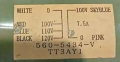
If you connect both windings in series (making sure that you get the polarity correct) then you can use it as an autotransformer, but then you will have no isolation.
PS. Get your units correct: VA is a measure of power, not voltage.
It is possible to use as an autotransformer, unfortunately, it will be possible to take only a small power from it. If one winding is 100V 7.5A , and the second would be 120V 15A , then it would be possible to take a large power
It is possible to use as an autotransformer, unfortunately, it will be possible to take only a small power from it. If one winding is 100V 7.5A , and the second would be 120V 15A , then it would be possible to take a large power
Auto transformers can be deceptive. With 7.5A out, there must be 3.75A input, so 3.75A flows in the “top” half of the winding.
In the bottom half, there is 7.5A secondary current in one direction and 3.75A primary current in the other, so the NET current is only 3.75A, so , ignoring the magnetisation currents, the transformer is running at 50% load when outputting 7.5A.
If you think of it as being supplied by a 120-0-120V supply, with equal loading on each half, the top supply gives 3.75A to the output via the transformer, and the bottom half gives 3.75A which bypasses the transformer.
This is designed for a 100/120 volt mains supply, and I might guess that it was designed for a 60 Hz supply. With 220/230 volt input it is likely that the magnetic core will be driven into saturation giving rise to a very significant overcurrent, which will either blow a fuse, burn out the transformer altogether, or start a fire.
I don't recommend trying to reconfigure this as an autotransformer. You could drive the equipment with 110 volt derived from 220/230 V using an external autotransformer.
I don't recommend trying to reconfigure this as an autotransformer because:
a/ This was not designed for this purpose,
b/ The manufacturer has not indicated the polarity/phase of the secondary winding wrt the primary.
c/ I don't know what the insulation specification is for the primary to core/frame
d/ I don't know whether the OP understands the implication of breaking the primary/secondary isolation normally afforded by the primary/secondary windings.
Potentially you are setting yourself - or a subsequent user to electrocution. Its just not worth it for an old transformer!
I don't recommend trying to reconfigure this as an autotransformer because:
a/ This was not designed for this purpose,
b/ The manufacturer has not indicated the polarity/phase of the secondary winding wrt the primary.
c/ I don't know what the insulation specification is for the primary to core/frame
d/ I don't know whether the OP understands the implication of breaking the primary/secondary isolation normally afforded by the primary/secondary windings.
Potentially you are setting yourself - or a subsequent user to electrocution. Its just not worth it for an old transformer!
As I understand, the TS has 110 volt equipment that he wants to use in a 220 volt region. And wants to use this transformer as an auto transformer.
Post #5 gives the answer.
The 100v and 110v are both part of the same winding as the 120v, therefore it is not possible to connect any other way.
It has to be a separate winding in order to series it .
The 100v and 110v are both part of the same winding as the 120v, therefore it is not possible to connect any other way.
It has to be a separate winding in order to series it .
So that would give a 100V, 110V, or 120V output as an autotransformer with no isolation from the primary to the secondary.
But it may be problematic from transformer saturation if the 220V goes up to 240V as can occur in some 220V systems.
There are not so many 220V countries. All of Europe, for instance, is 230V.
Your transformer might be rated for 60Hz, in which case it is likely to saturate on a 50Hz supply.
So that would give a 100V, 110V, or 120V output as an autotransformer with no isolation from the primary to the secondary.
But it may be problematic from transformer saturation if the 220V goes up to 240V as can occur in some 220V systems.
I don't think the primary has three complete windings. It seems like the primary is 120V total with two additional taps to allow the appropriate connection to get as close to 100VAC output as possible.
I don't think the primary has three complete windings. It seems like the primary is 120V total with two additional taps to allow the appropriate connection to get as close to 100VAC output as possible.
So that would give a 100V, 110V, or 120V output as an autotransformer with no isolation from the primary to the secondary.
But it may be problematic from transformer saturation if the 220V goes up to 240V as can occur in some 220V systems.

 Facebook
 Google
 GitHub
 Linkedin