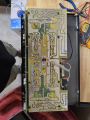
See the circles....I believe they are the power transistors and may be a driver.
If you desolder those pins then you can check for shorted power transistors
See the circles....I believe they are the power transistors and may be a driver. View attachment 344336
If you desolder those pins then you can check for shorted power transistors
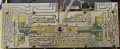
Three TO3 devices in parallel each with its own emitter resistor. The emitter resistors are where there is something written in feltpen on the board.
The heatsink is on the other side. The black screws fix it.
Nope. The black screws tie the PCB to the back panel via two sheet aluminum U-channels.
I think (I can't see the whole thing yet) the heat sink is one monolithic chunk of extruded aluminum held on to the PCB only by the TO-3 (silver) screws. Somehow, the screws must be insulated from the heat sink (shoulder washers?).
What I don't know is if I can remove the PCB just via the black screws. It looks like some hardware is mounted to both the PCB and the back panel, and there are a ton of wiring harnesses underneath the board.
I'm going to delsolder the transistors first and ensure one or more of them are shorted. Then I'll deal with the next step.
I've got a real job, so I can only spend a few minutes a day on this. It'll be a while.
I should pay more attention. I'm reading this while cooking my tea, and seeing a picture of a dismantled amplifier.
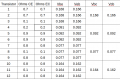
In situ, the lowest ones will be dead. Measuring across a good one will give the resistance of the bad ones plus one emitter resistor, plus several emitter resistors in parallel depending on how many dead ones there are.
Do you have the transistor’s part number? A photo of the device will be nice.
I don’t want to discourage you, but TO-3 packaged transistors will give you a sticker shock.

 Facebook
 Google
 GitHub
 Linkedin