Old Peavey mixing console trips breaker

Thread Starter

robismod

Joined Sep 22, 2015
343
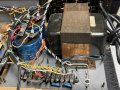
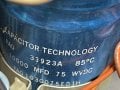
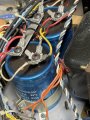
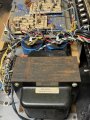
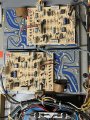
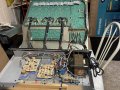
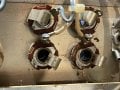
I have an old Peavey XR1200 powered mixer board (maybe late 80s or so) that hasn’t been used in many years. Plugged in some speakers and turned it on—heard a little bit of hum from a speaker or possibly both. Then kicked house breaker as well as the onboard 8 amp fuse. I’d like to get it working again so I could give it to a new, small startup church. And, I’m searching the net for service documents but haven’t found any yet. I have torn into it, but assuming a start with new caps. Maybe an issue with the transformer? And…just curious here, but, could a different power supply be fabbed up to replace the old one, if necessary?
Thanks again for any tips, hints…
 

Thread Starter

robismod

Joined Sep 22, 2015
343
This site claims to have the schematic:
https://elektrotanya.com/peavey_xr800_xr1200_xr1600_sch.zip/download.html

That's a start. Check components around the power supply, and check that the transformer is providing secondary voltages ok.
Good luck
I saw that in my searching, and a couple of others. But for the last couple of years I’m suspecting just about everything of being possible scammers, phishers, hackers, etc., so I was afraid to go any farther, unless someone we trust can verify for me…I’ve had some close calls despite the increased diligence I try and put in…
 

Thread Starter

robismod

Joined Sep 22, 2015
343
Wire a 100W mains incandescent lamp in series with the mains to the mixer power supply. That will stop you blowing things up while you chase the fault down. Then remove it once you get it going.
You know, I’ve seen that mentioned so many times, and I seem to forget it. I really want to try that…lol…
 

Tonyr1084

Joined Sep 24, 2015
9,744
Wire a 100W mains incandescent lamp in series with the mains to the mixer power supply. That will stop you blowing things up while you chase the fault down. Then remove it once you get it going.
I did that when my amp blew the 7A fuse. Enabled me to track down a shorted bridge rectifier. Replaced the rectifier and fixed the problem. A shorted rectifier can overload the transformer causing the fuse to blow. But tripping the house breaker - I would't have expected that. THAT could just be because at the time the circuit was already at near capacity. But the lightbulb trick is a good one. I've used it once so far in my life.
 

MisterBill2

Joined Jan 23, 2018
27,171
GOOD JOB on quickly discovering it was the bridge rectifier assembly. The TRANSFORMER is the very last component I would suspect, especially on a piece of quality equipment. In addition, rectifier diodes are simple and easy to test in circuit, so that is a good first place to look.
 

Thread Starter

robismod

Joined Sep 22, 2015
343
  1. Finally! Got around to building me a light bulb mains tester! Hopefully soon I’ll start digging in on this project.
 

Thread Starter

robismod

Joined Sep 22, 2015
343
This site claims to have the schematic:
https://elektrotanya.com/peavey_xr800_xr1200_xr1600_sch.zip/download.html

That's a start. Check components around the power supply, and check that the transformer is providing secondary voltages ok.
Good luck
I took a chance and grabbed this download. But, I believe it’s for a later revision—an XR1200-D…the power supply section doesn’t quite look right to me…but I could be wrong. I’m also going by seeing pics of the version D, and it is a different layout than mine…
 

MisterBill2

Joined Jan 23, 2018
27,171
A logical testing scheme should help locate the problem with the mixer board. Given that it popped the fuse, but not instantly, it is probably not a power transformer fault. That is very good news because the transformer would be a very big replacement expense.
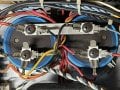
IF the mixer/amplifier was working when it was put away, then it is not likely that the transistors have failed, but much more likely that some of the large capacitors have failed with increased leakage current.
So with the light bulb to limit the mains current input, a logical step will be to check the voltage across the filter capacitors. although checking the power supply diodes is also a good idea.
 

Thread Starter

robismod

Joined Sep 22, 2015
343
A logical testing scheme should help locate the problem with the mixer board. Given that it popped the fuse, but not instantly, it is probably not a power transformer fault. That is very good news because the transformer would be a very big replacement expense.
IF the mixer/amplifier was working when it was put away, then it is not likely that the transistors have failed, but much more likely that some of the large capacitors have failed with increased leakage current.
So with the light bulb to limit the mains current input, a logical step will be to check the voltage across the filter capacitors. although checking the power supply diodes is also a good idea.
Sounds like a great way for me to start…I don’t think I mentioned—the mixer had been unused for quite a few years but did work. When I powered it up, I got a hum in the speakers. I then started flipping the power switch to the other position (unground?) and that’s when it blew the fuse and best I can tell the house breaker at that time. I didn’t get a chance to see if any audio signal was getting to the speakers with the hum.
 

meth

Joined May 21, 2016
298
Interesting indeed! It may be a shorted capacitor in the grounds selection part of the system. An investigation of the actual circuit is in order !
I came to write this. I had same problem on another audio device.
Check if you have short circuit from the +V (and if there is, -V) rail to ground. If yes, you would have to desolder the caps one by one until you find the faulty one.
 

schmitt trigger

Joined Jul 12, 2010
2,027
Ditto for the large electrolytic caps being the prime suspects. After many years of non use, the electrolyte may have leaked out. That, and the fact that you heard hum.
If you do find out a defective one, be sure to also test the bridge rectifier, which could have shorted out during the overload.
 

MisterBill2

Joined Jan 23, 2018
27,171
Posts #14and #15 make good points. The problem could certainly be a cascading failure. That term means that one part's failure caused another part to fail. Certainly possible.
 

Thread Starter

robismod

Joined Sep 22, 2015
343
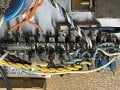
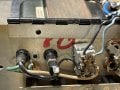
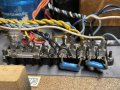
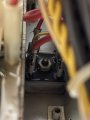
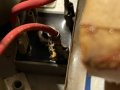
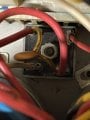
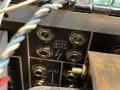
Last group…odd thing to me—notice the back panel with the 4 1/4” jacks grouped together. Labeled Power Amp Out. Seems odd that the lower two are not “wired” but merely touching the soldered terminals of the other two, and doesn’t appear to be soldered to anything…
 

Attachments

Top