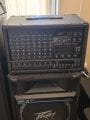
Peavey XRD 680S Plus

Thread Starter

joeyd999

Joined Jun 6, 2011
6,204
Okay, so the wife means well, but sometimes she gets expensive.

My Peavey amp is not putting out sound since my daughter's bday party Friday. The mixer section is working, all the way up to the power section input.

Upon cursory inspection, I noticed that a strand of decorative garland -- hung by my wife behind the amp -- was sucked in by and wrapped up around the cooling fan preventing it from spinning. Removed the garland, fan runs fine.

Question for the peanut gallery: how much damage was done to the power output board, and what should I look at first?
20250309_151110.jpg
 
Last edited:

Thread Starter

joeyd999

Joined Jun 6, 2011
6,204
BTW, the amp could have been running for hours with no cooling -- it runs in parallel to another amp driving another set of speakers.

All anyone would have noticed during the party was a slight reduction in overall volume, assuming they were even paying attention.
 

Thread Starter

joeyd999

Joined Jun 6, 2011
6,204
Output transistors, failed short and blown the DC rail fuses. At a guess, they would be the only casualties.
Is it possible the fuses saved the transistors (I think there's 6 per channel)? Or would a fuse blow only in the case of a damaged transistor?
 

Ian0

Joined Aug 7, 2020
13,097
Is it possible the fuses saved the transistors (I think there's 6 per channel)? Or would a fuse blow only in the case of a damaged transistor?
The fuse would only blow if the transistor failed.
Otherwise, fuses would blow if run at full output for any length of time.
 

Ian0

Joined Aug 7, 2020
13,097
Confirmed: both fuses blown.

@Ian0, is it possible to determine which transistors are failed without desoldering all of them?
Just look for emitter-collector shorts.
Probably best to replace them all.
If there are several in parallel, then it's better if you have almost identical devices in parallel.
If only one has blown, e.g. the one on the positive side, then only the fuse on the top side would have blown.
It's not common for them to blow the driver stage, but check the base-emitter resistors on the output transistors.
 

Thread Starter

joeyd999

Joined Jun 6, 2011
6,204
The amp is circa 1994. Should I change out the electrolytics while I'm at it?

BTW, power audio is absolutely not my forte.
 

Ian0

Joined Aug 7, 2020
13,097
The amp is circa 1994. Should I change out the electrolytics while I'm at it?
I don‘t usually bother. It‘s generally a case of “Will you fix my amp?”
”When do you need it?”
”We’re on the way to the gig, and we’d forgotten that we blew it up at the last gig”
It won’t do any harm to replace them, but more important is to check that the heatsink compound hasn‘t dried out, and if it has, clean it off and apply some more, then apply some to your fingers and transfer it to anything you touch for the rest of the day.

I‘d fix it for you if you weren’t so far away. It would probably take me less time to fix it that taking it apart and putting it back together.
 

schmitt trigger

Joined Jul 12, 2010
2,027
I would also search for the service manual. A wholesale replacement of the output transistors operating in class-AB may mean that you very likely require to adjust the bias.
The manual will tell you what that bias level is and where you should measure it.
 

schmitt trigger

Joined Jul 12, 2010
2,027
You **may** be lucky and the amp will run fine without ant adjustment.
But too little bias and the sound will distort or too much bias and the transistors will run hot.
 

Ian0

Joined Aug 7, 2020
13,097
It’s not exactly hi-fi. If there is some bias it will be OK. Anything between 25mA and 100mA Will work. Above that and it will start to run warm.

If there is no preset there is no adjustment!
 

schmitt trigger

Joined Jul 12, 2010
2,027
The preset will be located close to a transistor called Vbe multiplier. It will be a small signal transistor in close thermal contact to the main transistors. The measurement will be done by measuring the voltage drop across the main emitter transistors.

Of course, I am assuming that this is an ALL BIPOLAR OUTPUT stage.
If it has Mosfets, it won’t have bias adjustment but may require to match the transistors for Vgs(th). Again, you may be lucky and this step is not required.

FIRST THINGS FIRST. Open the unit and determine the transistor part number.
While you are at it, take photos (clear and focused) of the board area: one of the whole board and several close ups in the vicinity of the output transistors.
 
Top