Oscilloscope Features

Wuerstchenhund

Joined Aug 31, 2017
189
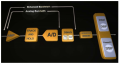
Oversampling. Keep in mind Nyquist applies to band limited signals.
Often not the case in digital work, eg. pulse fidelity considerations,
signals not band limited with many harmonics >> fundamental.
The original signal isn't BW limited but the input signal into the ADC is, because the scope's inputs are BW limited.

The 5x 'rule' is used to essentially compensate for the difference in spec'd BW (which also is only to the -3dB point) and in real BW (which is larger, sometimes only slightly, sometimes a lot). Besides, sample rates are stepped (often in multiples of 2), so the next lower sample rate may already be insufficient.

I'd rather use the real BW, even more so as on many better scopes you can setup and define your own filters so the actual BW can be variable.

Also keep in mind that the spec'd sample rates aren't fixed, they are maximums! Which means depending on your settings and available memory your scope may not be able to achieve them. That means while the analog BW is the same, the discernible BW may have now dropped more or less dramatically, and any frequency component above the discernible BW will show as aliasing.


Many DSOs offer oversampling as a means to increase resolution (HiRes modes) or reduce noise (averaging). One thing to remember is that with oversampling the discernible BW drops dramatically, increasing the chances for aliasing.

Which is why these are only optional modes.

But if you really need higher than 8bit resolution then buying a real high definition scope would be the better option than relying on HiRes modes.
 

Wuerstchenhund

Joined Aug 31, 2017
189
Interpolation is not "cleaning up", that's nonsense. Interpolation is a method to 'bridge' the individual sampling points so the user doesn't see just dots. Very eEarly DSOs only did vector (linear) interpolation which isn't a valid method of reproduction, i.e. the resulting waveform is not an exact reproduction of the actual signal, but in many cases ((especially with many sampling points per period) it's good enough.

Newer scopes perform sinc(x) interpolation which results in a mathematical valid and true reproduction of the input signal, as long as Nyquist-Shannon isn't violated (fs >= 3x highest frequency content) and the signal is BW limited (which it will be as the scope is BW limited).

None of this is 'cleaning up', and sin(x) interpolation is based on mathematical and physical laws (for example, that every non-sine waveform is made of multiple sine waves at different amplitude, frequencies and phase.)

As to DSPs, they are primarily used to compensate for insufficiencies in the signal paths (maintain linearity in amplitude and phase over the whole analog BW) which come from non-linearities and capacities/inductivities in the signal path, something in analog scopes either didn't happen or if it happened was through a series of trimmers and pots.

Especially Tek uses DSPs also for waveform processing, although not very successfully, as their digital scopes had and still have a worse performance than their competitors, but that is a different story.

How about we start talking about all the inherent issues in analog scopes, from non-linearities in the analog amplifiers to the horribly loose timebase specifications compared with even cheap China DSOs, to the limitations that come from an electron beam drawing on glooming phosphor, which hides a lot of the higher frequency components in the signal?


Yeah, let's talk about 'cleaning up' again...
 
Last edited:

danadak

Joined Mar 10, 2018
4,057
"cleaning up", "modifying", "interpolation" pretty much conveys
what happens to the incoming sample set. And then there is the
gain calibration applied in modern DSOs. Lots of "manipulation".

And god forbid, like analog scopes, we have amps (non linearities)
and filtering in the signal path. And I am permanently blinded by the
glooming phosphor on my analog and DSOs (with CRT). As well as
almost a million engineers raised on analog devil scopes......:).

And then we have the incredible resolution of DSOs with their immense
8 bit digitizers. Can it be that the ultimate limit of mankind is just 8
bits (I have a 12 bit DSO).

Sarcasm suits us both I see.

Yeah, let's talk about 'cleaning up' again...


Regards, Dana.
 
Last edited:

ebeowulf17

Joined Aug 12, 2014
3,307
And then we have the incredible resolution of DSOs with their immense
8 bit digitizers.
I was truly stunned when I first got my hands on a DSO (only about a year ago) and discovered that it only had 8 bit resolution. It's still an incredible tool that's helped me through all sorts of projects, but compared to all the other things it does well, the 8 bit resolution is a joke!
 

Wuerstchenhund

Joined Aug 31, 2017
189
I was truly stunned when I first got my hands on a DSO (only about a year ago) and discovered that it only had 8 bit resolution. It's still an incredible tool that's helped me through all sorts of projects, but compared to all the other things it does well, the 8 bit resolution is a joke!
Why? Even today the majority of new scopes sold are 8bit. Because it's enough for the majority of standard measurements. If your specific use care requires a higher resolutions, options exist. Don't forget that higher resolution means a lot more data is produced, which needs to be stored and processed.

Back in 1989 my main DSO was a Philips PM3320A which had 10bit resolution, but there were very few cases where the additional resolution has shown to be an advantage.

Also, many scopes have a mode ('Hi-Res' or 'ERES') where the vertical resolution is increased through oversampling but that comes at the cost of BW limitation.
 

ebeowulf17

Joined Aug 12, 2014
3,307
Why? Even today the majority of new scopes sold are 8bit. Because it's enough for the majority of standard measurements. If your specific use care requires a higher resolutions, options exist. Don't forget that higher resolution means a lot more data is produced, which needs to be stored and processed.

Back in 1989 my main DSO was a Philips PM3320A which had 10bit resolution, but there were very few cases where the additional resolution has shown to be an advantage.

Also, many scopes have a mode ('Hi-Res' or 'ERES') where the vertical resolution is increased through oversampling but that comes at the cost of BW limitation.
Just ignorance really. Everything the oscilloscope does in terms of timing precision, triggering options, etc was so far beyond anything I could do without an oscilloscope that I just assumed it would be good measuring voltage precisely too. As it stands, cheap multimeters, and even home made microcontroller solutions, can measure with greater precision than the scope.

I agree with you that its capabilities are remarkable and useful without the extra precision, and it's probably a logical compromise - it just surprised me.
 

ArakelTheDragon

Joined Nov 18, 2016
1,366
I suggest that you estimate what you will need the most. What will you be doing in general for a long time. Can you go withouth using a more expensive feature. If a 50 USD osciloscope is enough for you, get it.
 

Wuerstchenhund

Joined Aug 31, 2017
189
Just ignorance really.
Asking a question something isn't a sign of ignorance. More to the contrary, actually ;)

Everything the oscilloscope does in terms of timing precision, triggering options, etc was so far beyond anything I could do without an oscilloscope that I just assumed it would be good measuring voltage precisely too. As it stands, cheap multimeters, and even home made microcontroller solutions, can measure with greater precision than the scope.

I agree with you that its capabilities are remarkable and useful without the extra precision, and it's probably a logical compromise - it just surprised me.
Look at it this way - the 'scope' (i.e. something to view) in 'oscilloscope' was to be taken literally for most of its existence. Analog scopes, which people still use, have no real measurement capability whatsoever, they were instruments requiring the operator to look at and assess a waveform. 'Measurements' were done by counting indents on the graticule, which didn't exactly deliver precise results. Also, the specs of a typical scope weren't made for precision or high resolution, too.

When DSOs came out it turned out that 8 bits already provided for sufficient resolution compared to the operator staring on the CRT of an analog scope.

Today, many scopes, especially in the entry-level/low-end sector of the market, are still used by many users like an analog scope. Tasks where you need to measure at more than 8bit resolutions are rare but increasing, and for that there are true high definition scopes which offer 10bit or 12bit resolution and usually are located at the higher end of the market, where they offer sophisticated anaysis tools that make use of the higher resolution.
 
Top