Oscillator won't oscillate

Audioguru again

Joined Oct 21, 2019
6,826
I use modern enameled wire and my soldering iron removes the enamel.

Your first 0.411uH coil looks good for about 80MHz but needs a few more turns for 27MHz.
The ESR should be very close to zero so maybe you are measuring the resistance of the leads on your meter.

At this fairly high radio frequency you cannot use the trimmer board because the stray capacitance on it plus the capacitance of the wires to it are too high. The trimmer capacitor must be soldered directly beside the coil with very short wiring.
 

Tesla23

Joined May 10, 2009
560
I was feeling bored writing software, so I lashed up this 'oscillator' (taking me back to my HF comms days) to give me some "RF playtime". I thought the coil tapping looked wrong, and I wouldn't have chosen that biassing for an oscillator. I didn't have any 2N3904, from a quick search, the closest seemed to be a BC547.

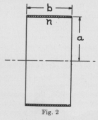
I wound a coil 9T on 5/16 drill of 21SWG, about 12mm long. For these types of inductors I use Wheeler's Formula https://ieeexplore.ieee.org/document/1669896:
1687687601806.png1687687630547.png

a and b are in inches.
For my coil, allowing for the diameter of the wire, a = 0.172, b = 0.441 giving L = 0.40uH

It didn't oscillate, so I moved the tapping to approximately the midpoint (actually 4T from the cold end). I haven't analyzed this, but the maths would be the same as the Clapp if the inductors weren't coupled, and there equal components are reasonable. I haven't worked out the effect of the coupling, it was easier to just move the tap point, It now oscillated, but squegged terribly. Oscillation lasted about 2us and repeated about every 10us.

Now I'm miffed, what was going to be a quick play now needs some time to make it work.

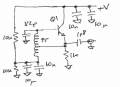
Squegging is when the circuit initially oscillates, but as the signal builds up it moves the bias point, and for any one of several possible reasons, kills the oscillation. I tried to stabilise the bias by using a voltage divider for the base:

1687687937166.png

To try to hold the DC on the base constant, I changed the configuration as shown. 10u on the base is probably overkill, but that is what was on the bench. Note I didn't build the buffer, just lightly coupled the emitter to my spectrum analyzer. It still squegged. I changed Q1 to a 2N5770 (an RF device Ft about 900MHz) and it oscillated steadily producing a reasonably clean signal.

0.40uH and 82pF resonate at 27.8MHz, my oscillator produces 26.1MHz. There is clearly some capacitive loading on the coil, and uncertainties in values.

Two low frequency devices BC547 and 2N2222A both squegged, whereas higher frequency devices 2N5770 and MPS3646 both worked reasonably. Maybe someone can explain this?

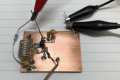
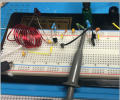
For interest here is my prototype:

1687688448597.png

This is my preferred style for prototyping with HF leaded components. I use 0.030" double sided board that I cut into small pads. If I was making something to last I would bond these to the groundplane, for prototyping you can often just hold them down with grounded components. I have some 0.030 teflon board from my microwave work and this is great.
 

Ya’akov

Joined Jan 27, 2019
10,258
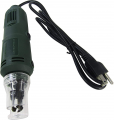
For magnet wire I've used two good methods. The first is a rotary magnet wire stripper. While not cheap, this is the Right Thing™ for the job. They are usually table top units but handheld ones are about 50% of the cost and more convenient for occasional use.

1687689986629.png
Available on Amazon, this model seems to be the most common.
The other method is using a solder pot. With the temperature high enough to burn off the enamel, the solder pot also has the advantage of tinning the wire at the same time. If you do this keep in mind ventilation, and removing the dross along with the burnt varnish occasionally during use. I set the temperature empirically—first using the solder melt point temperature, then testing the wire in that, then slowly increasing as required to get the stripping action desired. Keep in mind dwell time is a part of it and you should try to leave the wire in the pot for a few seconds rather than count on the immediate burn off.

USE PLIERS, the wire can get HOT.
 

Thread Starter

SamR

Joined Mar 19, 2019
5,495
Now I'm miffed, what was going to be a quick play now needs some time to make it work.
I know the feeling! This was a design from Mr. Carlson's Lab which is usually very reputable. In the comments section though, it's easily 50% or more saying it doesn't work or giving them lots of grief. What is so very odd about it was the tap placement @ ~1 turn. I came up with about the same uH for the coils I wound which using the standard Fr = 1/ 2π√LC gave me a sub pico capacitance? And, I initially got it to oscillate ~15MHz using a 180pF tank cap? Been a real learning experience and made me review the theory. I've also tried center tap on the current ~1.5uH coil I'm working with and no joy as yet.
 

Thread Starter

SamR

Joined Mar 19, 2019
5,495
rotary magnet wire stripper
I'll look into that! I also used a bigger/more mass tip with no results as well. The big problem is the tap point on the coil being hard to "get to" as the ends are easier to scrape/sand. Also, while I have your attention, what do you use as the temp setpoint for your Hakko iron? 662° seems a bit low for me.

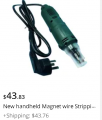
Edit: I thought I had found a deal, until I read the fine print on AliX
1687694707884.png
Kinda looks like my Dremel tool would do the same thing!
 

Ya’akov

Joined Jan 27, 2019
10,258
Edit: I thought I had found a deal, until I read the fine print on AliX
Kinda looks like my Dremel tool would do the same thing!
Yes, I looked there first, 220V tools only for some reason.

Also, while I have your attention, what do you use as the temp setpoint for your Hakko iron? 662° seems a bit low for me.
So, for 63Sn/37Pb solder, I use 335℃, which is 635℉. The melting point of the 63Sn/37Pb eutectic alloy solder is 183℃. The rosin core flux will melt at about 175℃. Practical limits on thermal coupling and the need to heat more than just the solder makes a higher temperature than the strict melting point necessary.

The Kester solder I prefer has a manufacturer maximum recommended iron temperature just a bit lower than I choose but the difference is not significant. From the datasheet:

1687695912303.png
If you are having trouble with getting good joints at the relatively high temperature you are using, I would look to other things to fix it. Also, I would reduce the temperature and try to make it work at no more than 350℃ because the higher temperature can degrade the flux and promote a lot more oxidation.

Get a tip thermometer like one of the myriad Hakko 191 clones from AliExpress and measure your tip to be sure your iron is calibrated. You might not be as hot as you think. If you do need to go above 350℃ do it incrementally to minimize how much hotter you are.

Obviously, make sure the solder you are using is good stuff, make sure it's 63Sn/37Pb for component to board soldering. 60Sn/40Pb alloy has notably better wetting action and so it's best for tinning wires.

I hope this is helpful.
 

Thread Starter

SamR

Joined Mar 19, 2019
5,495
Yes, I looked there first, 220V tools only for some reason.
Didn't see the 220V models, but eBay has quite a few offers in the 50USD range with free ship from china. In a hurry so bought one on Amazon. Thx for the heads up!

for 63Sn/37Pb solder, I use 335℃, which is 635℉
Thanks, my Xtronic 3020 quit so went ahead and got the Hakko. Some key differences, all in Xtronic's favor! F/C switch, very simple to change temp, has a sleep mode with quick recovery. A big noticeable difference is the Hakko has a transformer and Xtronic uses SMPS. Don't know why the Xtronic died but suspect it is the heating element. Ordered replacement (2 pack) and soldered one in BUT they are ~1/4" longer than mine which is over 5 years old and the first model in the 3000 line (no longer made). They use the same element in several models. The good thing is Hakko and Xtronic use the same tips. Xtronic says life span of element is only 6 months depending on usage and I got over 5 years with light/intermittent usage. Replacements ~7 bucks for 2 and not difficult to replace IF you have a vacuum desoldering iron (I do) and a backup soldering iron (didn't so I bought the Hakko). Anyway... Back to trying to get this circuit to oscillate!
 

Ya’akov

Joined Jan 27, 2019
10,258
Thanks, my Xtronic 3020 quit so went ahead and got the Hakko. Some key differences, all in Xtronic's favor! F/C switch, very simple to change temp, has a sleep mode with quick recovery. A big noticeable difference is the Hakko has a transformer and Xtronic uses SMPS.
The Hakko ( I assume you mean the FX-88) is a production-focused station, so the settings are designed to be set and forget. That’s why the temperature and C/F settings are modal. It’s true that it’s not as convenient though I found it made me choose improving my technique rather than increasing the heat.

Since the tip is not quick change, if I was going to put a bigger tip on for some reason, I could adjust at that time.

Anyway, it’s a really solid station that should last you a very long time.
 

Thread Starter

SamR

Joined Mar 19, 2019
5,495
It's not that big of a hassle to change tips and in a pinch, it can be done hot with a bit of care. Put the 18AWG 1.785uH coil on the board and center-tapped it. Pretty much ran the full gamut of pF caps across it and still no oscillation! This is getting very frustrating!
1687706975300.png
@1.785uH for 27MHz the tank capacitor should be ~20pF
1687707201380.png

But, all I'm getting is hash...
1687707721494.png
 

bertus

Joined Apr 5, 2008
22,938
Hello,

The problem may well be the breadboard.
Using a breadboard for rf circuits above 1 Mhz may be problamatic.
The manhattan prototyping style that @Tesla23 used will work fine for rf circuits.

Bertus
 

Thread Starter

SamR

Joined Mar 19, 2019
5,495
Yes, I agree, time to go ahead and put it on FR4 clad... I have a bit different method of cutting islands in the clad instead of stacking that I want to try anyways.
 

Halfpint786

Joined Feb 19, 2018
109
Yes, I agree, time to go ahead and put it on FR4 clad... I have a bit different method of cutting islands in the clad instead of stacking that I want to try anyways.
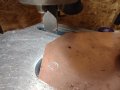
This works ok... Just a standard driver bit cut down to a tooth with a dremel. Its good to clamp the board down because if you cut the island too fast the bit wil grab the board and ruin it. Gotta cut slow, but it works good if you have a drill press.
IMG_20230625_175100223.jpg

Edit, and since that last post a few minutes ago, I was able to cut all the islands for the hartley with buffer amp I was going to try making on the other side of that board. Forgot 2 islands on the right though lol.
IMG_20230625_180336358.jpg
 
Last edited:

Thread Starter

SamR

Joined Mar 19, 2019
5,495
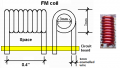
Yep, it's .75" and my meter reads it as 1.785uH which should take a 20pF capacitor to oscillate ~27MHz. Why do you say too large? My calculations say it would need 20 turns @ 5/16" to do the same.
 

Thread Starter

SamR

Joined Mar 19, 2019
5,495
works good if you have a drill press.
There's another trick using a handheld leather belt hole punch with the teeth serrated that gives 4.5mm and smaller islands. Clamp it down on the board and twist it back and forth to cut the groove. For larger islands I have a larger set of arbor punches that could work with a bit of effort. Or the standard Manhattan style using small bits board attached to the main ground plane board. I see you sketched the layout, that's my next step but got sidetracked with the grandkids and my son-in-laws birthday party at our house. I'll get to it when I can but grandkids here for the week and a couple of doctor appts. to get to as well...
 
Last edited:

Ya’akov

Joined Jan 27, 2019
10,258
This thread makes me wonder if it would be possible to create a high frequency breadboard. Maybe using PTFE for the body and carefully designed contacts inside, or some other thing like "connectors" that clamp to the leads and are accepted by the board. I really don't know if this is a practical idea, but it might be cool.
 

Thread Starter

SamR

Joined Mar 19, 2019
5,495
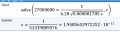
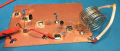
Ok, I did it "Manhattan" style. I cherry picked and ended up paralleling 2 capacitors to get the 5.35uF the calculations called for (5.34uF exactly).
1687993589629.png
I tried to keep it compact but I think it could be better...
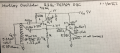
Here's the schematic and some EBC voltages.
1687993716221.png
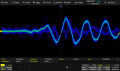
At first I kept the ~1 turn tap on the coil and went to mid-coil after. But all I am getting out of the oscillator is noise...
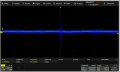
1687993910341.png
It is so jittery the scope can't keep up with it. What next???
 
Last edited:
Top