Oscillator won't oscillate

Thread Starter

SamR

Joined Mar 19, 2019
5,487
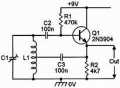
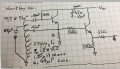
Here is the circuit. Xstrs are 2N3904s. Coil is 9 turns of 22AWG with 5/16"ID. Only waveform showing on the O'scope is 60Hz noise.
1687119592359.png
The numbers are screwy. Calculation for the coil specification says it is 6.44uH but my LCR meter says it is actually ~1.85uH. The design gave me the 82pF and 27MHz values and the 9 turns on a 5/16" mandrel. But running the calculation for my actual inductance and the frequency specified the capacitor should be 0.188pF which I seem to be out of for some reason. @Audioguru again yes, I built it on a breadboard but even that won't oscillate. I could sure use a nudge in the right direction here to make this thing oscillate preferably ~27MHz even if I have to wind another coil. I've checked, double-checked, and rechecked the board circuit and all is there in their correct spot and the Xstrs do work so I've run out of ideas.
 

Audioguru again

Joined Oct 21, 2019
6,826
A Hartley oscillator is mot made with emitter-followers that have no voltage gain. The transistor must have some voltage gain so a common-emitter transistor (collector output feeds feedback in the center-tapped coil to the base).

A capacitor that is 0.188pF has NO capacitance. 6.44uF might work at a low audio frequency.

Here are a couple of Hartley oscillators:
 

Attachments

Thread Starter

SamR

Joined Mar 19, 2019
5,487
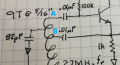
An odd feature is the coil is not divided by a center tap. See points A & B. A is at the start of the coil and B is less than 1 full turn out of 9. And the coil is DC isolated by capacitors so it is not the "usual" Hartley osc. Yes, I've often seen it drawn with a variable cap in the "Tank".
1687127531582.png
The schematic doesn't quite show where they physically are located. And, that point A to B is actually only about 3/4 5o 7/8 of a turn.
1687128095907.png

Getting it to oscillate spot on at 27MHz is not necessary but I would like to get it in the ballpark and others don't seem to have the problem that I do. Or, they could be fibbing! The only way out that I see is to modify the coil? If so, I need to calculate based on using 22AWG. Turns, tank capacitor value, and ID are up for grabs. Also, it was never specified but the power supply is 5V and that is also up for grabs. I do have some 220pF? trimmer caps somewhere that I think I can find so let me find them.
Edit: Yep, found a bunch of them up to 120pF so have that covered. I'm still a bit shaky on Xstrs (got sidetracked by op amps) but can do the basics.
 
Last edited:

Audioguru again

Joined Oct 21, 2019
6,826
I see that the emitter drives a tap on the coil then the ungrounded end of the coil produces a higher signal that feeds the base in-phase. The input and output of the emitter-follower are also in-phase then the circuit oscillates if the rows of contacts and wires all over the place on a breadboard do not feed in too much interference.
 

Audioguru again

Joined Oct 21, 2019
6,826
With the tap on the coil so close to the base end then the coil does not produce any voltage gain. Then no oscillation.

Try a center-tapped coil,then try it with the emitter feeding 1/3rd of the coil and the base getting the entire coil.
 

michael8

Joined Jan 11, 2015
472
I'd think it very hard (if at all possible) to get it to oscillate at 27 MHz on one of those white protoboards.

Keep in mind there is at least 10 pF (?guess) between A and B. Plus all the other invisible components
added by the protoboard.
 

Thread Starter

SamR

Joined Mar 19, 2019
5,487
How are you checking the radio frequency?
My Siglent o'scope. At first there was nothing. Now, after rebuilding the coil for a cleaner installation, there is a definite 60Hz noisy waveform. I've tried putting a 120pF trimmer across the coil. Using my LCR meter, out of circuit, I'm seeing the little button trimmer go from 80-150pF. It really needs to be hard mounted on a PCB. I have some decade capacitance boards but they are nF and uF. Nothing but ceramic caps in pF or these trimmers and they are too difficult to work with unless board mounted. Many need to make a pF board for a few of them... I could use a frequency counter module but so far the 100MHz scope is fine.
 

michael8

Joined Jan 11, 2015
472
Have you checked the transistor DC current? What's your Vin voltage?

You can put a resistor (say 10K?) on the DMM probe to avoid adding much extra capacitance
when probing for DC levels.
 

Thread Starter

SamR

Joined Mar 19, 2019
5,487
OK, I gave up on the capacitive trimmer and put in a 180pF 1kV ceramic I had on the bench and it started oscillating @ ~18.5MHz! Not sure why, but it finally started. Nice clean signal! Now I can play with some fixed values before I build it on a double sided FRP sorta dead bug style. Thanks for the input guys!
 

Thread Starter

SamR

Joined Mar 19, 2019
5,487
You can put a resistor (say 10K?) on the DMM probe
I have a Siglent 5-1/2 digit bench DMM that has quite a bit of input impedance. Enough for today, back to it tomorrow. Lots to probe around and try still.

EDIT: Standard input DC impedance is 10MΩ and configurable for >10GΩ
 
Last edited:

michael8

Joined Jan 11, 2015
472
I looked at the SDM3055 datasheet, nice. I don't see the full input impedance specification for DC volts. It says
10 MOhm or 10 Gohm selectable but no mention of capacitance. For AC input it says 1Mohm and less than
100 pF.

The problem is that measuring a DC voltage on a high frequency circuit adds say 10Mohm and 10 pF at
the circuit probe point. 10pF at 27 Mhz is only about 600 ohms (and 100 pF would be 60 ohms). Putting
something like 10K in series at the probe point will be a much smaller circuit change.

What's your Vin voltage?
 

Thread Starter

SamR

Joined Mar 19, 2019
5,487
5V. Spent the day at doctors. I played around with the tank capacitor values this evening. The lowest to achieve resonance was 150pF @ ~9.1MHz and up to 227pF @ ~7.7 MHz. Above and below those thresholds it won't oscillate? No doctors tomorrow so I want to check the voltages probably in the middle of that range with a 180pF cap. again. Stretching and compressing the coil changes the resonant freq. so, I'll add that to the to do list while I'm at it. Once I get it threshed out, I'm still planning on putting it on a piece of double sided FRP sorta dead bug style. More on that when I do...
 

Ya’akov

Joined Jan 27, 2019
10,235
Hey, @SamR—a philosophical question:

If a circuit doesn’t oscillate is it even an oscillator at all?

I mean, doesn’t it have to oscillate before it can be called that? Maybe you should say “circuit won’t be an oscillator”...

/me runs
 

Audioguru again

Joined Oct 21, 2019
6,826
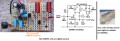
Your "27MHz" oscillator has its parts spread out on a breadboard and has rows of contacts then it has lots of stray capacitance. It has extra inductance in its long wires.
The winding of its coil is very loose and suitable for a microwaves frequency.
It does not work.

My 100MHz FM transmitter has a compact parts layout on a stripboard and has no long wires or rows of breadboard contacts.
My coil has the same number of windings as yours but is wound tightly for it to work at 100MHz.
It works perfectly.
 

Attachments

Thread Starter

SamR

Joined Mar 19, 2019
5,487
So far, this has simply been a "proof of concept design" on a breadboard. Next will be on the double sided FRP and should "tighten up" quite a bit. As of now, even trying to measure V & I, it goes in and out of oscillation. Not as simple as it looks on paper.
 

Thread Starter

SamR

Joined Mar 19, 2019
5,487
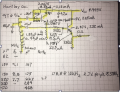
OK, it is sitting on 15.197MHz and twitchy. Trying to pull measurements from it had it doing some odd things including in and out of oscillation. Here is what I collected from the transistors both V and I. If you can read my chicken scratching.
1687287772441.png
 

Audioguru again

Joined Oct 21, 2019
6,826
The tuning capacitor should be across the entire coil, not just part of it.
Your tap on the coil for the emitter signal should not be near the top of the coil, try it at halfway on the coil.

Your transistor voltages and currents show the transistors are turned OFF. The base voltages should be 0.6V to 0.7V higher than the emitter voltages.
 
Top