Oscillator won't oscillate

Thread Starter

SamR

Joined Mar 19, 2019
5,494
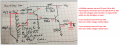
I've shown a few actual pics and the tank capacitor IS across the entire coil and the schematic needs to be updated to show that. Both transistors are DC isolated from the coil by the 0.01uF caps. I've ordered some bare 18AWG magnet wire (instead of stripping 22AWG hookup wire) to rebuild the coil and play with size and turns. I'll start with 26MHz and the 181pF tank capacitor and work from there. I didn't design the coil and agree that I think the tap should be closer to the center but I'm working with what I was given. I'm baffled at the narrow range of capacitors to make it oscillate and frankly don't understand why. I got 3.027V on one base and 3.07 on the other but yeah, both are ~19.5uA so they sure don't look to be on. I've done the basics on xstrs but still need a better grasp on them and never worked with oscillators other than a few labs showing what the various types are and do. I've been using mostly ceramic 20% 50V caps but seem to have better results with higher voltage caps? I have ordered some 200V and 1kV ceramic caps. I didn't get to it today but I also wanted to put a trimmer cap on a strip board and work with tuning it alone and parallel with a fixed cap to get a "feel" for what it can do. I have a set of 10ea of all the trimmer cap sizes to work with albeit cheap chinesium ones. Also ordered some small ceramic tuning screwdrivers as all I have is the metal blade in a plastic tube tuner now and it is always a pain to use adjusting trimmers. I try to mix up my book and bench work and this has been a good eye-opening experiment so far. The source for this has given no explanation for the coil tap right at the end of the coil so I need a better understanding of just why they did it... I also need to look at the AC component of the circuit as well...
 
Last edited:

Audioguru again

Joined Oct 21, 2019
6,826
A trimmer capacitor is used to tune the circuit to the frequency you want.
The tight or loose coupling of the turns on the coil also changes the frequency.
Stray capacitance from anything moved closer or away from the circuit's wiring also changes the frequency.
The breadboard has lots of stray capacitance and also lots of wiring inductance.
Here are some guessed and calculated voltages:
 

Attachments

Thread Starter

SamR

Joined Mar 19, 2019
5,494
I was putting together a module where I could measure the range of a trimming cap and be able to plug in a fixed cap into in-series sockets to have an adjustable tank cap. But, my soldering iron died after 5 years of good use and I had given my backup to my son. So... A new heating element on order with Xtronic and a new Hakko station as well if the heating element is not the problem. Hopefully that is all it is (has quite a complex control board) and I'll have a backup again! @Audioguru again I see you corrected the tank capacitor wiring and some new values to check out, thanks. Oh, how well I know the foibles of using breadboards with oscillators. Which is why I couldn't believe it wouldn't oscillate at all! I have ~ 6 different values of trimmer caps that I wanted to test and see what kind of range they have but new iron will be here tomorrow and will do it as soon as it gets here! I have never played with series caps before so I'm looking forward to seeing how that goes.
 
Last edited:

Ylli

Joined Nov 13, 2015
1,092
Get a 470 - 1000pF cap between that collector and ground. The base may show a voltage less than a diode drop above the emitter if the transistor is being driven into class C by rectified RF.
 

Thread Starter

SamR

Joined Mar 19, 2019
5,494
that collector and ground
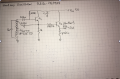
Not sure that I understand? Both collectors are attached to the 5V Vin. Going left to right on the circuit schematic let's call them Q1 and Q2. Q1 is separated from the tank by 0.01uF caps. There is no emitter 1kΩ resistor paralleled cap going to ground on Q1. Nor is there one for the 330Ω emitter to ground for Q2. The "hanging" 51Ω on Q2's emitter is the output terminal.
 

Audioguru again

Joined Oct 21, 2019
6,826
Not sure that I understand? Both collectors are attached to the 5V Vin. Going left to right on the circuit schematic let's call them Q1 and Q2. Q1 is separated from the tank by 0.01uF caps. There is no emitter 1kΩ resistor paralleled cap going to ground on Q1. Nor is there one for the 330Ω emitter to ground for Q2. The "hanging" 51Ω on Q2's emitter is the output terminal.
Both collectors and the 100k base resistor are connected to +5V. The 4.7uF capacitor has too much inductance to remove 27MHz from the +5V so use a 470pF to 1000pF ceramic capacitor with very short leads to the +5V at the collectors and to circuit ground.
 

Thread Starter

SamR

Joined Mar 19, 2019
5,494
The 4.7uF capacitor has too much inductance to remove 27MHz from the +5V
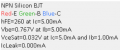
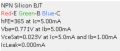
That cap C1 is an anti-noise and snubber and currently a tantalum 4.7uF. So, please explain in detail why it should change and I will try it. I also want to redo the coil when the 18awg magnet wire arrives so I have left C1 & C2 blank for now. Also redrew the schematic.
1687378802076.png
Q1
1687379213167.png

Q2
1687379381466.png
 

Ylli

Joined Nov 13, 2015
1,092
This is an emitter follower, or a Common Collector amplifier. To be common collector, the collector needs to be grounded at the frequency of operation. Neither the +5 volt bus, nor the 4.7 uF cap provide an adaquate ground at 27 MHz. (both have too much inductance). Leave the 4.7 uF, but add a capacitor that will properly bypass at 27 MHz as close to the collector of Q1 as you can.
 

Audioguru again

Joined Oct 21, 2019
6,826
Did you buy hundreds of transistors, measure then all then pick the hFE and Vbe that you show?
The tap on the coil must not be near the top of the coil winding like you show. At half the winding should be good.
 

Thread Starter

SamR

Joined Mar 19, 2019
5,494
add a capacitor that will properly bypass at 27 MHz as close to the collector of Q1 as you can.
The only thing on the collector is the wire to Vin. Add cap in series, parallel, how to determine value? Thanks! I would think parallel as Q1 needs the 5V DC feed on its collector.
Did you buy hundreds of transistors, measure then all then pick the hFE and Vbe that you show?
Nope, just grabbed a couple from a lot of 20 I think and hooked them up to my DCA PRO. hFE a bit higher than predicted. chinesium parts marked 1N3904 but who knows what they really are... At least they work.
I still need to do more in-depth work with xstrs but have covered the basics at least.
I want to work with what I was given which means keeping the tap near the end of the coil please!
 

Ylli

Joined Nov 13, 2015
1,092
The only thing on the collector is the wire to Vin. Add cap in series, parallel, how to determine value? Thanks! I would think parallel as Q1 needs the 5V DC feed on its collector.
You want the collector grounded for RF. So you want the cap between the collector and ground, as close to the transistor collector as possible. You want the cap to have low reactance at 27 MHz - a 470 pF cap has a reactance of 12.5 ohms, and a 1000 pF cap has a reactance of 5.9 ohms. That 4.7 uF tant is unspecified at 27 MHz, and that +5 volt bus is who knows what.
 

Thread Starter

SamR

Joined Mar 19, 2019
5,494
K, thanks. I'll start looking at it after dinner! That is what the 4.7 tant is across the rails for as well.
 

Audioguru again

Joined Oct 21, 2019
6,826
A Hartley oscillator will not work with its tap near the end of the coil. In tutorials, the tap is at halfway on the coil.

I haven't used a tantanum capacitor for 55 years and never at radio frequencies.
A 4.7uF tantalum capacitor has a low impedance for audio and ultrasonic frequencies but might be useless at 27MHz.
Fairly low capacitance ceramic capacitors are used at radio frequencies.
 

Thread Starter

SamR

Joined Mar 19, 2019
5,494
as close to the transistor collector as possible. You want the cap to have low reactance at 27 MHz
Not sure where I would find the data for 27MHz. My Extech LCR200 meter will measure series or parallel equivalent R @ different freqs but the highest are 1kHz, 10kHz, and 100kHz and what results I get appear to be logarithmically linear. For 1nF I get an R of .009 @ 100kHz and increasing. For 150pF I get an R of .001 @ 100kHz and decreasing. So it looks to me that I want to use a 150pF snubber in addition? to the 4.7uF tant. On both collectors? Kinda at a standstill until I get a soldering Iron and the magnet wire on order which should be here tomorrow.
 

Audioguru again

Joined Oct 21, 2019
6,826
A capacitor has some inductance, large capacitors have high inductance.

A large capacitor and its inductance causes it to have a high impedance at your high frequency. You want a low impedance at 27MHz on the +5V rail.

On a proper pcb, both collectors are very close together on the +5V.
 

Thread Starter

SamR

Joined Mar 19, 2019
5,494
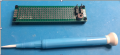
Soldering iron and other nice things arrived so first I put together this adjustable capacitance module. It has a 120pF trimmer cap that I can adjust between ~55-165pF and the sockets are parallel for a fixed cap and pins to connect to. Putting my LCR meter on the pins found the range of adjustment for this particular trimmer. Very twitchy adjusting and having to wait on the LCR meter to scan and display after adjustment. Want to jump around 5pF for each tweak but still not bad and gives me room to adjust the tank more closely. Now I need to work on the coils... Also, the tweaker is made of plastics and ceramics so as not to interfere with the capacitance adjustment. Just came in so will have to find out how durable it is but already far better than using a metal tweaker! Left room on the module to mount other smaller range trimmer caps and see if they are twitchy.
1687470033781.png

Edit: Put a 60pF trimmer cap on with it's range of ~22-94pF and not as twitchy! 30pF trimmer cap range ~16-44pF.
 
Last edited:

Thread Starter

SamR

Joined Mar 19, 2019
5,494
Nope, going to use a piece of double clad FR4 board and build it "Manhattan" style by carving "islands" out of the plated board for termination points with rest of the entire front and all of back as a ground plane. Building and testing some coils now to try and get that design done first. But I may use a trimmer cap to determine the exact (or close to) capacitance for the tank part of the circuit once I get the coil specified out. Also testing the tap point on the coil while I'm at it. I know it has to be 27MHz but I need to dial in the coil uH and tank capacitance specs. Lots of doctor appts. after the accident so have to squeeze it in between office visits plus grandkids coming next week to entertain us...
 

Thread Starter

SamR

Joined Mar 19, 2019
5,494
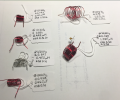
I made and tested several coils. I like 18AWG better than 22AWG as 18AWG holds it shape much better. I did some reading (always a dangerous thing with me) and calculating then settled on ~1.5uH as for 27MHz it needs ~20pf tank capacitor to resonate. Also, for the same number of turns, larger turns yield larger values of uH. So, in addition to the 5/16" form I found a 3/4" form to use. Started with the 5/16" and couldn't get close to 1.5uH without ~20 turns. So, did the calculation for .75" ID of 18AWG and came out 10 turns. Built both 18AWG and 22AWG @ 10 turns, results below. Haven't finished testing but so far, no oscillation again! More work to do.
1687572265826.png
If anyone has any secret tips on removing magnet wire enamel, I can use them. So far, burning it off doesn't work and sanding it off with an emery board kinda does but still a PITA! The ends are bad enough but I also have to solder a capacitor to one of the coils for a tap. Acetone? Scraping with a knife also a real PITA and near impossible once the coil is wound for the capacitor tap point. I could wind the coil, mark the tap spot, unwind the coil, clean the tap spot, and then recoil the wire but that would be a nightmare to do. There must be a better way. Yes, I could use unvarnished bare tinned wire...

Edit: Nope, acetone won't touch it...
 
Last edited:

Thread Starter

SamR

Joined Mar 19, 2019
5,494
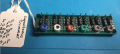
Went ahead and finished the low end of the trimmer board as I am going to be looking around the 20pF region.
1687584948475.png
Each trimmer has 2 sockets for parallel fixed caps and 2 pins on each side for external connections. Bit of overkill but had the space so I filled it up! So trimmers for 5, 10, 20, 30, 60, 120pF. with the over and under ranges of each trimmer it fully covers from below 5 to ~170pF. And then even more with the addition of parallel fixed caps. I have a couple of capacitance decade boards but one is for nF using poly caps and one for uF using electrolytics but nothing going down into the pF range and this will cover it with the addition of parallel fixed caps.
 
Top