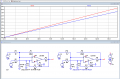
The better way to think about the condition at the inputs of the opamp is not that it is a "virtual ground", because that only applies if one of the inputs is tied to ground, but rather that there is a "virtual short" between the two since they are held at the same voltage, like a real short would, but no current flows between them, and hence it is only virtual, not real.
I mean I can understand the part with only negative feedback.
The gain in those specific circuits can be positive or negative.
But what if both feedback ? For non inverting OPA it was positive feedback, for inverting OPA the gain was negative. With both feedback it seems a bit scatchy.
Because increasing Vin I will increase Vp but I will also increase Vn, So where will go Vout ? Will it decrease or will it increase? If one of them then why ?
But what if both feedback ? For non inverting OPA it was positive feedback, for inverting OPA the gain was negative. With both feedback it seems a bit scatchy.
Because increasing Vin I will increase Vp but I will also increase Vn, So where will go Vout ? Will it decrease or will it increase? If one of them then why ?
Which circuit are you talking about now? PLEASE, we are NOT mind readers. There are a number of different circuits in this thread, you need to make it clear which one you are talking about.
Which circuit are you talking about now? PLEASE, we are NOT mind readers. There are a number of different circuits in this thread, you need to make it clear which one you are talking about.
From the previous circuits (inverting OPA and non inverting OPA) one input didn't change at all, so it was easy to say what will happen in the Vout. Usually Vp was usually the same. For inverting OPA VP was constant 0V, so changing Vin will change Vn.
so increasing Vin will increase Vn so Vout must decrease. For non inverting increasing Vin will increase VP, but VN was equal Vout (at the beggining let's say it was 0V). So now Vn will change again when Vp is constant. So Vout must increase because Vn<Vp.
So now with both feedbacks there are no constant value in one of the inputs. Therefore increasing Vin will increase Vp and Vn, so how will Vout will react ? Will it increase or decrease ? changing Vout will change both Vp and Vn and not like in single feedback only Vn.
It's hard to even tell the gain because as I said increasing Vin increases Vp and Vn. In simple OPA increasing Vin will increase Vp or Vn and not both so saying what will happen to Vout and what is the gain was a lot easier.
I mean more like a concept.
For non-inverting and inverting OPA I could tell why the Vout is increasing or decreasing, without resistor values.
For example for inverting Vp is constant = 0V so increasing Vin will increase Vn also decrease Vout.
Here increasing Vin will increase Vp and Vn.
Basically the circuit with both feedback Post #124. Negative gain results in saturation. So it's like increasing Vin cannot result in decreasing Vout. That is for me mysterious. Because Vp and Vn changes there is no constant value for Vn or Vp.
So for example values : R1=R2=R4 = 1k, R3 = 10k
And R1=R3=R4 = 1k, R2= 10k.
hi X,
Your values of So for example values : R1=R2=R4 = 1k, R3 = 10k
And R1=R3=R4 = 1k, R2= 10k.
are unrealistic values, which IMO would never be chosen in that combination.
The problem I have is that why it has positive gain.
Maybe I said it incorrectly.
For inverting and non inverting we can say what is the gain right ?
Increasing Vin in non inverting will increase the Vp, while Vn is constant. So Vout will increase just to increase Vn to make them equal.
For inverting increasing Vin will increase the Vn but Vp is constant so Vout will decrease to decrease Vn to make Vn equal to Vp.
For both feedback increasing Vin will increase both of them Vn and Vp. So I don't know why acutally positive gain works here but negative gain doesn't. There is no constant value. Like in inverting or non inverting. Why it doesn't work like increasing Vin could decrease Vout (negative gain). But it works this way increasing Vin increases Vout (positive gain). There is no constant value like in inverting or non inverting Op Amp
The problem I have is that why it has positive gain.
Maybe I said it incorrectly.
For inverting and non inverting we can say what is the gain right ?
Increasing Vin in non inverting will increase the Vp, while Vn is constant. So Vout will increase just to increase Vn to make them equal.
For inverting increasing Vin will increase the Vn but Vp is constant so Vout will decrease to decrease Vn to make Vn equal to Vp.
For both feedback increasing Vin will increase both of them Vn and Vp. So I don't know why acutally positive gain works here but negative gain doesn't. There is no constant value. Like in inverting or non inverting. Why it doesn't work like increasing Vin could decrease Vout (negative gain). But it works this way increasing Vin increases Vout (positive gain). There is no constant value like in inverting or non inverting Op Amp
For the dual-feedback circuit you keep referring to, increasing Vin increases Vp.
Vn hasn't changed yet, because Vout hasn't changed yet.
Because Vp has gone up while Vn hasn't changed, there is an increase in the differential voltage (Vp-Vn), which in turn results in Vout starting to increase.
The increase in Vout causes BOTH Vp AND Vn to increase, but not by the same amount. How much each of them increases is dictated by the two voltage dividers.
Vp increases by an amount determined by R1/(R1+R2).
Vn increases by an amount determined by R4/(R3+R4)
If Vn increases faster than Vp, it will catch up to Vp and cause the output to stop increasing at a new, higher, level. This is because the negative feedback to Vn is stronger than the positive feedback to Vp.
However, if Vp increases faster than Vn, the differential voltage will continue to increase, resulting in ever higher Vout until the output saturates. This is because the positive feedback to Vp is stronger than the negative feedback to Vn.
In order for the circuit to be stable, we therefore need the voltage divider feeding Vn to be greater than the voltage divider feeding Vp, or
or the dual-feedback circuit you keep referring to, increasing Vin increases Vp.
Vn hasn't changed yet, because Vout hasn't changed yet.
Because Vp has gone up while Vn hasn't changed, there is an increase in the differential voltage (Vp-Vn), which in turn results in Vout starting to increase.
Aha I thought that Vn would also change. I thought that the path is like this : Vin -> Vp -> Vout (which is for this moment 0V) -> Vn and -> GND.
But I think I see my logical mistake. Because assuming that Vout was at the beggining 0V and there is ground so in both sides there is 0V so yea
So that's why gain is positive. And cannot be negative. Because increasing Vin will increase Vp while Vn is constant ? So then Vout increases and THEN Vp and Vn increases at the same time.

 Facebook
 Google
 GitHub
 Linkedin