Plasma is easy, the thermodynamics is chaotic but mainly deterministic for computer feed-back control, I've done small industrial plasma beams in the several KW range for decades, with reactive dose ion control in the nA range, with high sigma 2D uniformity across 200mm and 300mm semiconductor platens using dynamic feedback from in-beam control Fence and Halbach electromagnetic magnet arrays.
Fusion reactions are a wild cat looking a raw meat. You can whip it into a relative but dynamical unstable position but you can't really predict what it's going to do next. You need to mind-read by looking at its soul.
I am always interested to hear something genuinely new in this field. Care to share a brief synopsis?
I already know that we are one step closer to being one step closer to being one step closer to ... just about everything imaginable (ha ha) so hope this is something new.
Seriously though they may be making some progress, and I really hope they do. If not, we here at AAC will have to get together and design one that actually does work.
See, we ourselves are already one step closer now (ha ha)
I am always interested to hear something genuinely new in this field. Care to share a brief synopsis?
I already know that we are one step closer to being one step closer to being one step closer to ... just about everything imaginable (ha ha) so hope this is something new.
Seriously though they may be making some progress, and I really hope they do. If not, we here at AAC will have to get together and design one that actually does work.
See, we ourselves are already one step closer now (ha ha)
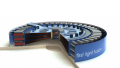
The stellarator was invented by American scientist Lyman Spitzer in 1951. Much of its early development was carried out by Spitzer's team at what became the Princeton Plasma Physics Laboratory (PPPL). Spitzer's Model A began operation in 1953 and demonstrated plasma confinement. Larger models followed, but demonstrated poor performance, losing plasma at rates far worse than theoretical predictions. By the early 1960s, hopes of producing a commercial machine faded, and attention turned to studying fundamental theory. By the mid-1960s, Spitzer was convinced that the stellarator was matching the Bohm diffusion rate, which suggested it would never be a practical fusion device.
They think that modern computer power can correct for the original issues.
His 1958 description was simple and direct:
Magnetic confinement in the stellarator is based on a strong magnetic field produced by solenoidal coils encircling a toroidal tube. The configuration is characterized by a 'rotational transform', such that a single line of magnetic force, followed around the system, intersects a cross-sectional plane in points which successively rotate about the magnetic axis. ... A rotational transform may be generated either by a solenoidal field in a twisted, or figure-eight shaped, tube, or by the use of an additional transverse multipolar helical field, with helical symmetry.[14]
The lack of a beam heating plasma current in operation (it does use one to start the plasma) means you don't have the space charge sheath (and other plasma effects) interface zone that concentrates the dense charged particles to a central core from the much less dense vacuum chamber, so much stronger magnets and needed to confine and control the plasma even before fusion ignition. This increases instability as you increase the magnetic confinement field. https://cnls.lanl.gov/shields/presentations/SHIELDS Wang Talk 43.pdf
These 1D approximations must be expanded into 3D, with much better precision, with compute result and control system response speeds less that the thermal and drift speed (Velocity) of the charged particles to the walls and control electrodes to maintain active plasma stability control.
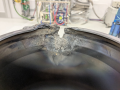
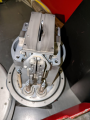
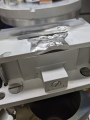
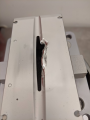
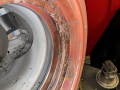
When we have plasma instability due to beam contamination or badly tuned focused EM fields, things like this happen at 10KW beam power to tungsten in very high vacuum and metals with lower melts are completely vaporized.
Imagine what will happen at high MW power levels with loss of containment.
Tungsten plasma arc slit. Melts 3,422 °C (6,192 °F; 3,695 K). boiling point, at 5,930 °C (10,706 °F; 6,203 K)
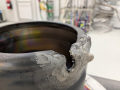
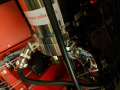
Source acceleration insulator under ultra high vacuum.
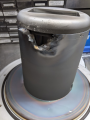
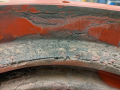
When we lose vacuum under high (for us) energy, the machine implodes, and takes every pumping system with it.
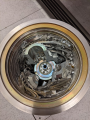
The insides of this pump after stopping in a fraction of a second while using electromagnet levitation (no bearings, floating in the vacuum stream) at 30,000 RPM.
I've got decades of pictures of these sorts of plasma failures on simple machines that dose wafers. If there was a easy or even hard solution, we would have found it a long time ago. We see it as the cost of doing business and put the costs in the product.
IMO It's going to be a neat trick of control engineering to measure, calculate and control each tiny cm of fusing plasma each microsecond by microsecond using a bulk set of magnetic fields that also interact with the areas surrounding instabilities.
"First Light isn’t quitting fusion—it’s redefining its role. Instead of building reactors itself, it’s now licensing its "amplifier," a device that boosts fusion reactions in others’ systems"
A BS "amplifier", one that takes in money, and uses negative feedback until the money is gone.
If (they failed with the previous designs) they can solve the plasma pinch other types of instability issues without a protection plasma beam current sheath it will be a great step forward.
If they are really building this it says a lot about their confidence in fusion power. Then again, they may have a backup plan for the construction site if it doesn't work.
Or is it total internet BS.
In their experiment, the researchers wanted to see if they could deliberately steer the outcome of this interaction. They carefully controlled the pressure of the fuel gas during tokamak startup and added a burst of heating called electron cyclotron resonance heating.
These changes altered how the plasma interacts with the tokamak walls through a cooler plasma boundary, which dramatically reduced the degree to which wall impurities entered the plasma.
Under this regime, the researchers were able to reach densities up to about 65 percent higher than the tokamak's Greenwald limit.
This doesn't mean that magnetically confined plasmas can now operate with no density limits whatsoever. However, it does show that the Greenwald limit is not a fundamental barrier and that tweaking operational processes could lead to more effective fusion reactors.
The team will be experimenting further with their findings to see how EAST operates under high-performance conditions in the newly described density-free regime.
"The findings suggest a practical and scalable pathway for extending density limits in tokamaks and next-generation burning plasma fusion devices," Zhu says.
I wonder if the fusion folks are talking to the EUV process guys. The EUV folks had to overcome a lot of similar hurdles and perhaps some of the techniques, or at least modeling tools, used can transfer. You would think they are, but that's far from a certainty.

 Facebook
 Google
 GitHub
 Linkedin