Facebook
 Google
 GitHub
 Linkedin

IR2101 is a 600V chip, which will have a big impact on die size and therefore price. There are single low side drivers available that will be cheaper, just because two 2A fets and a bit of logic don´t take as much chip space as when you add a 600V isolation distance. As for reliablility, I doubt there will be any difference, and the chip will likely be better characterized than your disrete circuit regarding reliablility and absolute limits.As for board space, you're right about that. But wouldn't this circuit be more reliable and last longer than the IR2101?
For reliability calculations, our safety engineers need to know the number of transistors in said IC, and the reliability of ICs is more or less logarithmic to the number of transistors used, whereas reliability of discrete transistors is linear. So for a hundred thousand transistors in an Ic you would get reliability of say 1000 FIT (failures in 1e9 hours), but for hundred thousand discrete transistors it would be more like 20,000 FIT.
ICs have internal protecion diodes, discrete circuits generaly don't. Even though cmos structures are susceptible to shoothrough, that is exactly why the protection diodes are a rather large part of the die and why those might actually make them less susceptible to ESD and other EMC damage or degradation, than your discrete circuit might be....but I'm under the impression that the 2n3904 and/or 2n3906 are less susceptible to ESD or spurious surges in voltage than a driver ic.
Sorry for making it sound so complicated. In other words, it is easier to ensure that the input of an IC doesn't exceed 20mA no matter what, than to analzyze a discrete circuit and take into account all the factors that might bring you over the edge.

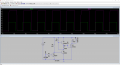
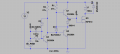
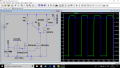
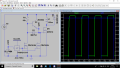
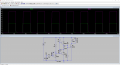
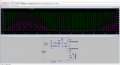
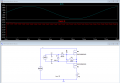
 ... Anyway, I adjusted the values of R1 and R2 to 27k, and it barely made a dent in the circuit's performance. The top part of the rising edges of the gate signal rounded a little bit, but that's all.