Facebook
 Google
 GitHub
 Linkedin
A long time ago I built a variable power supply, mostly from scavenged parts. Voltage regulation was adjustable up to about 30V through discreet transistors (a design from a book) and current was limited to about 0.6A.
I’m in the process of upgrading it to supply from a few volts up to about 40V with adjustable current limiting from 0.1A to a max. of about 4A.
The primary will supply (as measured with no load) 34V at about 6A continuous (200W).
The intermediate is a boost regulator. I’ve removed the onboard pot and substituted it with a potentiometer with series/parallel resistors to enable the Vintermediate output to be adjustable from a Min. of 37V (must be > Vprimary) to a max of 50V. The pot. will be ganged so that when Voutput is lowered, Vintermediate is also lowered to reduce dissipation in the last stage.
The last stage is a TL783 adjustable regulator. It will have bypass transistors to increase the output current.
Most of the designing/assembly is done. The final hurdle is implementing the adjustable current limiting. To date I’ve figured that a current sense resistor driving a non-inverting amplifier will give me the signal that I want to drive a transistor which bypasses the R2 part of the TL783’s adjust pin. If the transistor can be turned on in a controlled way, Voutput will be lowered until constant current output is reached.
I’m new to amplifiers so at first glance LM741 seems a good choice.
Q1. Where to source V for V+ and V- ? The primary will also feed a 12V(?) regulator to drive fans for cooling – could this 12V source be used for V+ and V- ?
See block diagram for clarification.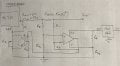
I’m in the process of upgrading it to supply from a few volts up to about 40V with adjustable current limiting from 0.1A to a max. of about 4A.
The primary will supply (as measured with no load) 34V at about 6A continuous (200W).
The intermediate is a boost regulator. I’ve removed the onboard pot and substituted it with a potentiometer with series/parallel resistors to enable the Vintermediate output to be adjustable from a Min. of 37V (must be > Vprimary) to a max of 50V. The pot. will be ganged so that when Voutput is lowered, Vintermediate is also lowered to reduce dissipation in the last stage.
The last stage is a TL783 adjustable regulator. It will have bypass transistors to increase the output current.
Most of the designing/assembly is done. The final hurdle is implementing the adjustable current limiting. To date I’ve figured that a current sense resistor driving a non-inverting amplifier will give me the signal that I want to drive a transistor which bypasses the R2 part of the TL783’s adjust pin. If the transistor can be turned on in a controlled way, Voutput will be lowered until constant current output is reached.
I’m new to amplifiers so at first glance LM741 seems a good choice.
Q1. Where to source V for V+ and V- ? The primary will also feed a 12V(?) regulator to drive fans for cooling – could this 12V source be used for V+ and V- ?
See block diagram for clarification.