The circuit in post #10 will have the speaker powered all the time unless you have a series capacitor in line with the speaker, or add a relay to remove power from the amplifier when not sounding.
The other way to go is just buy an alarm horn that incorporates the tone generator and amplifier in the speaker horn then all that is needed it to apply power to it.
EDIT: OOPs. Post #20 notes the "off" problem needing a relay. That is a comment I missed.
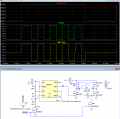
I'm not getting the full peak-to-peak output expected. Basically about 18V p-p instead of 24V. And I'm not sure why. The 12V source for testing is a SLA battery on 14 gauge wires to the board, and reads 12.3V during testing
Voltage on the MOSFETs is 11.3V to ground. As I probe around the breadboard I'm believing more and more that the loss is due to the tiny Dupont jumper wires.
I'm happy with the result and will be committing it to copper.
Also thank you for the "enable" addition. I see that your setup uses a 5V control signal. Will 3.3V be enough to turn off (enable) the 2N7000's?
You are totally correct, my R/G color blindness kicked in. What I saw was the white trace going from 0 to 5 back to 0 and thought that was the /enable trace. But in fact the trace is red and not really obvious to me on the computer screen - and it should have been because the legend at the top for the trace is red. Sorry for my confusion.
You are totally correct, my R/G color blindness kicked in. What I saw was the white trace going from 0 to 5 back to 0 and thought that was the /enable trace. But in fact the trace is red and not really obvious to me on the computer screen - and it should have been because the legend at the top for the trace is red. Sorry for my confusion.
Yes, from the n-channel Source to the p-channel source pins. I really think the issue is related to the breadboard and tiny wires (still some tiny wires between the MOSFETs. Since the MOSFETs don't even get warm, the losses have to be elsewhere. I'm going ahead with committing this to copper.
The most reliable way to switch off an alarm sounder is to switch off the power with an actual switch, or a relay contact. AND, probably the reduced output power level is due to connection resistance. In higher powered circuits, just a little bit of resistance can provide a voltage drop that reduces the power quite a bit.
Just a quick update to close this out. The circuit has been committed to copper and the voltage levels no longer reduced. I went with the relay option to turn it on & off. Working well. Thank you to all.

 Facebook
 Google
 GitHub
 Linkedin