Facebook
 Google
 GitHub
 Linkedin
Hello everyone! I'm extremely confused about this and I was looking for advice, I'm sorry if this is the wrong place to ask.
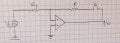
I have the following inverting operational amplifier with these values:
- Rs = 1k ohms
- R = 10k ohms
- C = 10 mF
- Aol = 74dB
- Zin = inf
- Zout = 5 ohms
I need to find the transfer function, plot the bode diagram of the transfer function and calculate mid-band gain. Got no issues with the first two, I found an expression for the transfer function dividing the impedance on the feedback network by the input impedance, this is what I got:
\[ \frac{V_o}{V_s} = -\frac{sRC+1}{sR_sC} = - \frac{100s+1}{s} \]
I'm very confused regarding mid band gain. I know that the open loop gain is 74dB but the capacitor in the feedback network is throwing me off. The closed loop gain is equal to:\[ Av = \frac{A_{OL}}{1 + \beta A_{OL}} \] If I replace the resistor R and capacitor C in the feedback network with one impedance, I get that beta is equal to this:
\[ \beta = \frac{R_s}{R_s + \frac{jwRC+1}{jw}} \] which is dependent on frequency, this is where I'm lost. How can I find the mid-band gain if it's dependent on frequency? I can find it easily for low frequencies (ω → 0) and high frequencies (ω → inf), however I really don't know what to do when it comes to mid-band.
Thanks for the help and sorry for the confusion!
I have the following inverting operational amplifier with these values:
- Rs = 1k ohms
- R = 10k ohms
- C = 10 mF
- Aol = 74dB
- Zin = inf
- Zout = 5 ohms
I need to find the transfer function, plot the bode diagram of the transfer function and calculate mid-band gain. Got no issues with the first two, I found an expression for the transfer function dividing the impedance on the feedback network by the input impedance, this is what I got:
\[ \frac{V_o}{V_s} = -\frac{sRC+1}{sR_sC} = - \frac{100s+1}{s} \]
I'm very confused regarding mid band gain. I know that the open loop gain is 74dB but the capacitor in the feedback network is throwing me off. The closed loop gain is equal to:\[ Av = \frac{A_{OL}}{1 + \beta A_{OL}} \] If I replace the resistor R and capacitor C in the feedback network with one impedance, I get that beta is equal to this:
\[ \beta = \frac{R_s}{R_s + \frac{jwRC+1}{jw}} \] which is dependent on frequency, this is where I'm lost. How can I find the mid-band gain if it's dependent on frequency? I can find it easily for low frequencies (ω → 0) and high frequencies (ω → inf), however I really don't know what to do when it comes to mid-band.
Thanks for the help and sorry for the confusion!
Attachments
-
 25.3 KB Views: 10