Need help with amplifier circuit for alarm system

Thread Starter

ischonfeld

Joined Jun 22, 2019
63
I’m in the process of replacing my 1980’s Napco Magnum alarm system panel with an up to date panel that I’ve built. I’d like to duplicate the speaker output from the original panel.

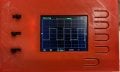
Putting a ‘scope on the output, I see an approx. 1,250 Hz square wave output going to the speakers. Kind of what I expected.

What I didn’t expect is that the peak-to-peak voltage is approx. 26V. The panel is run off of 12V (nominal) – either rectified AC from a transformer or DC from a SLA 12V battery.

2024-11-19 13.03.49.jpg


The panel's speaker output rating is 15W 8 ohms, 30W 4 ohms. The existing speaker rating is 8 ohms 15W

I expected to use or design a simple amplifier to put out the 1,250 Hz square wave. But that output would be 12V P-P, and thus half the power that’s currently driving the speaker.

Can anyone point me to an amplifier (circuit or buy) that can produce 24-26V P-P output from a 12V supply? I can easily drive it with a 1,250Hz square wave signal.

Thank you.
 

LesJones

Joined Jan 8, 2017
4,511
It could be that neither side of the speaker is ground (Or +12.) . It may work like bridge ampifier. Call the speaker wires A & B.
For half a cycle A will be at ground potential and B will be at + 12. For the other half cycle A will be at +12 & B will be at ground potential. There are amplifier ICs available that are really two amplifiers that can be configured to work in bridged mode. You will have to trace out the circuit of the speaker driver to see if that is how it worked. Two other possibilities that there is a boost regulator to generate 24 volts or there is an output transformer to increase the amplitude of the output.

Les.
 

Thread Starter

ischonfeld

Joined Jun 22, 2019
63
It could be that neither side of the speaker is ground (Or +12.) . It may work like bridge ampifier. Call the speaker wires A & B.
For half a cycle A will be at ground potential and B will be at + 12. For the other half cycle A will be at +12 & B will be at ground potential. There are amplifier ICs available that are really two amplifiers that can be configured to work in bridged mode. You will have to trace out the circuit of the speaker driver to see if that is how it worked. Two other possibilities that there is a boost regulator to generate 24 volts or there is an output transformer to increase the amplitude of the output.
I'll start looking for an IC Amp than can be configured as a bridge amplifier (unless anyone can point me to one). That makes sense.

I guess it's possible that they have a boost regulator to get 24V.

Doubt there's an output transformer - (1) I don't see one, and (2) the square wave output looks kind of too clean to have come from a transformer - unless they generated a 1,250 Hz sine wave, fed that into a transformer to increase the amplitude, then rectified/clipped it to get the square wave.

Now to look for a bridge amplifier IC.

Thanks.
 

Audioguru again

Joined Oct 21, 2019
6,826
The original 26Vp-p into an 8 ohm speaker produces 10.7W.
If the signal is half at only 13Vp-p then the power is only 2.64W.
Because halving the voltage also halves the current.
 
Last edited:

crutschow

Joined Mar 14, 2008
38,316
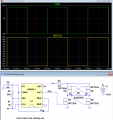
Below is the LTspice sim of a simple example circuit that should do what you need:
A 555 astable is driving a simple complementary MOSFET bridge to generate ±(V+) across the speaker resistance.
Since that simple bridge suffers from shoot-through current spike during switching, I added R3 to limit it.
That shouldn't be a problem here, since the speaker is only on for a short period during an alarm activation.

The MOSFETs can be just about any with ≤0.1Ω on-resistance and a Vds rating of at least 20V.

1732906028234.png
 
Last edited:

Thread Starter

ischonfeld

Joined Jun 22, 2019
63
Below is the LTspice sim of a simple example circuit that should do what you need:
A 555 astable is driving a simple complementary MOSFET bridge to generate ±(V+) across the speaker resistance.
Since that simple bridge suffers from shoot-through current spike during switching, I added R3 to limit it.
That shouldn't be a problem here, since the speaker is only on for a short period during an alarm activation.

The MOSFETs can be just about any with ≤0.1Ω on-resistance and a Vds rating of at least 20V.
WOW! Really appreciate the circuit and info. I'll breadboard it up and see what it sounds like, but I have no doubt this is what I'm looking for. Thank you!
 

Thread Starter

ischonfeld

Joined Jun 22, 2019
63
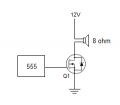
Before you try that I suggest my circuit in post #8 for comparison.
It may be loud enough as is.
Thanks for the suggestion. I just tried it (especially since it only involves adding one component). I compared the current alarm system to this circuit.

With my phone positioned 10' from the speaker (off axis, the speaker is mounted high) and using a sound meter app, the original alarm system produced a sound level of 95 dB. Using your circuit (12V p-p vs 24v p-p) results in a sound level of 83 dB. Figures are rough, but telling.

Audibly, both are near painful, but in a bedroom with the door closed (we all close our bedroom doors while sleeping, don't we?) there is a difference. I'm going to breadboard up the complementary MOSFET design and see what that does.

Still testing, but close. Thanks to all.
 

crutschow

Joined Mar 14, 2008
38,316
With my phone positioned 10' from the speaker (off axis, the speaker is mounted high) and using a sound meter app, the original alarm system produced a sound level of 95 dB. Using your circuit (12V p-p vs 24v p-p) results in a sound level of 83 dB. Figures are rough, but telling.
That's -12dB or a factor of 16 reduction in audible power.
 

Thread Starter

ischonfeld

Joined Jun 22, 2019
63
Below is the LTspice sim of a simple example circuit that should do what you need:
A 555 astable is driving a simple complementary MOSFET bridge to generate ±(V+) across the speaker resistance.
Since that simple bridge suffers from shoot-through current spike during switching, I added R3 to limit it.
That shouldn't be a problem here, since the speaker is only on for a short period during an alarm activation.

The MOSFETs can be just about any with ≤0.1Ω on-resistance and a Vds rating of at least 20V.

View attachment 336981
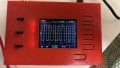
I breadboarded this up. I used two IRL3705 (0.010-0.018 ohms RDS) and two IRF4905 MOSFETs (0.02 ohms RDS) since I had them on hand. For the purpose of testing, I ran it into a 10 ohm 10W resistor - connecting and disconnecting the test setup to the alarm system speaker got old.

This works, but I'm not getting the full peak-to-peak output expected. Basically about 18V p-p instead of 24V. And I'm not sure why. The 12V source for testing is a SLA battery on 14 gauge wires to the board, and reads 12.3V during testing (yes, it could use a charge). The breadboard setup uses those small Dupont jumpers, but there doesn't seem to be enough resistive loss there to account for the drop. And nothing, other than the 10 ohm load, gets warm.

Any idea why I'm not getting closer to 24V p-p?

2024-11-30 15.57.21.jpg
 

Thread Starter

ischonfeld

Joined Jun 22, 2019
63
A breadboard is not designed to pass 1.2A. Soldered wires work much better.
I'm happy to chalk it up to that and the tiny Dupont jumpers. Just didn't think that would account for much loss. I guess it does.

The next thing I'm going to need to deal with is how to turn this off. Stopping the 555 timer would mean that one pair of MOSFETs will always be conducting depending on whether the 555 off state is high or low. In actual use there would be no "off state" unless the whole circuit is controlled by a relay, which is probably the easiest answer - given that the alarm activation signal is coming from a microcontroller chip.
 
Top