Multivibrator circuit with vacuum tubes

Ian0

Joined Aug 7, 2020
13,132
That spec was with a grid voltage of 0 volts. At initial startup the grids would be almost at supply. One would think the current would be higher and the plate resistance lower.
The 5600 plate resistance number you mentioned was with a grid voltage of -1volt in a class A amp configuration.
True, but the device has a maximum positive grid bias of zero; and from the Ra vs. Vg graph, it doesn't seem that it gets much lower than 5.6k.
 

sghioto

Joined Dec 31, 2017
8,634
from the Ra vs. Vg graph, it doesn't seem that it gets much lower than 5.6k.
I'm not sure about that. It appears to me that the curve is trending down as the grid voltage exceeds 0 volts.
Is it going to damage the grid if the bias is +30 volts?
 

Ian0

Joined Aug 7, 2020
13,132
It depends on how much current flows through the grid-cathode diode. As the manufacturer didn't intend it to be used with a positive grid voltage, they haven't put that information on the datasheet!
 

Thread Starter

popcalent

Joined Mar 17, 2018
138
Hello after a couple of months!

I finally got all the parts I needed, and got around to putting everything together. But, it doesn't work...

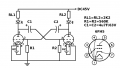
These are the circuit and the tube (6FH5):

multivib.png


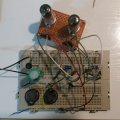
This is what I made (not that you can tell much just by looking at this picture, but I thought I'd post it anyway):
vco.jpg


To power the tubes I use an AC26V transformer, and I fully rectify the output toa DC45V (approx.). The DC6.3V I get from the two coin cell batteries. This is something temporary, when I get this to work, I'll use a transformer.

I double checked all the connections, and it's the same as the schematic diagram. I double checked the voltages, and everything checks out. However, the circuit doesn't do what it's supposed to do. Both LEDs are permanently ON and dim (the one on the right is slightly dimmer), and that's it...

Is there anything that is very obvious, and I'm doing wrong?

I thought of these possibilities:
- One tube or both tubes don't work. If that's the case, how can I check?
- Pin 7 (cathode) should be connected. I didn't connect it because in all the schematics I've seen, this pin is not connected. Pin 1 is also a cathode and it is connected. Pin 6 (internal shield) is also not connected.
- The coin cell batteries are not good enough for the heaters (again, these are temporary).

Since I'm not an expert on tubes, I wanted to confirm before connecting pin 7 and ruining the tubes.

Any other ideas?

Thanks!

6FH5 Datasheet
 

MrChips

Joined Oct 2, 2009
34,828
Why are you still using coin cells when you were told that they would not work?
Get a proper 6VAC or 12VAC transformer.
 

Thread Starter

popcalent

Joined Mar 17, 2018
138
Alright. Both cathodes on both tubes are connected to negative, and I'm using a DC5V/2A for the heaters (that's all I found), and a AC26V/300mA for the rest. When rectified it becomes DC45V. Is that enough amps? The next transformer I have is DC12V at 1500mA. Both LEDs are dimmly glowing, but they won't do anything.
 

Ian0

Joined Aug 7, 2020
13,132
Alright. Both cathodes on both tubes are connected to negative, and I'm using a DC5V/2A for the heaters (that's all I found), and a AC26V/300mA for the rest. When rectified it becomes DC45V. Is that enough amps? The next transformer I have is DC12V at 1500mA. Both LEDs are dimmly glowing, but they won't do anything.
Put both heaters in series and use the 12V 1500mA
 

Thread Starter

popcalent

Joined Mar 17, 2018
138
It works now. I found out the problem. I was interpreting the pinout as the bottom of the tube, not the top. I checked every pin with my tester in continuity mode and found out pins 4 and 5 where connected instead of 3 and 4 (the heaters).

However, as I'm writing this, the circuit stopped working. The LEDs are permanently on again.
 

Thread Starter

popcalent

Joined Mar 17, 2018
138
How do you have the heaters connected?
DC12V/1500mA in series.

I turned everything off, let it rest for a few minutes, and turned it back on. It works for now, but it starts with both LEDs turning on and off at the same frequency, then one of the two LEDs slowly begins to stay on longer than the other, and the difference keeps increasing.
 

Thread Starter

popcalent

Joined Mar 17, 2018
138
DC12V/1500mA in series.
then one of the two LEDs slowly begins to stay on longer than the other, and the difference keeps increasing.
Never mind, I removed the capacitor at the output of my rectifier, and it works now.

Now it looks messy because of the mess of cables, and being on a breadboard. I'll put it on a PCB and post pictures.

Thank you everybody for your help!
 

schmitt trigger

Joined Jul 12, 2010
2,091
Schematics are the language of electronics.
Could you draw a schematic of what you did?

Even if you made it work today, what will happen 6 months or 6 years down the road? Would you still remember how you did it?
 

Thread Starter

popcalent

Joined Mar 17, 2018
138
Even if you made it work today, what will happen 6 months or 6 years down the road? Would you still remember how you did it?
Yes, because I posted the schematic in this thread already: here, here, and here.

I thought I would post a picture as a courtesy to everybody who helped, as opposed to just disappearing because I already got what I wanted from this thread. Also, besides seeing the schematics, I like to see pictures of the actual thing to get ideas about how people mounted something, what materials they used, whether they used a box for electronics or they recycled something they had at home, etc. I wasn't aware that posting a picture was an issue.
 
Last edited:
Top