BJT-based Astable Multivibrator Circuit Design

Thread Starter

AgentTesla

Joined Dec 19, 2024
5
Need help in designing a 3.3V input voltage astable multivibrator circuit that would generate a 1-second duration pulse periodically every 3 hours for microcontroller reset. Need it to be power efficient as it would be used for solar set up.
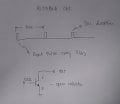

Astable.jpg
 
Last edited by a moderator:

ericgibbs

Joined Jan 29, 2010
21,391
Hi,
The ESP32 I am suggesting would not be the main MCU, but it will be dedicated to generating the Reset pulse every 3 hrs, nothing else.

It is the Reset generator.
E
 

Thread Starter

AgentTesla

Joined Dec 19, 2024
5
Hi,
The ESP32 I am suggesting would not be the main MCU, but it will be dedicated to generating the Reset pulse every 3 hrs, nothing else.

It is the Reset generator.
E
It's an overkill I guess? What's in my mind is using a capacitor to charge/discharge then trigger a BJT to generate a pulse when a given voltage level is met during charging of the capacitor.
 

DickCappels

Joined Aug 21, 2008
10,661
A multivibrator using RC components to set the frequency and pulse width is likely to have a wide tolerance (can be adjusted with pots or by selecting resistors). A digital solution, using a couple of counters and some gate(s), clocked by a quartz crystal (such as a 32768 Hz watch crystal) would do a much better job and would not need programming.

Would you consider a digital solution or does it need to be analog?
If analog, how much "slop" can the timing have?
 

Thread Starter

AgentTesla

Joined Dec 19, 2024
5
A multivibrator using RC components to set the frequency and pulse width is likely to have a wide tolerance (can be adjusted with pots or by selecting resistors). A digital solution, using a couple of counters and some gate(s), clocked by a quartz crystal (such as a 32768 Hz watch crystal) would do a much better job and would not need programming.

Would you consider a digital solution or does it need to be analog?
If analog, how much "slop" can the timing have?
I need it to be as simple(less component) as possible and super power efficient. I'm considering using a LMC555 timer.
 

LesJones

Joined Jan 8, 2017
4,511
I don't think you will be able to get a multivibrator to generate a wave form with a 10800 : 1 duty cycle. I think using an 8 pin microcontroller such as 12F1840 or an attiny13 would be the lowest device count solution.
Les.
 
3 hours are impossible with RC itself or multivibrator.
Maybe 5min multivibrator + clock divider could be a solution.
But one stage of frequency divider costs about 18 parts. You will need 5 stages.

Here is one stage driven from multivibrator:

IMG_1282.jpeg
 
Last edited:

BobTPH

Joined Jun 5, 2013
11,463
Using an 8 pun PIC requires only two parts. The PIC and a decoupling capacitor. Using its watchdog timer, it would be in sleep mode nearly all the time and use as little as 1uA. You cannot beat that with any BJT circuit. And if you need more accuracy, running off a 32KHz crystal is possible for maybe 10uA.
 

Papabravo

Joined Feb 24, 2006
22,058
Using an 8 pun PIC requires only two parts. The PIC and a decoupling capacitor. Using its watchdog timer, it would be in sleep mode nearly all the time and use as little as 1uA. You cannot beat that with any BJT circuit. And if you need more accuracy, running off a 32KHz crystal is possible for maybe 10uA.
That's almost as funny as an "8 PIC pun"
 

AnalogKid

Joined Aug 1, 2013
12,045
Agree. Didn't someone used to make a uC in a 3-pin TO-92 package?

Anyway, back to geezer parts, a total of 18 connected pins -

1 - CD4060
3 - resistors (delay period, output period, oscillator protection)
3 - capacitors (delay period, output period, power supply decoupling)

Varying one resistor sets the long delay period. Varying another resistor sets the output pulse width.

ak
 

AnalogKid

Joined Aug 1, 2013
12,045
I don't think you will be able to get a multivibrator to generate a wave form with a 10800 : 1 duty cycle.
Depends on the multivibrator. Two transistors or 2 MOSFETs, yes but difficult. The ultra-slow edge rate would be a problem for the single-transistor stages. But a +/-10%, 22uF ceramic cap, a 4.7 M resistor, and 1/6 of a CD40106 Schmitt trigger hex inverter should be close to the desired delay period with very stable operation. Add a differentiator pulse former and another inverter and you have the desired output. As above, the delay period and output pulse period are independently adjustable. With this approach, the oscillator can be symmetrical, with each half-cycle being 540 seconds. 16 connected pins.

Another approach would be to replace the differentiator with a diode and resistor in the oscillator stage feedback path. Same number of components, but the oscillator capacitor would have to be twice as large because it is doing the entire delay period in one "half"-cycle.

ak
 
Last edited:

schmitt trigger

Joined Jul 12, 2010
2,027
I also join the chorus that a small microcontroller, those optimized for nano-power operation, is by far the simplest and cheapest way to go.

I used one to flash a LED to locate a light switch on a dark basement. With the help of a joule thief, the circuit would be operating continuously for over a year on a single AA cell.
 
Top