Selecting DC motor (RPM & torque) for friction-based disk launcher (27V max)

Thread Starter

Sjoelbakka

Joined Feb 25, 2026
2
Hi everyone,


I’m a first-year engineering student working on a project where we need to launch a small wooden disk (similar to a shuffleboard puck) using a motor-driven rotating wheel.


We are unsure how to properly determine the required motor specifications (RPM, torque, power) and would appreciate some guidance.

Project details:

  • Disk diameter: 52 mm
  • Disk thickness: 12.5 mm
  • Disk material: Wood
  • Track length: 1840 mm
  • Launching mechanism:
    A single rotating wheel accelerates the disk by friction while the disk is guided by a rail. The concept is inspired by this design:
    https://makerworld.com/nl/models/965780-motorized-disc-launcher-physics-lesson#profileId-936287
  • The entire launcher will rotate using a servo motor for aiming (angles will be calculated separately).
  • The system will be controlled using an ESP32.
  • Maximum supply voltage: 27V DC.
  • The motor must be controllable via a remote or smartphone app.
Main questions:

  1. Would a DC motor be the most appropriate choice for this type of friction-based launcher?
  2. How can I estimate the required wheel RPM to achieve sufficient launch speed for a 1840 mm track?
  3. How do I estimate the required torque, considering the disk is accelerated through friction contact with the wheel?
  4. What are common beginner mistakes when selecting motors for this type of application?

We want the disk to reliably travel the full 1840 mm track, but we also want to avoid massively oversizing the motor.


Any advice on calculation approach or motor selection strategy would be greatly appreciated.


Thank you!
 

BobTPH

Joined Jun 5, 2013
11,463
Would a DC motor be the most appropriate choice for this type of friction-based launcher?
It would likely be the simplest and least expensive option.

How can I estimate the required wheel RPM to achieve sufficient launch speed for a 1840 mm track?
Determine the velocity needed, then exceed that velocity with the speed of the outer rim of the flywheel, calculated from the radius and RPM.

How do I estimate the required torque, considering the disk is accelerated through friction contact with the wheel?
The torque is best provided by a flywheel, rather than directly by the motor. The power and torque of the motor needed will depend on how much energy is needed to accelerate the disk and how much time it has to recover. A small motor could suffice if you have minutes between launches. A more powerful motor is required if you need to launch 5 disks every second.

What are common beginner mistakes when selecting motors for this type of application?
Choosing too small a motor, choosing too large a motor, and choosing the wrong kind of motor.
 
Last edited:

Thread Starter

Sjoelbakka

Joined Feb 25, 2026
2
Hello Sir, your previous comment helped me a lot and my professors were very impressed by my calculations. Since you know a lot about engineering and I’m only a first-year student, I have another question.
I’ve already started working on this project, and I’m wondering about the disk setup.
We need to launch the disks over a shuffleboard, and I’ve done some experiments to determine the resistance coefficients(Static=0,402 kinetic=0,195). The disks slide over a smooth surface and we aim them into specific holes.
I will attach some photos to make it easier to understand.
The disks, as I mentioned before, are made of wood and their dimensions are in my previous message. How much clearance should I leave between the flywheel and the guide rail? If I make it exactly the same as the disk diameter, won’t it get stuck?"
1772472964344.png

1772473090955.png
 

MrAl

Joined Jun 17, 2014
13,667
Hello,

Just a small note...

You have to make sure the motor can start properly, which means it has to be at least big enough to start the mass moving. There would be some static friction that has to be overcome. The inertia does not matter as much.
It's a little hard to see what you are actually doing, but if the disk is actually sliding on some surface you have to consider the dynamic friction as well.

Of course for you question about something moving inside of something else, you can't have the guide the same size as the object because small imperfections or even random dust will clog up the mechanism. You may even consider using a lubricant of some type.
 

BobTPH

Joined Jun 5, 2013
11,463
If I make it exactly the same as the disk diameter, won’t it get stuck?"
A wood puck will actually change in size based on temperature and humidity, so make allowance for that as well. I have a solid wood workbench, and the width of the top changes by 1/4” summer to winter.
 

MrAl

Joined Jun 17, 2014
13,667
Hi,

Looking at the diagram again, It is not clear to me what is actually pushing the puck and in particular what direction it is coming from.
For example, if the force was tangent to the curve of the track, the puck would always get the optimal force, but if the force was normal to the curve of the track, the puck would not move at all no matter how much force it received. Something less than tangent but not exactly normal should work but would probably introduce more dynamic friction. It starts to sound like something that has to be tested in real life because of all the possible variations in dimensions and shape and materials and other issues, as well as environment.
 

Sensacell

Joined Jun 19, 2012
3,767
Hello Sir, your previous comment helped me a lot and my professors were very impressed by my calculations. Since you know a lot about engineering and I’m only a first-year student, I have another question.
I’ve already started working on this project, and I’m wondering about the disk setup.
We need to launch the disks over a shuffleboard, and I’ve done some experiments to determine the resistance coefficients(Static=0,402 kinetic=0,195). The disks slide over a smooth surface and we aim them into specific holes.
I will attach some photos to make it easier to understand.
The disks, as I mentioned before, are made of wood and their dimensions are in my previous message. How much clearance should I leave between the flywheel and the guide rail? If I make it exactly the same as the disk diameter, won’t it get stuck?"
View attachment 364092

View attachment 364095

This device is a great start- I am sure it uses a compliant rubber tire, rather than a specific "perfect fit"
Design things to be tolerant of imperfection.
 

BobTPH

Joined Jun 5, 2013
11,463
I don’t like the mechanical arrangement at all. I imagined the wheel being vertical and contacting the top of the puck. The current arrangement has the puck take a circular path with extra friction against the guide rail to go around the curve. A vertically oriented wheel would move the puck in a line, parallel to the guide rail and the only friction would be on the top and bottom.
 

panic mode

Joined Oct 10, 2011
4,864
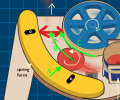
Looking at the diagram again, It is not clear to me what is actually pushing the puck and in particular what direction it is coming from.
blue arm ejects one puck at a time from magazine.
puck is then between curved yellow wall and spinning wheel.
this will make it roll CCW along the wall and it is ejected forward (part of last shot puck is shown at the top).
to ensure contact both with the curved yellow wall and wheel tire, there need to be some sort of compliance.
since the wheel does not have much of a compliance (no inflatable tire), perhaps the curved wall is not fixed
but has a bit of travel and it is forced by springs towards the wheel.

1773068142497.png
 
Last edited:

wayneh

Joined Sep 9, 2010
18,085
And don't forget that this will spin the disk. The center of mass will be moving at half the rate of the edge. There may be consequences of sending the disk out with all that angular momentum. I don't know but it seems like it would be harder to hit a target. The disk may want to roll away instead of land and slide.
 

ronsimpson

Joined Oct 7, 2019
4,645
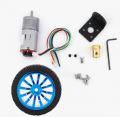
Robot wheel motor. Amazon. 120 rmp Too slow. Most of these have a gear box where you can change the speed.
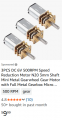
Now I see one that looks the same but 500rmp.
1773069049544.png
Faster motor. 30, 100, or 500rpms
1773069139529.png
Also search for "rc airplane motor". Some of those are way too fast. 20,000 rmp
 

ronsimpson

Joined Oct 7, 2019
4,645
Those motors are tiny, I doubt they have the power required.
That is a good question. Put some weight in the wheel. You only need power for a fraction of a second. You have time to wind up the wheel, store energy in it, then dump that energy into the flying disk.

---edited---
It hit me that the speed of the puck is 1/2 of that I thought it should be.
At point A the puck is not moving, At side C the puck is moving at the speed of the wheel. The center of the puck (B) is moving at 1/2 that of the wheel.
1773077403795.png
 
Last edited:

MrAl

Joined Jun 17, 2014
13,667
blue arm ejects one puck at a time from magazine.
puck is then between curved yellow wall and spinning wheel.
this will make it roll CCW along the wall and it is ejected forward (part of last shot puck is shown at the top).
to ensure contact both with the curved yellow wall and wheel tire, there need to be some sort of compliance.
since the wheel does not have much of a compliance (no inflatable tire), perhaps the curved wall is not fixed
but has a bit of travel and it is forced by springs towards the wheel.

View attachment 364439
Hi,

Thanks for the explanation.

Ok so this does not look very good so far. The light blue spin wheel presses on the red disk which then presses on the yellow guard curve.
The problem with that is there will be some compression from the blue spin wheel and the red disk, and from the red disk to the yellow guard rail, and one the disk ejects from the mechanism the energy stored in the compression will be released. If the compression from the blue spin wheel is not equal to the compression from the red disk to the yellow guard rail, the red disk gets ejected at an angle relative to the expected tangent. That angle will probably be hard to predict, and could vary as time goes on because of small changes in the mechanism due to aging.

A fix could be to provide an exit shoot that guides the red disk after it exits the main part of the mechanism.

Another idea would be to simply have two spinning wheels, with the red disk getting pushed between them. The wheels spin in opposite directions so they 'squeeze' the red disk a little and move it forward at somewhat high speed. The shoot would then be after the two spin wheels to correct any small error in the trajectory. The shoot does not have to be perfect in either case, but it should have smooth sides, and possibly a slight inward angle so the direction of the disk gets gradually corrected before it exits the shoot.

Without any shoot in either scenario it could work OK for a while then suddenly the disk starts to shoot to one side or the other.
 

ronsimpson

Joined Oct 7, 2019
4,645
Any advice on calculation approach or motor selection strategy would be greatly appreciated.
You want the puck to travel 2meters. We need to know more about that. Must the puck start out level and drop 2 meters? Or does the puck need to be shot out at 45-degree angle? Start out by understanding the flight. Then calculate what speed the puck needs to start out at.

From post #10 & #13 it seems the wheel needs to have a speed of twice the speed as the puck. Assuming no loss in speed and ...... I think you should aim for 3x or 4x speed on the wheel. There will be slippage.

I would use a robot rubber tire that has some give to it. (and grip) You will have losses there.
 

MrAl

Joined Jun 17, 2014
13,667
Hi,

There is also the simple pinball machine launch mechanism that just quickly smacks the disk and sends it flying in the direction opposite to the force vector. That might make a little noise though :)

I did a little reading on tennis ball throwing machines and they seem to use the dual spin wheel mechanism for consistent operation.
 

wayneh

Joined Sep 9, 2010
18,085
Good points. A solenoid "pusher", maybe with an arm for leverage, or dual spinning wheels both sound like better solutions. A catapult arrangement might be the best for fine tuning the aim. Gravity is very reproducible.
 
Top