Monostable Multivibrator circuit

Thread Starter

Vihaan@123

Joined Oct 7, 2025
220
Trying to solve another multi vibrator circuit, there is some terminology i have never worked with before like rbb' and hFE and hoping to learn here

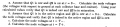
1764588288886.png
1764588324677.png
1764588401415.png
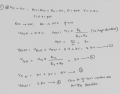
The problem refers to the circuit as emitter coupled monostable multivibrator, the below is the partial solution am i doing, correct?

1764588137106.png

Thank you in advance for your time and the continuous support.
 

MrAl

Joined Jun 17, 2014
13,667
Trying to solve another multi vibrator circuit, there is some terminology i have never worked with before like rbb' and hFE and hoping to learn here
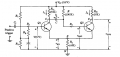
View attachment 359787
View attachment 359788
View attachment 359789
The problem refers to the circuit as emitter coupled monostable multivibrator, the below is the partial solution am i doing, correct?
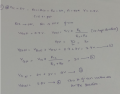
View attachment 359786

Thank you in advance for your time and the continuous support.
Hi,

This looks like an interesting circuit too.

rbb' is the resistance described by @Papabravo .
I think the physical interpretation is how the current spreads out from the contact point to the junction.

In any case, it is modeled as a resistor in series with the base. In the analysis that would just mean connecting a resistor from the input source node to the 'base' of the transistor. The base current has to pass though this resistor to get to the BE diode. I am not sure how you are modeling that diode yet though.

I did not check your work yet, but maybe you did not include that rbb' resistor yet?
 

Attachments

Last edited:

MrAl

Joined Jun 17, 2014
13,667
I will include rbb' and try what best i can do and post it.
Hi again,

Don't worry too much, if you have problems with it we can simply go over it. It takes a little time that's all, and that requires a little more patience. If you don't get in a big hurry, you'll be able to understand all of this stuff.

I mentioned rbb' because the problem statement seemed to want you to use that in the calculations also.

You do know that you can model the transistors as current controlled current sources right?
That means the base emitter current times the Beta equals the collector current.
I think you know this just wanted to make sure.

Two transistor problems are always a bit more work than a one transistor problem, but sometimes a one transistor problem can be used to help understand a two transistor problem.
 
Top